
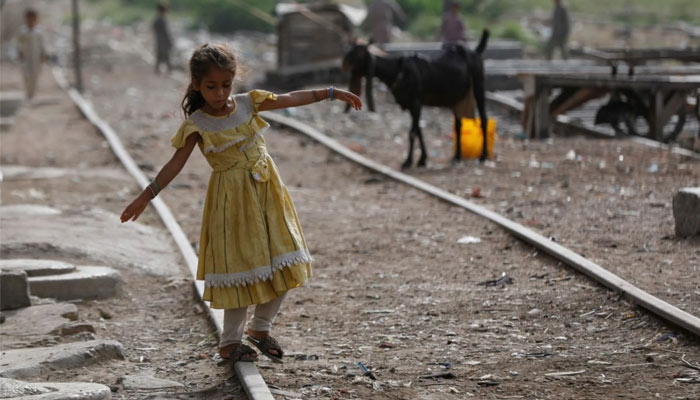
- Pakistan’s peers achieved more than double its GDP per capita.
- The global lender assesses Pakistan’s performance over the past 10 years.
- The Fund recommends improved property as a core course.
The International Monetary Fund (IMF) has highlighted the “need for urgent” policy reforms in Pakistan in its recent staff report, saying the country has failed to meet the living standards of its peers in the region. The News reported on Saturday.
“Pakistan has lagged behind its peers in recent decades in terms of per capita income, competitiveness and export performance. From 2000 to 2022, Pakistan’s GDP per capita grew at an average annual rate of only 1.9% “, the report states.
According to the report, Pakistan’s peers achieved more than double the aforementioned rate.
“Bangladesh averaged 4.5% growth, India reached 4.9%, Vietnam 5% and China around 7.5%,” the Washington-based lender said.
The IMF reviewed the past 10 years of its funded programs in Pakistan and recognized that underlying challenges remain, suggesting strengthening ownership as a key lesson.
The IMF has assessed Pakistan’s performance over the past decade. During this period, Pakistan had three senior credit arrangements and one use of the Rapid Financing Instrument under the General Resources Account (GRA).
These programs were generally launched in the context of weak external conditions or unprecedented external shocks, such as the COVID-19 pandemic and floods, combined with prolonged fiscal and external vulnerabilities, along with structural challenges. Although early progress was often made due to stronger policies under fund-supported programmes, this progress was not sustained, leading to the re-emergence of imbalances and the need for successive programmes.
To be effective, program conditions must evolve to capture emerging risks and policy issues. For the new Enhanced Fund Facility (EFF), this is particularly important. During the 2013 EDF, reform efforts were weakened, resulting in 13 resignations. While spending and external borrowing were initially restrained, large future debt commitments set the stage for the reemergence of imbalances.
As it emerged, under the IMF’s $7 billion EDF, Pakistan has accepted 22 conditions, including a written commitment to phase out incentives for Special Economic Zones (SEZs) by 2035.
The government will prepare a phased plan by June 2025 to eliminate all incentives applicable to SEZs.
In addition, Pakistan has agreed to adjust gas tariffs by the end of December 2024 and impose 5% federal excise duty (FED) on fertilizers and pesticides in the 2025-26 budget.
To strengthen the effectiveness of the anti-corruption framework, the government will amend the Civil Servants Act by February 2025.
It will ensure that asset declarations of high-level civil servants (including assets owned by them or their family members) are digitally archived and made publicly accessible through the Federal Board of Revenue (FBR), with a robust risk-based verification framework by a single principle.
The government also aims to achieve net zero cyclical debt flow by FY25 through timely tariff hikes, targeted subsidies and cost-cutting reforms in the power sector.
“Pakistan’s repayment capacity is subject to significant risks and remains critical to policy implementation and timely external financing,” the IMF staff report said.
While the IMF lauded Pakistan’s policy implementation under the SBA 2023–2024, it stressed that sustained efforts are needed to ensure macroeconomic stability and sustainable growth.
The SBA has achieved its short-term goals, but structural challenges remain. To break the cycle of economic boom and bust, the IMF emphasized the need for Pakistan to fundamentally transform its economic policy-making, reduce the role of the state in the economy, strengthen the business environment, attract private investment and invest in human capital while protecting the most vulnerable.
Pakistani authorities recognize these challenges and are committed to strengthening the country’s resilience and economic prospects. Strong ownership of sound macroeconomic policies and decisive implementation of reforms are essential. Fiscal efforts in the FY25 budget and ambitious reforms to broaden the tax base are critical to strengthening fiscal sustainability.
The passage of the 25th budget marks an important first step, with high-quality revenue measures targeting general sales tax, personal income tax and corporate income tax for exporters and developers. These steps are aimed at improving fairness, transparency and revenue collection.
The IMF confirmed that the federal government has taken measures to boost revenue by Rs 1,723 billion, including boosting direct taxes by Rs 240 billion, increasing personal income and corporate tax rates and improving GST collection by Rs 286 billion Rs. The government also improved administration to collect Rs 250 billion, expanded FED to generate Rs 413 billion and streamlined customs duties for Rs 65 billion.
Pakistan’s low tax-to-GDP ratio calls for continuous efforts to broaden the tax base through equitable measures. Short-term reforms include provincial agricultural income taxation and the abolition of privileges, exemptions and concessions, along with revenue management reforms.
These will support fiscal consolidation, create space for meaningful investment in human capital and maintain a downward trajectory for public debt.
Provinces must also implement agricultural income tax reforms and support revenue mobilization, including through property taxation, to meet primary surplus targets.
Reforms in public investment management, liquidity management and debt reduction remain critical. Monetary policy should remain tight and data-driven to control inflation and maintain exchange rate flexibility. SBP’s commitment to transparency in foreign exchange transactions is essential to rebuild reserves.
Attracting high-quality investment will require compliance with current account regulations, including the repatriation of dividends and profits.
a href=”https://www.geo.tv/latest/568601-pakistan-fails-to-match-regional-peers-in-living-standards-imf”>Source link



