
Pakistan is intensifying efforts to secure discounted Russian crude oil as the conflict in the Middle East throttles its traditional Gulf supply routes, pushing the country’s petroleum import premiums to record levels and reviving an energy partnership with Moscow that began with test cargoes three years ago.
The government is seeking crude from Russia, Venezuela and Nigeria to offset shortfalls caused by the ongoing US-Israel-Iran conflict, according to OilPrice.com. The same report noted that Pakistan, which imports roughly 80 per cent of its oil requirements, is now paying an all-time-high premium of $34 a barrel on petroleum product imports, up from around $12 a barrel over benchmarks before the supply crunch. Every $10 increase in oil prices adds an estimated $1.8 billion to $2 billion to the country’s energy import bill, the report said.
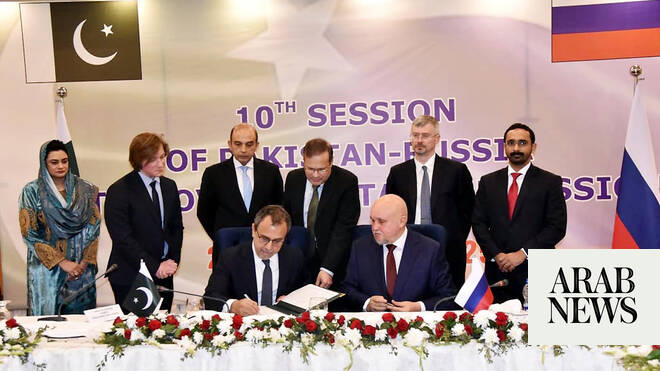
The renewed interest builds on a framework cemented late last year. At the 10th session of the Pakistan-Russia Intergovernmental Commission, held in Islamabad from November 25 to 27, 2025, Pakistan’s Energy Minister Sardar Awais Ahmad Khan Leghari and his Russian counterpart Sergei Tsivilev signed an official protocol alongside three new memoranda of understanding, Arab News reported. The two sides reaffirmed what they described as “positive engagement in the oil and gas sectors,” though bilateral trade remains modest at “still under $1 billion,” the report noted. The 11th session is scheduled to be held in Russia later this year.
The diplomatic groundwork dates to 2023, when Islamabad began test shipments of discounted Russian crude under a new payment arrangement designed to ease foreign-exchange constraints, Arab News reported. The first government-to-government cargo arrived in Karachi in June 2023, with Prime Minister Shehbaz Sharif declaring he had “fulfilled another of my promises to the nation,” according to Dawn. That cargo was processed initially by Pakistan Refinery Limited, followed by Pak-Arab Refinery Limited and others, Dawn reported.
The bulk of subsequent volumes flowed to Cnergyico, Pakistan’s largest refinery, which took a private-sector shipment of 100,000 tonnes of Urals crude in October 2023, Offshore Technology reported. The plant has a capacity of 156,000 barrels per day, accounting for one-third of national refining capacity of 450,000 bpd, the same report said. The economic logic was clear: in September 2023, Urals crude averaged $83.08 a barrel against $96.55 for Brent, Offshore Technology noted.
The strategic case has sharpened with the Hormuz disruption. Russia’s offer of concessional supply gains weight as Islamabad scrambles to diversify away from Gulf producers, who historically met about 80 per cent of Pakistan’s roughly 154,000 bpd requirement, according to Dawn.
The economics of the early experiment were uneven. Pakistan’s imports of crude oil from Russia were valued at just $47.63 million in 2023, paid largely in Chinese yuan to navigate around payment restrictions, Arab News reported. Whether the latest pivot translates into sustained, large-volume purchases will depend on Islamabad formalising terms with Moscow and on how long the Middle East supply shock persists. For now, with Pakistan State Oil reportedly urging the government to absorb premium increases rather than pass record costs to consumers, per OilPrice.com, discounted Russian barrels offer one of the few near-term levers available to ease the strain on the national exchequer.



