
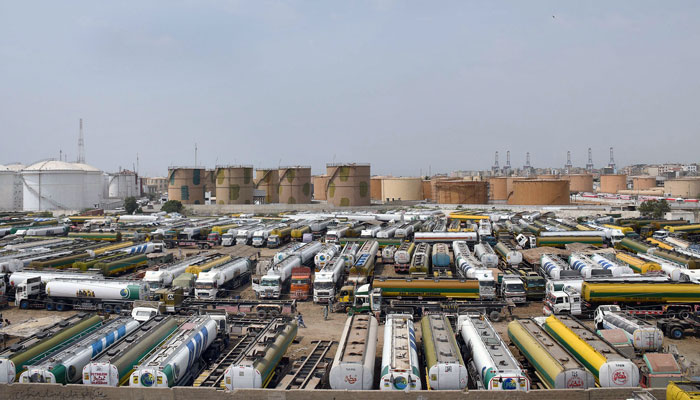
- Ogra will immediately deploy new framework, sources say.
- Sources say there is an urgent need to increase storage capacity.
- A thorough appraisal is required to assess ultimate reserves and duration.
As the Middle East remains beset by tensions, the caretaker government has decided to expand the country’s strategic oil reserves, sources in the Petroleum Department said.
The government’s move comes on the heels of Israel’s ongoing war in Gaza, which began after a surprise attack on an Israeli kibbutz by Hamas, a resistance group fighting for a free Palestine, nearly a month ago.
The sources said there is an urgent need to increase the storage capacity of oil reserves as Pakistan imports its fuel from other countries.
The final stockpiles and the length of time they can last can only be determined after a thorough assessment of the country’s needs, according to the sources.
The sources also said that the government, through the Oil and Gas Regulatory Authority (Ogra), has decided to develop a framework for strategic oil reserves.
“Ogra will immediately develop the new framework with the help of global experts,” the sources said.
The new framework, he added, will determine domestic crude oil, refined oil requirements and storage, while also including the duration of strategic oil stocks of various products.
Global oil prices expected to rise: World Bank
Last month, the World Bank’s latest report predicted that global oil prices could reach $140 to $157 a barrel in the event of a “major disruption” scenario in the Middle East, similar to the impact of the 1973 Arab oil embargo. .
The report says global oil prices will average around $90 a barrel in the fourth quarter of this year and fall to an average of $81 in 2023 due to slowing economic growth, which is reducing demand for oil. .
However, the report also highlights a significant risk that an escalation of the ongoing conflict in the Middle East could cause oil prices to rise significantly.
The report notes that since the start of the Israel-Hamas war, oil prices have risen only about 6 percent, while prices for agricultural products, most metals, and other commodities have seen little change.
The report examines three risk scenarios based on historical conflicts in the region, with varying degrees of disruption. In the event of a “small outage”, equivalent to the reduction in oil production seen during the Libyan civil war in 2011 (about 500,000 to 2 million barrels per day), oil prices could rise to a range of 93 to 102 dollars per barrel. quarter quarter
a href=”https://www.geo.tv/latest/517601-petrol-reserves”>Source link



