Crude oil prices jumped on Monday after US forces struck two Iranian launchers on Larak Island inside the Strait of Hormuz and Tehran retaliated, reversing part of a week-long slide built on hopes the waterway was reopening (Geo News).
The numbers, and when they were taken
By 0241 GMT — 7:41am PKT — Brent crude futures were at $90.61 a barrel, up $2.51 or 2.85%. US West Texas Intermediate was at $85.53, up $2.13 or 2.55% (The Express Tribune).
Two hours earlier, at 0040 GMT (5:40am PKT), the same Reuters report had Brent at $89.18, up 1.23%, and WTI at $84.32, up 1.10% — the figures Geo published at 6:02am.
The two sets are not different benchmarks and they do not conflict. Both measure against the same Friday settlements — $88.10 for Brent, $83.40 for WTI — and both reconcile. The gap is the Asian morning: prices roughly doubled their gain in two hours.
Why Larak matters
Larak is a small Iranian island sitting inside the strait, near Bandar Abbas. A US official said the launchers hit on Sunday were being prepared to fire rockets carrying sea mines into the waterway; Washington said the strikes were meant to stop Iran laying more mines in the strait. Iran struck two US air bases in Jordan in response, an escalation covered separately.
How much oil is at stake
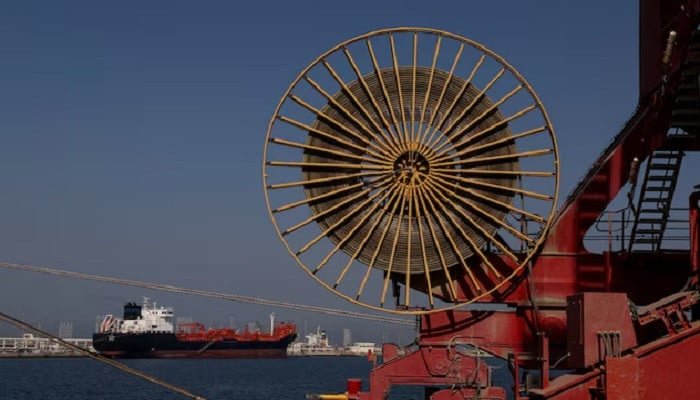
Before the war began on 28 February, the strait carried oil and gas shipments equal to about a fifth of global consumption. Flows have since fallen to roughly a quarter of pre-war levels, according to ship-tracking data cited by Reuters via Geo on 27 August, the day Qatar’s prime minister flew to Tehran and Iran and Oman were finalising an agreement to manage the strait.
Visible commodity vessel crossings dropped to about five a day over the weekend, on shipping data reported Monday; the true figure may be higher, because some ships have switched off their automatic identification systems (Geo News). The UK Maritime Trade Operations reported on Sunday that a tanker was struck by a projectile while sailing inbound through the strait on Saturday.
What analysts actually said
“Looks like we are in another escalation phase. How long that lasts is impossible to determine. Could be days, could be weeks,” said Tony Sycamore, market analyst at IG. He said that if WTI clears resistance at $85.80–$85.90, the path opens to last week’s $87.69 high and then July’s $93.50 high.
ANZ analysts, in a client note, framed the fragility precisely: “While the path to a deal to reopen the strait is elusive, increases in oil flows through the Hormuz strait kept concern over supply disruption in check.”
The Pakistani transmission
Ogra now sets petrol and diesel prices daily on a rolling seven-day average of international prices, which is how Monday’s spike reaches Pakistani pumps. Petrol is Rs342.02 and high-speed diesel Rs371.44 — the rates Ogra’s price build-up brought into force from 29 August, and which stand until the next revision (Geo News; Ogra price publications). Since daily pricing began on 21 July, petrol has risen a net Rs25.87 a litre and diesel Rs17.09 as of 29 August, Tribune reported on 30 August.
Even with Monday’s jump, Brent and WTI are still set to close August lower, after falling more than 4% last week — their first weekly decline in three. Whether that holds depends on shipping: talks are at an impasse, and the market is now watching vessel counts rather than communiqués.