
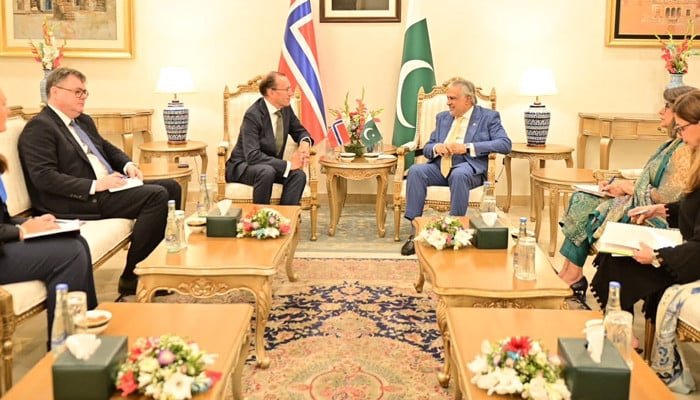
Norwegian Foreign Minister Espen Barth Eide has held a full round of meetings in Islamabad and Rawalpindi on the first day of a two-day visit — the first by a Norwegian foreign minister to Pakistan in a decade (Geo News; Express Tribune).
He arrived in Islamabad in the morning, received at the airport by Additional Foreign Secretary (Europe) Ambassador Ayesha Ali, and is visiting at the invitation of Deputy Prime Minister and Foreign Minister Ishaq Dar.
At the Foreign Office. Eide and Dar held a restricted-format meeting before leading delegation-level talks at the Ministry of Foreign Affairs. The two sides reviewed what the Foreign Office called the whole gamut of bilateral cooperation, covering trade, investment, climate change, maritime affairs and education, and held in-depth discussions on regional and international developments. They expressed satisfaction at the state of relations, agreed to deepen cooperation, and recognised the role of the Pakistani diaspora in Norway, agreeing to strengthen people-to-people ties.
Dar said the two countries shared a 78-year partnership and noted that Norway had remained in contact with Pakistan through the Iran-US tensions.
At GHQ. A high-level Norwegian delegation led by Eide called on Chief of Defence Forces and Chief of Army Staff Field Marshal Asim Munir at General Headquarters in Rawalpindi, according to Inter-Services Public Relations. The two sides discussed matters of mutual interest, regional security and bilateral relations.
Eide appreciated “the professional role played by the Pakistan Armed Forces in promoting regional peace and stability”. Munir set out Pakistan’s perspective on global peace and regional stability and stressed the importance of cooperation in addressing common security challenges. Both sides, ISPR said, reiterated a resolve to strengthen bilateral ties and to “expand engagements in defence and security domains”.
That last phrase is the one worth marking. Norway is a NATO member, and an agreement to widen defence and security engagement — however generally worded — is a different order of commitment from the trade and climate agenda set out at the Foreign Office an hour earlier.
At the joint press stakeout. Eide was unusually direct about what Pakistan has taken on in mediating between Washington and Tehran, speaking as the foreign minister of a country with its own long record in peace facilitation.
“I know how hard it is,” he said. “I know what a massive task you’re taking on when you offered Islamabad, not only as the venue, but also as the facilitator of these talks.”
The distinction he drew — venue versus facilitator — is the substance of it. Hosting talks is a logistical undertaking; facilitating them means owning the outcome, and Eide’s remark is among the clearest external acknowledgements yet of how far Pakistan has committed itself.
He commended Pakistan’s “important and constructive role” during the Iran-US conflict, naming Prime Minister Shehbaz Sharif, Dar and Munir, and said Pakistan had gained international recognition for its peace efforts and had shown courage during a difficult period. He warned that tensions between the United States and Iran were harmful to international peace and the global economy.
He also noted the size of the Pakistani community in Norway — one of the country’s larger minority populations, dating to labour migration from the late 1960s — and said Norwegian companies operating in Pakistan were contributing to its development.
Dar reaffirmed Pakistan’s commitment to strengthening ties and broadening cooperation, including in renewable energy.
The visit continues on Friday.



