
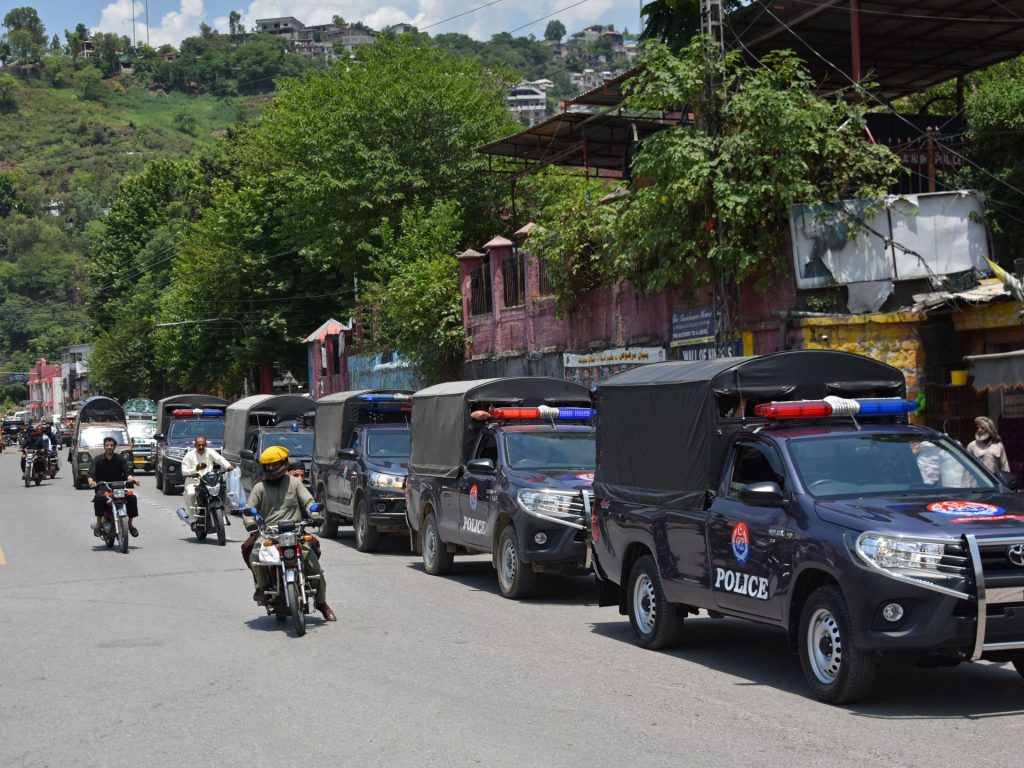
At least nine people were killed in two distinct incidents in Azad Jammu and Kashmir on July 15 as thousands of protesters attempted to begin the Joint Awami Action Committee’s long march toward Muzaffarabad, only for the march to stall when security forces blocked departure from Rawalakot (Al Jazeera; Express Tribune; Daily Pakistan).
In Rawalakot, Poonch district, security personnel raided a house on the town’s outskirts on a tip about a weapons cache and came under fire. Rangers Naik Imtiyaz Ali was killed and another official injured. Armed groups affiliated with the banned JAAC separately opened fire near the Matial Maira Bus Terminal in a civilian area. In Sudhnoti district, seven protesters and a police officer were killed when a security convoy was blocked by demonstrators and came under fire.
A separate deployment of 3,000 to 4,000 people assembled in Rawalakot on Wednesday afternoon for the march but had not departed by the scheduled 2pm start time. Muzaffarabad’s deputy commissioner, Munir Qureshi, said the city and its adjoining areas were “all clear, and there is no disturbance to public life.” Inspector General Liaqat Ali Malik said there had been “no violence today” in Muzaffarabad itself.
Government response
The AJK government said the Rawalakot attack had made further action against the banned JAAC “unavoidable.” The home secretary said “no armed or violent group will be allowed to challenge the writ of the state” and that law enforcement agencies had the situation “fully under control.” Security deployment across AJK continued to include Rangers, police and Frontier Constabulary.
The AJK government said higher educational institutions including medical colleges across the territory would reopen from Tuesday, presenting the move as evidence of normalisation — though the announcement itself indicated they had been closed.
Cumulative toll
Twenty-eight people have been killed since protests began on June 4, including 23 civilians and five security personnel across six weeks of unrest. Seventy-nine have been injured. The AJK election is eleven days away, scheduled for July 27.
JAAC’s core demands — sharply reduced electricity tariffs, subsidised wheat flour at Gilgit-Baltistan rates, and elimination of 12 reserved assembly seats for Kashmiri diaspora — remain unmet. The committee has not announced a suspension of its mobilisation.



