
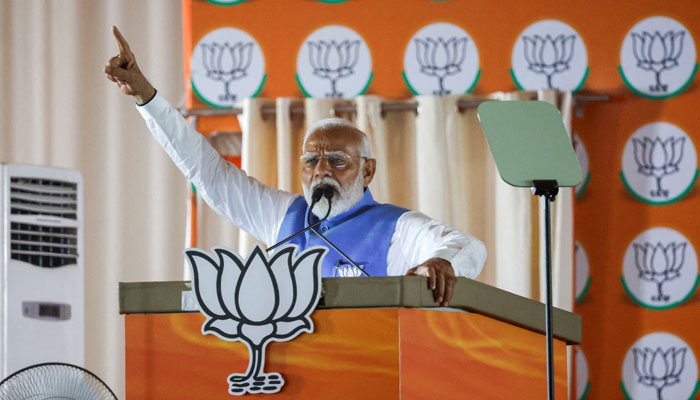
- Exit polls have shown that PM Modi is well on his way to victory.
- Counting began at 8 am and results were expected within hours.
- The election chief declared a “world record” 642 million votes cast.
Prime Minister Narendra Modi is widely tipped to win India’s election on Tuesday, in what would be a triumph for his Hindu nationalist drive that has thrown the opposition into disarray and heightened concerns about minority rights.
Exit polls showed Modi, 73, on course for victory after a six-week election in which 642 million people voted across seven stages in the world’s most populous country.
Modi said at the weekend that he was confident “the people of India have voted in record numbers” to re-elect his government, a decade after he first became prime minister.
Observers believe his appeals to growing Hindu nationalist sentiment will give him a third term in office.
Modi’s opponents have struggled to counter his Bharatiya Janata Party’s (BJP) election campaign and have been hampered by infighting and what they say are politically motivated criminal cases aimed at misleading challengers.
US think tank Freedom House said this year that the BJP was “increasingly using government institutions to target political opponents”.
On Sunday, Arvind Kejriwal, chief minister of the capital Delhi and a key leader in an alliance formed to rival Modi, returned to jail.
Kejriwal, 55, was arrested in March in a long-running corruption probe, but was later released and allowed to campaign as long as he returned to custody once voting was over.
“When power becomes a dictatorship, then jail becomes a liability,” Kejriwal said before surrendering, vowing to continue “fighting” behind bars.
In the run-up to the election, many in the Muslim minority of more than 200 million felt increasingly anxious about their future and the place of their community in the nominally secular country.
Modi himself made a series of scathing comments about Muslims on the campaign trail, referring to them as “invaders”.
Logistics of counting votes
The polls were staggering in their size and logistical complexity, with voters casting their ballots in the megacities of New Delhi and Mumbai, as well as in the sparsely populated forest and high-altitude region of India’s illegally occupied Jammu and Kashmir.
The votes were taken on electronic voting machines, so counting will likely be quick, with results expected within hours.
Counting will begin at 8:00 am. (0230 GMT) at key centers in each state, with the data fed into computers.
“People need to know about the strength of Indian democracy,” Chief Election Commissioner Rajiv Kumar said on Monday, pledging a “robust counting process”.
India’s major television networks will have reporters outside each counting center, competing for the results for each of the 543 elected seats in the lower house of parliament.
In previous years, the main trends have been clear by midnight with the losers admitting defeat, even though the full and final results may not come until late Tuesday night.
Celebrations are expected at Modi’s BJP headquarters if the results reflect exit poll predictions.
The winning seat is a simple majority of 272 seats and the BJP won 303 in the last polls in 2019.
Heat vote
Chief Electoral Officer Kumar announced on Monday that the 642 million votes were a “world record”.
But based on the Commission’s tally of 968 million voters, turnout stood at 66.3%, down about one percentage point from 67.4% in the last polls in 2019.
The final voter turnout is yet to be released as re-polling took place in two stations in the state of West Bengal on Monday.
Analysts have partly blamed the lower turnout on a heat wave in northern India with temperatures topping 45°C (113°F).
At least 33 voters died of heatstroke on Saturday in the state of Uttar Pradesh alone, where temperatures reached 46.9 degrees Celsius.
Voting should have been scheduled to end a month earlier, Kumar admitted. “We shouldn’t have done it in this heat,” he said.
a href=”https://www.geo.tv/latest/547501-modi-eyes-triumph-as-india-counts-epic-vote”>Source link



