
KARACHI:
The parking of bank deposits in safe government bonds reached a new high of 92% in November 2023, leaving very little funding for the private sector, which has remained the engine of economic growth.
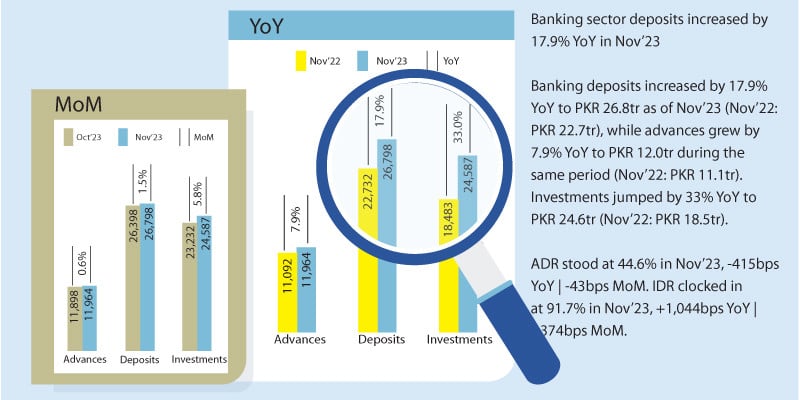
According to the latest State Bank of Pakistan (SBP) data on deposits, investments and advances in commercial banks, banks lent Rs 24.58 trillion to the government through investments in securities such as bonds and Pakistan Investment Bonds (PIBs). Investment made up about 92% of total bank deposits of Rs 26.79 trillion by the end of November.
Banks’ investment in government securities rose 33% over the past year to Rs24.58 trillion in November compared to Rs18.48 trillion in the same month of 2022.
Accordingly, banks’ investment-to-deposit ratio (IDR) increased by 10.44 percentage points in a year to 91.7% in November against 81.3% in the corresponding month of the previous year.
design: Ibrahim Yahya
design: Ibrahim Yahya
Speaking to The Express Tribune, Arif Habib Limited, Head of Research, Tahir Abbas said that a higher interest rate scenario has discouraged the private sector from borrowing funds from banks to run their businesses. “This situation prompted banks to lend large sums to the cash-strapped government.”
He was of the view that it was no longer feasible for industrialists and businessmen to borrow from banks at the prevailing high interest rate of 23-24% for starting new projects like setting up factories and expanding existing production lines.
The government, which relies heavily on domestic debt to run its day-to-day affairs, is constantly borrowing funds from banks despite a significantly high rate of return.
Reading Pakistan, GCC hold talks on investment capital
It needs a consistent flow of funding to meet the rising cost of interest payments on debt and to pay monthly salaries and pensions to existing and retired employees. These are important current expenses of the State.
Heavy borrowing by domestic banks continued in the wake of comparatively lower revenue collection, although tax collections rose sharply in the current financial year.
The Federal Board of Revenue (FBR) surpassed its revenue collection target for the fifth consecutive month in November, collecting nearly Rs 3.5 trillion and staying on track to meet the target set by the International Monetary Fund (IMF).
The tax authorities have collected Rs 34 billion more than the target set for the July-November period of the current financial year due to extremely healthy growth in direct taxes.
Abbas said the private sector was forecast to return to banks for new lending next calendar year, when the central bank was expected to cut its policy rate by a total of seven percentage points to 15 percent by December 2024. The policy rate remained at a record high of 22% since the end of June 2023.
Currently, the private sector is largely repaying its old debt. As a result, banks’ lending to the private sector against deposits – the advances-to-deposit ratio (ADR) – shrank by 4.15 percentage points to 44.6% in November from 48.8% in November 2022.
In absolute terms, banks’ lending to the private sector rose nearly 8% over the past one year to Rs 11.96 trillion in November 2023 compared to Rs 11.09 trillion in the same month last year.
Central bank data suggested bank deposits rose 18% over the past year to Rs26.79 trillion in November, but the increase could not translate into an expansion of economic activities as debt piled up to unsustainable levels.
Abbas, however, said the increase in deposits was in line with the gradual recovery in economic activities. In addition, a higher rate of return on deposits encouraged households to park their savings in banks.
“This has reduced the circulation of cash amid digitization of the economy and the financial sector.”
Bank deposits will continue to grow with moderate economic growth which the central bank has forecast at 2-3% for the 24th year.
Pakistan’s gross domestic product (GDP) grew by 2.1 percent in the first quarter (July-September) of the current fiscal year compared to a 1 percent contraction in the same quarter last year.
Abbas pointed out that remittances sent home by overseas Pakistanis were the biggest source of growth in bank deposits as the inflows were converted into Pakistani rupees and spent or parked in banks.
He predicted that bank deposits, investment and lending will continue to move at the same pace in the near term.
He expressed hope that the central bank’s reliance on domestic borrowing will decrease once inflows from multilateral and bilateral creditors increase.
Published in The Express Tribune, December 17u2023.
Like Businesses on Facebook, follow @TribuneBiz on Twitter to stay updated and join the conversation.
a href=”https://tribune.com.pk/story/2450244/investment-in-govt-debt-hits-record”>Source link



