

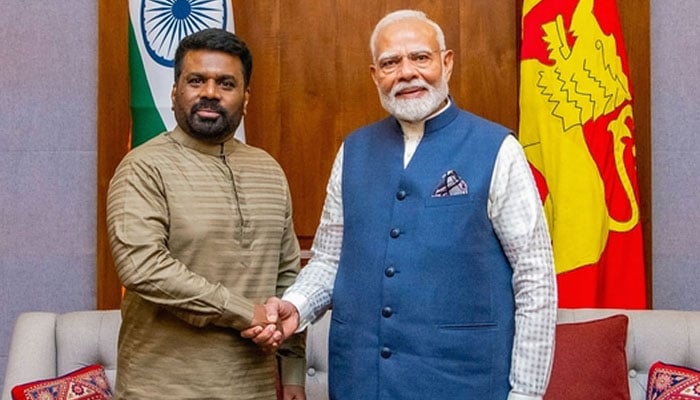
India has secured the defense and energy dealing with neighboring Sri Lanka on Saturday during the visit of Prime Minister Narendra Modi, which is considered a move to tackle China’s growing influence in the region.
Sri Lanka President Anura Kumara Dissanayake put the red carpet for Modi and gave him the country’s highest political honor for the “deep personal friendship” presented to the smallest neighbor.
“We believe that our security interests are aligned,” Modi said during a television ceremony by Dissanayake’s office in the capital.
“Our safety is interdependent and interconnected.”
A five -year defense cooperation agreement provides Sri Lanka military personnel in India as well as the exchange of information and technology.
Dissanayake applauded what he called “India’s rise as world power, not just as a regional power”.
“I have reiterated our position to Prime Minister Modi that Sri Lanka’s territory will not be allowed to be used by anyone to undermine India,” he added.
India has previously opposed Chinese underwater and research vessels they called at the main port of Colombo.
Sri Lanka has not allowed the Chinese submarine dock since 2014, after India raised concerns about two such visits.
Last year, Colombo imposed a ban on foreign research vessels following the new Delhi charges that Chinese ships were used to spy on India.
On Saturday, Dissanayake welcomed Modi-the first foreign official to visit Colombo since the left-wing leader swept power last year with 19 arms greeting.
Balancing of China
The two leaders also celebrated the start of the construction of a 120 Megawatt solar energy project, developed as a consortium between the two nations.
The solar plant, located in the northeast Trincomalee area of the island, had stopped for years, but was rejuvenated with the support of New Delhi.
Modi’s visit comes as Colombo fights with the competitive interests of New Delhi and Beijing.
India is worried about China’s influence on Sri Lanka, which she considers to fall into her sphere.
Dissanayake’s first foreign visit was to New Delhi in December, but was followed by a visit to Beijing in January, underlining the delicious act of Sri Lanka’s balancing.
China has emerged as Sri Lanka’s largest single bilateral creditor, representing more than half of the $ 14 billion bilateral debt while the island was in debt debt in 2022.
Beijing was also the first to restructure its loans to Sri Lanka, a move that helped pave the way to get out of the island from the worst economic collapse.
In January, Colombo announced that he had signed an agreement with a Chinese state -owned company to invest $ 3.7 billion in a oil refinery in the south of the island.
The agreement will mark Sri Lanka’s largest uniform foreign investment and is considered vital to its economic recovery.
Modi’s visit to Sri Lanka followed a summit in Thailand and a series of meetings with neighboring nations leaders, as it sought to promote India’s regional links.
On the sidelines of Bangkok Bimstec-the Group of Seven Nations in the Gulf of Bengal-The Modi held a rare face-to-face meeting with Myanmar Junta chief Min Aung Hlaing.
He also held talks on Friday with Bangladesh’s temporary leader, Mohammed Yannos-the first such meeting from the Dhaka revolution, threw the long-term ally of New Delhi, Sheikh Hassina and sent relationships to a bullet.
India was the biggest benefactor of the Hasina government and its overthrow prompted Yunus to make his first state visit last month to China.
Modi also met on Friday in Bangkok with his counterpart in Nepal, KP Sharma Oli – their first encounter since Oli returned to power last year – as well as Bhutan’s Tshering Tobgay.
a href=”https://www.geo.tv/latest/598552-indias-modi-clinches-defence-energy-deals-in-sri-lanka”>Source link



