
The Indian army brought in specialized equipment on Sunday as efforts to free 41 trapped workers entered a third week, with excavations continuing in three directions after repeated setbacks in the operation.
The Indian Air Force said on Sunday it was “responding with alacrity” as it flew its third cargo after the under-construction Silkyara road tunnel partially collapsed on November 12 in the Himalayan state of Uttarakhand.
Rescue officials said they called for an overheated plasma cutter to be brought to the remote mountain site after engineers drove a metal pipe horizontally through 57 meters (187 feet) of rock and concrete, struck metal beams and construction vehicles buried in the ground.
A giant earth boring machine broke just nine meters from the breach.
The plasma cutter will be used to remove the broken giant drill bit and the metal blocking the horizontal path, before hand digging can continue.
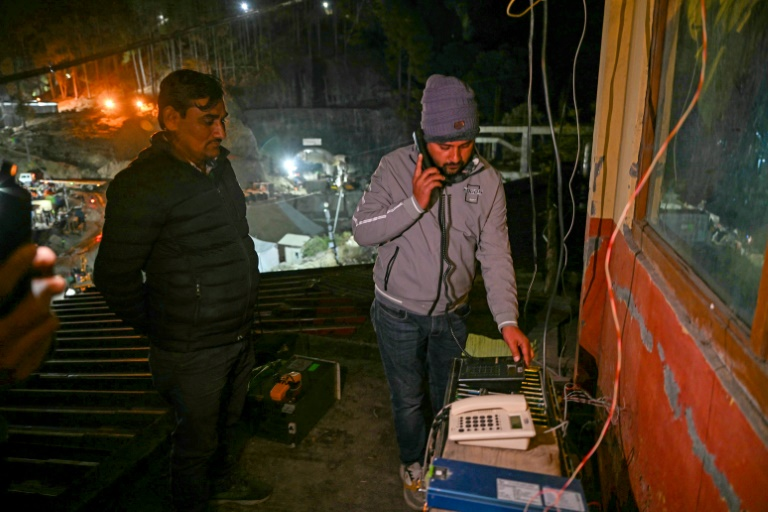
A rescue officer controls a call center to trap workers. PHOTO: AFP
Thick metal beams in the rubble block the path, and using conventional oxyacetylene cutters to remove them is difficult from inside the confined pipe, only wide enough for a man to crawl through.
The Air Force said the “critical” kit came from the country’s Defense Research and Development Agency, the government’s defense technology research arm, without elaborating.
Vertical drilling has also begun digging 89 meters down, a dangerous route above the men in an area that has already collapsed.
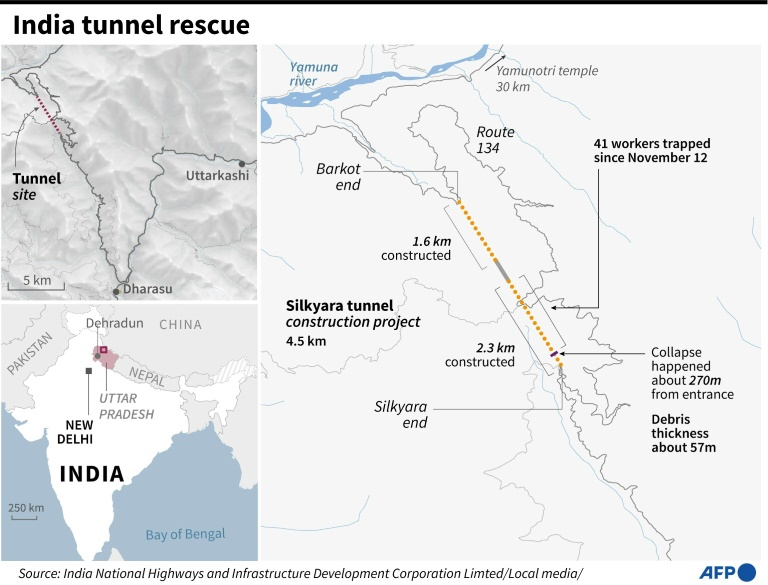
Work has also started on the far side of the road tunnel, a much longer third run estimated to be around 480 metres.
Uttarakhand Chief Minister Pushkar Singh Dhami on Sunday visited the home of one of the trapped laborers and informed the family about the efforts being made to rescue them.
“We are working full force to get all workers out safely,” he said in a social media post.
Also read: Indian tunnel rescue to take much longer after drill disaster
The workers were seen alive for the first time on Tuesday, looking into the lens of an endoscope camera that rescuers sent into a thin tube through which air, food, water and electricity flow.
A basic call center has been set up at the site so families of the trapped men — many of whom are migrant workers from poor families from as far away as India — can call to speak to them.
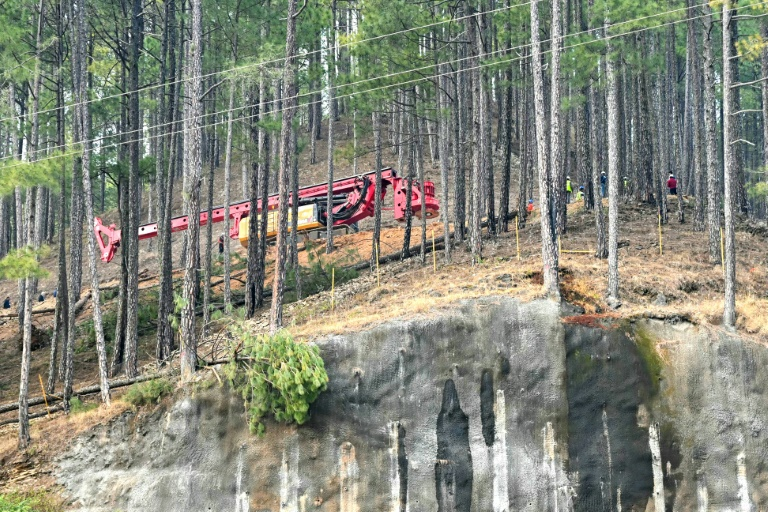
Digging has also begun on the wooded hill in a vertical shaft above the trapped men. PHOTO: AFP
Efforts are painfully slow, complicated by falling debris and repeated breakdowns of drilling rigs.
Hopes that the team were on the verge of a major breakthrough on Wednesday were dashed, with a government statement warning of “challenging Himalayan terrain”.
For distraught relatives of the trapped men, it was an ordeal with no end in sight.
Indrajeet Kumar, whose brother Vishwajeet is among the men “jailed”, told The Times of India on Saturday that he “feels like crying” when his brother asks him during their chats on the communication system why he was still stuck.
Om Kumar, who hails from the eastern state of Jharkhand, said three of his cousins were trapped inside.
“If they somehow escape, they’ll save their lives — they’ll go home and never work in the tunnel again,” Kumar, 20, said.
Syed Ata Hasnain, a senior rescue official and retired general, called on Saturday for “patience”.
“It continues to be a very difficult operation,” he told reporters.
“When you do something with mountains, you can’t predict anything,” he added. “This situation is just like war.”
a href=”https://tribune.com.pk/story/2448061/india-bid-to-free-41-trapped-workers-enters-third-week”>Source link



