
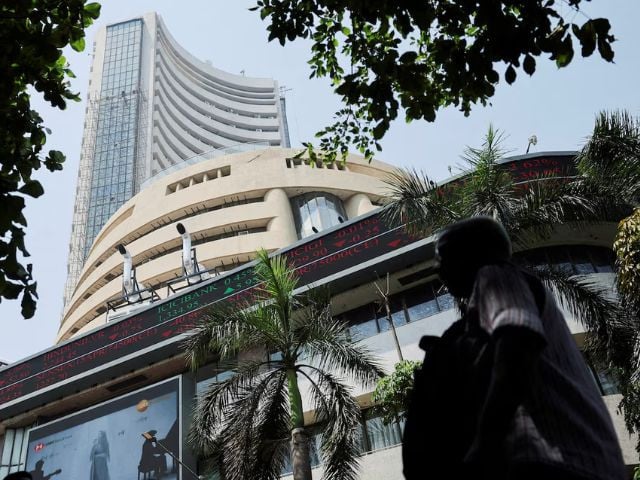
Indian stock markets lost about $ 83 billion in market capitalization this week as the escalation of the military conflict with Pakistan raised investor concerns and hit financial markets.
The sale that deepens after Pakistan launched a military operation, the Bunyan-Un-Marsoos operation, aiming for strategic Indian installations in response to missile strikes from New Delhi earlier in the week.
The Nifty 50 index decreased by 1.1% on Friday, close above the psychological level of 24,000 points. BSE SENSEX also decreased by 1.1%, ending under the 80,000 mark that held a day earlier.
The two reference indicators have now published a weekly loss of about 1.3%, ending in a three-week rally-their biggest win in 2025.
At one point during Friday’s commercial meeting, total market losses approached $ 108 billion before partial recovery late in the day.
“With so much escalation, the domestic markets are full because further antagonistic measures from Pakistan could lead to a prolonged, complete conflict,” said Avinash Gorakshaka, head of research at Profitmart Securities.
Analysts noted that the basics of the market had taken back seat, with a feeling that is now largely driven by geopolitical updates. India’s volatility index, known locally as a “fear meter”, increased for the eighth straight session, reaching a high not observed in more than a month.
Twelve of the 13 large sectoral markers ended in the week in Red. Small capital and medium capitalization stocks went worse than blue chips, with losses of 1.9% and 0.8% respectively.
Indian rupee also encountered pressure, urging the central bank to enter to stabilize the currency in coins.
One remarkable bright spot was in the car. Tata Motors’ shares increased by 8.7% in expectations that a possible UK-US-US trade agreement could boost sales for the British subsidiary of Jaguar Land Rover (JLR).
The company was the top winning among the Nifty 50 ingredients this week.
Despite the ongoing tensions, analysts say that optimism for a possible US trade agreement and India’s resistant economic elements could help reduce long -term market losses if diplomatic efforts succeed in facilitating hostilities.
Simmering tensions
Tensions between India and Pakistan were escalating abruptly after April 22 attack on Pahalgam, located in Indian illegally occupied Jammos and Kashmir (Iiojk), left by 26 people dead. India has accused the data based in Pakistan for the attack without presenting evidence. Islamabad categorically rejected the accusations.
In response, India closed Wagah’s land borders, recalled by Pakistani theories and announced the suspension of the indus waters treaty on April 23. Pakistan described each disorder in the treaty as a “act of war” and then sealed the passage of Wagah on its part.
The situation was further exacerbated on May 6 and 7, with explosions referring to several Pakistani cities, such as Muzaffarabad, Kotli, Muridke and Bahawalpur. Pakistani military spokesman Ahmed Sharif Chaudhry confirmed that Indian air strikes had targeted multiple sites. Pakistan responded with air and land under a new military campaign called Operation Bunyan-Un-Marsoos.
Within the first hour of retaliation, Pakistan claimed to have paid five Indian fighter aircraft, including four Rafale aircraft. Lt Gen Chaudhry said Pakistan was able to reduce more but to exercise. Indian media provided limited coverage, with one report from Hindu Later he retired.
International observers, including analysts in CNN, noted that the fall of Rafale Jets questioned India’s regional air supremacy narration. A senior French information employee also confirmed the loss of a Rafale aircraft in CNN – the first battle loss for the jet.
In addition, Pakistan’s Armed Forces reported the monitoring and neutralization of 77 Israeli Harop aircraft allegedly started by India. According to Public Relations (ISPR), the aircraft were reduced using an electronic warfare and conventional air defense systems. ISPR describes drone’s activity as a “desperate and panicked answer” to Pakistan’s defense strikes.
Sources have confirmed that Bunyan-Un-Marsoo is targeting the bases recognized as launching points for citizens and mosques attacks. Pakistan also started the al-Fatah rocket as part of the business in honor of children who were killed during recent Indian attacks.
a href=”https://tribune.com.pk/story/2545080/indian-markets-lose-83-billion-amid-pakistan-tensions”>Source link



