
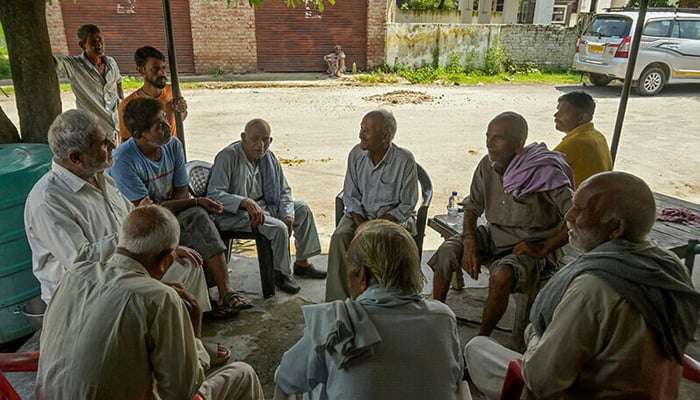
It took 77 years for Dev Raj to vote in local elections in Indian Occupied Jammu and Kashmir (IIOJK), and the Hindu elder is clear who he will please.
“I will vote, and happily, for Modi,” Raj said, referring to Indian Prime Minister Narendra Modi, leader of the Hindu nationalist Bharatiya Janata Party (BJP).
Three-phase elections begin in the occupied Muslim-majority region on September 18, the first IIOJK regional elections in a decade — and the first since New Delhi revoked the disputed region’s semi-autonomous status and imposed direct rule in 2019 — with 8 .7 million voters.
Raj’s case illustrates the legacy of colonialism and the complex shifting identities in the contested Himalayan region.
Kashmir has been divided between nuclear-armed rivals India and Pakistan since their partition at the chaotic end of British rule in 1947, with both countries claiming the territory in full.
About 500,000 Indian troops have been deployed in the region for decades, which has seen an endless series of Kashmiri party bans, curfews, crackdowns and killings of civilians and freedom fighters fighting for their right to self-determination under UN resolutions.
Raj, 90, was a teenager when Pakistan became independent and an estimated one million people on both sides of the new border were slaughtered.
Hindus fled to India. The Muslims fled from the other side.
Raj settled with about 5,700 Hindu families under Indian rule in IIOJK.
Since then, the descendants of these families, now totaling 150,000, have been designated as “West Pakistani Refugees” (WPR).
They have long been recognized as Indian citizens who can vote in national elections, most recently in June when Modi won a third term in office.
But the IIOJK’s special semi-autonomous status—constitutionally enshrined power to control its affairs—meant that only those of local descent in 1934 could vote and own property.
That changed in 2019 when the Modi government scrapped those rules and imposed direct rule from New Delhi.
However, the major Kashmiri parties, which demand independence for Kashmir or its merger with Pakistan, oppose the election which they see as validating New Delhi’s control.
Critics say the 90-seat assembly will have only nominal powers over education and culture. Key decisions will remain in New Delhi’s hands, including the appointment of its governor.
Observers say previous governments have not granted full rights to the group for fear of upsetting the demographic balance.
However, the Modi government has encouraged those from outside the region to move to IIOJK, especially in Jammu region, which has had a majority Hindu population since partition.
Some, like WPR activist Labha Ram Gandhi, said they would not automatically vote for the BJP.
“They (BJP) expect that since they have given us full citizenship rights we would vote for them, but the party has not given a single ticket to any of us,” Gandhi said. AFP. “Of course, we’re angry.”
Gandhi said he would vote for candidates who would help them secure formal ownership of the land they live on.
But while the WPR group is not large enough to significantly change the poll results, commentators see their vote as part of the BJP’s wider push for Hindu support.
a href=”https://www.geo.tv/latest/564527-indian-hindu-group-in-iiojk-readies-for-vote-in-disputed-territory”>Source link



