
India pretends to projectr to have 88,000 acre feet of live storage with faulty spillway design in clear violation of IWT 1960
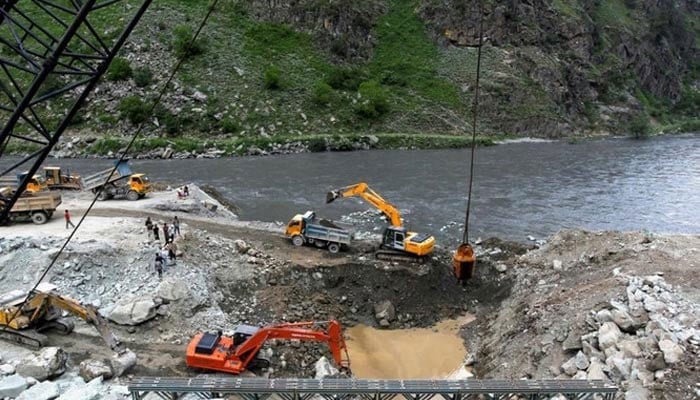
- The project has 99,000 acre-feet of live dam storage.
- Pakistan has already invoked Article 9 of the Treaty.
- India also started construction of Kiru, Kwar projects.
ISLAMABAD: India has started construction of the first hydroelectric project on the Maru Sadar, the right bank tributary of the Chenab River which violates the provisions of the Indus Waters Treaty (IWT) of 1960, The news reported on Monday.
Islamabad and New Delhi are already locked in a legal battle at the arbitral tribunal and a neutral expert, the two international forums, over the flawed designs of the 330 MW Kishanganga and 850 MW Ratle hydropower projects being built on Pakistan’s rivers.
Pakistan has opposed plans for the hydropower project, which has live dam storage of 99,000 acres and a hydropower generation capacity of 1,000 MW.
India is pretending to have 88,000 acre-feet of live storage with faulty spillway design in clear violation of IWT 1960, according to experts. The project will be completed within two years.
However, Pakistan has already invoked Article 9 of the Treaty, under paragraph 11 of Annex-E, on the project’s spillways and freeboard designs a year and a half ago.
“We are observing the project in question and have already raised objections to its design under Article 9. We would raise the issue again under Article 9 of the treaty with the Indian side in PCIW-level talks, which may be held before March 2024,” a senior official confirmed to Pakistan’s Commissioner for Indus Waters (PCIW). The news.
India, under the treaty, has the right to store 3.6 million acre of water in Pakistan’s rivers for irrigation purposes, and for this purpose, it is going to complete the Pakal Dal project with a 99,000 acre water reservoir.
Pakistan is of the view that India will have a live storage capacity of 99,000 acre-feet at the Pakal Dal Dam and that amount of water should be deducted from the 3.6 million acre-feet of water storage right.
But India, with a faulty spillway design, wants to pretend that it has a live storage capacity of 88,000 acre-feet, so the volume of 88,000 acre-feet should be deducted from its right to store water in Pakistan’s rivers.
If the Article 9 talks fail, the Pakistani side will start exhausting other efforts mentioned in the Indus Waters Treaty and after that, in case no solution is reached, Pakistan will have no option but to move an arbitral tribunal for the specific project.
Meanwhile, India has fast-tracked construction work on two more projects – the Kiru and Kwar projects upstream of the Ratle project on the Chenab river with plans in clear violation of the provisions of the 1960 Indus Waters Treaty.
Pakistan has opposed the plans of the 624 MW Kiru hydroelectric project and the 540 MW Kwar hydroelectric project in its recent interaction with India at the PIWC level. India is committed to sharing its project plans with Pakistan under the agreement.
The Kiru hydroelectric project is being constructed along the river Chenab near Patharnakki and Kiru villages, about 42 km from Kishtwar. It will be located between the upstream Kirthai-II hydroelectric project and the downstream Kwar hydroelectric project.
According to India, Kwar is a project that crosses the river. The net head of the project will be 56.6 meters. The total number of reservoirs, pipes or large channels that carry water from the hydroelectric reservoir to the turbines within the actual power station, is expected to be four in number. The length of the stockpile will be 236 meters. The diameter of the stock will be 5.65 meters. The project is expected to generate 1,975.54 GWh of electricity. The hydroelectric project consists of four turbines, each with a capacity of 135 MW.
“India shared with us a few days ago the plans of two more projects that it plans to build on the Chenab river hydroelectric project upstream of Ratle,” said a senior PCIW official. The news.
“We have submitted our objections to the designs of both projects on components that include spillways, breakwaters and catch basins. India repeats violations of the planning provisions of the 1960 Indus Waters Treaty in its project plans despite repeated objections from Pakistan. Similar flawed designs adopted in Kishenganga and Ratle projects are being repeated by India in more hydropower projects on Pakistani rivers,” the official added.
Transboundary water expert Engineer Arshad H Abbasi said a report recently by India’s Ministry of Energy demonstrates the speed at which India is developing dams on the Chenab River. The progress report reveals the pace at which India is completing bumper-to-bumper projects along the Transboundary River.
Abbasi, referring to the report, said that India completed the road construction work while the MAT (multi-area tunnel) excavation was in progress. About 90% of the Power House Cavern excavation is complete, 15% of the dam abutment excavation is complete and 84% of the Power House Access Tunnels excavation is complete. However, Indian environmentalists and the local population forced India to halt this project indefinitely.
The progress report states that the 624MW Kiru HEP is expected to be completed in early 2024, after 16 months. The Kiru power project will cost only INR 4.27 per unit, unlike the high tariff of Pakistani hydro projects.
On another project, the 540MW Kwar Hydropower Project on the same river, work is in full swing. This project will be completed in 2026 after three years. On completion, this project will offer electricity at a rate of INR 4.07 per unit only.
a href=”https://www.geo.tv/latest/521549-india-building-another-controversial-hydropower-project-on-river-chenab”>Source link



