
Islamabad:
Pakistan has informed the International Monetary Fund (IMF) that its debt servicing costs could reach Rs 8.5 trillion, marking a slippage of Rs 1.2 trillion over the allocated budget. Challenges remain in servicing about $6.5 billion in foreign debt this year due to difficult economic conditions.
Pakistani authorities have now sought the Fund’s help to bridge the external financing gap, which remains despite the IMF program, according to finance ministry sources.
Excessive spending on interest payments and difficulties in raising external debt due to adverse domestic and global economic conditions are the two main issues in the ongoing talks on the $710 million loan tranche. Debt settlement challenges of $6.5 billion represent nearly a third of planned borrowing for this fiscal year. The $6.5 billion figure may be reduced to $5.5 billion if the Chinese fund their loans due in May-June next year on time, the sources said.
Discussions on domestic debt and external financing requirements were shared with the IMF during the second day of talks at the technical level.
The IMF raised questions and will share its assessment next week, sources said. However, the IMF staff noted that Pakistan’s budget deficit will grow much higher than estimated due to rising debt servicing costs, according to government sources.
Reading FBR warns IMF on Rs 9.4 trillion tax target
Debt management office was also discussed. Sources noted that the IMF has raised concerns about an understaffed office, with many key positions vacant and much of the work being handled by foreign-funded consultants.
Unlike earlier practices where the technical level talks were conducted by the Finance Minister, this time the Caretaker Finance Minister Dr Shamshad Akhtar also participated in the technical rounds.
The IMF has been told that interest costs may rise to Rs8.5 trillion during the current financial year, representing a slippage of Rs1.2 trillion against budget estimates of Rs7.3 trillion.
It said efforts will be made to reduce the projected cost of Rs 8.5 trillion through raising debt with a one-year, six-month maturity profile. This would shift some of the debt payments from this fiscal year to the next, but would not significantly affect the overall cost of debt.
Of the Rs 8.5 trillion debt cost, a significant portion, over Rs 7.5 trillion, was for domestic debt servicing. The external debt servicing cost has now crossed Rs 900 billion, according to sources.
The global lender will now review those figures and provide its assessment of the country’s revised budget deficit and external financing needs. Both sides are negotiating a second loan tranche of $710 million under the $3 billion short-term program.
Qamar Abbasi, a spokesman for the Finance Ministry, was asked to confirm the development and whether alternative plans had been shared with the IMF to deal with high interest payments and challenges in settling the $6.5 billion in loans. His response was awaited pending the filing of this report.
The government had estimated interest payments at Rs 7.3 trillion, assuming an interest rate of 18%, but the central bank has already raised rates to 22%.
Sources said the IMF’s outlook was that the increase in 12-month Treasury debt would only have an accounting impact, as interest would still accrue in this financial year.
read more The debt of the electricity sector soars to 2.54 trillion
The IMF program will end in April next year. In the last quarter of the current fiscal year, Pakistan’s interest payments are estimated to be close to Rs2.9 trillion, including Rs2.6 trillion to domestic lenders.
During the first quarter of this fiscal year, the country paid off a debt of Rs 1.38 trillion, almost equal to the entire net federal income. Pakistan’s finance minister expressed concern over rising interest costs, calling it the primary issue for fiscal stability.
Due to overrun interest payments, the projected Rs7.5 trillion federal budget deficit could reach a new record of Rs8.7 trillion even if all other estimates remain constant, sources said.
With below-budget foreign borrowing, the cost of financing the fiscal deficit has shifted entirely to domestic sources. The government is also unlikely to get fiscal coverage for a significant portion of the IMF debt and the $1 billion UAE loan it received in July this year.
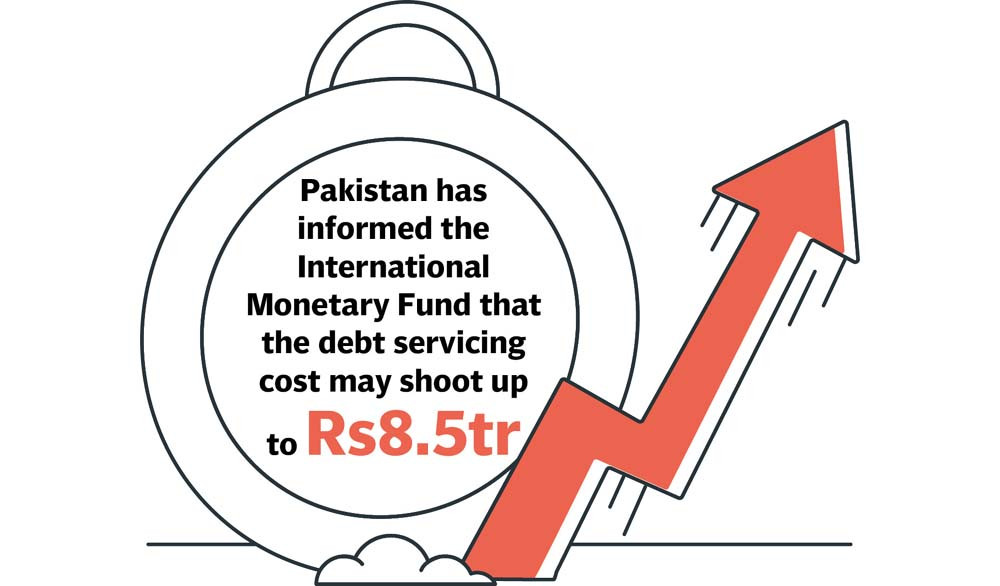
design: Ibrahim Yahya
In its July report, the IMF projected the cost of interest payments at Rs8.6 trillion, which is Rs1.3 trillion more than the annual budget figures. The Ministry of Finance is gradually realizing and adapting to the real realities.
External funding issues
Sources noted that Pakistani authorities have informed the IMF that the implementation of external loans of about $6.5 billion will depend on market conditions. Pakistan has sought the help of the IMF to settle these loans. Earlier, the IMF played a role in getting loans from Saudi Arabia and the United Arab Emirates.
The IMF has been informed that the raising of foreign commercial loans, Eurobonds and some debt by the Islamic Development Bank will depend on favorable market conditions. The Islamic Development Bank had pledged to provide $1 billion this fiscal year, but the full amount may not materialize.
One option could be to increase the size of the current $3 billion loan program, but that would require the IMF’s consent.
The government had estimated that it received over $20 billion in foreign loans from all creditors.
Sources said that in contrast to earlier estimated external financing requirements of more than $26 billion, the current needs are below $24 billion. Some needs have eased due to a lower-than-projected current account deficit, now estimated at $6.5 billion, and the rescheduling of Chinese loans.
Total foreign loan rollovers, previously estimated at $11 billion, are now projected at close to $12.5 billion, offsetting some of the projected shortfalls in foreign debt inflows.
The sources also noted that some of the shortfall will be offset by reduced imports, further reducing the projected current account deficit.
They said that the prospects for raising significant debt through Green Bonds are not very bright, although discussions have recently taken place on its rules at the level of the Special Investment Facilitation Council (SIFC).
Published in The Express Tribune, November 5u2023.
Like Businesses on Facebook, follow @TribuneBiz on Twitter to stay updated and join the conversation.
a href=”https://tribune.com.pk/story/2444823/imf-talks-uncover-major-gaps”>Source link



