
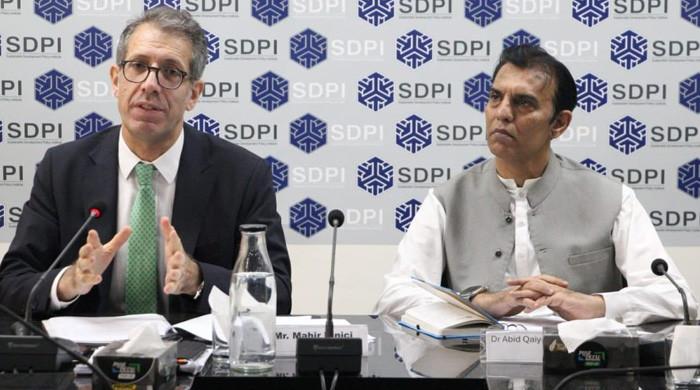

- Binici confirms IMF’s continued financial support in Pakistan.
- He says that the first completion of the IMF review in May was a key milestone.
- “Support through RSF will enhance Pakistan’s climate durability.”
Residents of the International Monetary Fund (IMF) for Pakistan Mahir Binici said that the country’s performance in the context of the extensive EFF establishment was “strong so far” and expressed hope that its economic growth would be strengthened this year.
Binici gave a comprehensive lecture by guests at the Sustainable Development Institute (SDPI) in which he shed light on the evolving economic landscape throughout the Mena and Pakistan region.
It reaffirmed Washington’s continued support for the country’s economic agenda and the country’s climate reform.
Facing economists, researchers and politics experts, Binici said that growth throughout the Middle East, in the North African region (Mena) and Pakistan was expected to be strengthened in 2025 and beyond.
However, he warned that increased commercial tensions, geopolitical fragmentation and weakening world cooperation continued to create excellent uncertainty and weigh in world economic prospects, underlining the urgent need for prudent and future politics.
Focusing on Pakistan, Binici said that the country’s performance as part of the IMF’s EFF was “strong so far”, adding that the successful completion of the first review by the IMF executive in May 2025 was a key milestone.
“The first policy measures have helped to restore macroeconomic stability and rebuild investor confidence, despite persistent external challenges,” Binici observed.
He stressed that structural reforms remain central to Pakistan’s long -term financial viability, in particular the reforms that boost tax equality, improved business climate and encouraging private sector investment.
He also made Pakistan’s progress in climate -related reforms in the context of the IMF’s durability and viability unit (RSF).
According to Binici, the RSF is designed to help countries such as Pakistan to enhance climate -related resistance and to meet international climate commitments.
He said that the main areas of reform under the RSF included the strengthening of public investment planning, the promotion of effective and sustainable use of water resources, the improvement of institutional coordination for the preparedness and funding of disasters and the extension of the availability of data related to the database.
Binici stressed: “Support through RSF will not only enhance Pakistan’s climate durability, but will also help to unlock green investment and promote a more conscious economic trajectory.”
SDPI’s executive director, Dr Abid Qaiyum Suleri, welcomed the promotion of the IMF spokesman, noting the importance of documented economic dialogue and multilateral cooperation on the country’s journey to sustainable development.
The lecture ended with an interactive debate on tax and monetary policy frameworks, external buffers and the role of international institutions to promote growth without exclusion.
Pakistan and the IMF had reached an agreement at staff level in March with $ 7 billion, with the aim of ensuring economic stability and facilitating structural change.
a href=”https://www.geo.tv/latest/613829-imf-official-praises-pakistans-strong-progress-under-eff-programme”>Source link



