
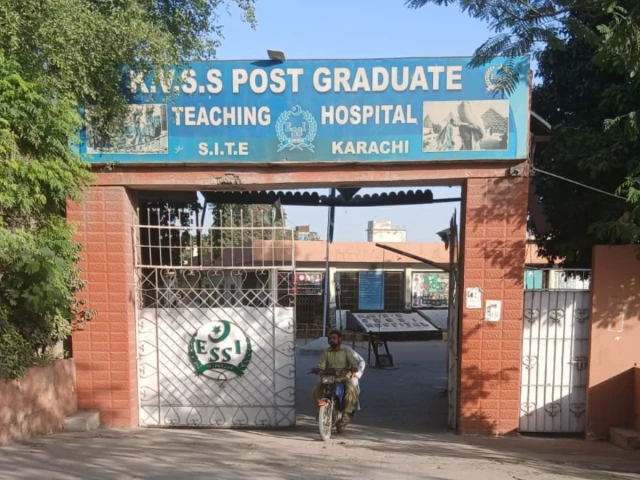
The information surfaced in a WhatsApp group of reporters: Eight young children were allegedly infected with HIV at the Kulsum Bai Valika Hospital in Karachi and two were dead. Every reporter was busy calling Sindh government contacts to get confirmation and details. Since I am new to health reporting, I decided to go to the local Pathan colony to see if I could find any parents who might know how this happened? Was there any connection with Kulsum Bai Valika Hospital as people claimed?
It took me a while to get to Valika Hospital in SITE, which is in the upper left corner of the Karachi map. This is where all our big soft drink factories are located next to textile mills. Pathan Colony is a katchi abadi of tall skinny buildings directly opposite the hospital, accessible through a hole in the wall at the petrol pump.
When I went to Valika on Tuesday afternoon, the government hospital was really quiet, which I found strange because it offers free treatment to registered factory workers and their families.
I went upstairs to meet the person running the hospital, Medical Superintendent Mumtaz Shaikh. I mentioned the rumors of at least 18 HIV-positive children. “We don’t read all the news,” he told me. “And we don’t believe all the news.” Of course, I thought. How stupid. He wasn’t going to be open with me.
Interview with the head of the hospital
The MS goes on to say, however, that first, there were two children, one from Banaras and one from the Pathan colony. Both positive. They were immediately sent to Indus and Civil hospitals.
Valika notified the Sindh HIV program on October 22 that all hospitals have standing orders for diseases that cause epidemics. Within 24 hours, inspection teams came to the SITE. According to the MS, 35 people sitting in the OPD that day were tested and came back negative.
The hospital also had to inform its watchdog, the Sindh Health Commission, and asked it to send officers to shut down small clinics run by fake doctors and barbershops in the area.
But wait. I stop PS because he had just shown me the letter. He says six to eight kids tested positive, I tell him. No 2.
Sheikh closed the file. “No patients admitted,” he replied. “They were people from outside the hospital, from the area.”
Translation: Eight children have HIV. Two are probably dead. Six may still be out there, somewhere, with HIV.
The Sindh HIV program is part of the Communicable Disease Control or CDC. I meet a young CDC employee in the MS office, but he also refuses to share any information. “It would spread panic. People would be ostracized,” he said.
I try to tell him I don’t want names. Just numbers. Just confirmation.
“All I can tell you is that the CDC is here,” he says, handing me a flyer with an address. “Go here, but they won’t tell you anything.”
Neighborhood watch
Rather deflated, I walk out into the parking lot to think about what to do next. Fortunately, I notice a man talking to the CDC staff and stay back until he’s alone. He introduces himself as Irshad Khan, the local elected representative for the Pathan Colony Union Council 1. He also happens to be the chairman of the SITE Town health committee. He has a thick file of papers.
Irshad Khan has been chasing authorities since August, when the first diagnosis surfaced. “We ask Valika for the list, but they don’t give it,” he said. They told the hospital that the committee could help by gathering the other people in the area for testing.
Irshad has done something quite commendable. He has got grassroots political party workers to form a committee to work on the issue. There is someone from ANP, PTI, Jamaat-e-Islami and PPP.
The city representatives asked Valika to organize a seminar where hospital staff, people from the Pathan colony and grassroots organizations spoke about HIV. People learned that it is not transmitted through touch.
Dr. Arman, the pediatrician everyone knew, was there. He has now been transferred to Landhi, I am told.
In the absence of real information, rumors circulate in the colony. I have shared videos of hospital waste being taken to waste bins. The neighborhood committee has started to collect its own data. They count ten cases.
Akhtar Ali, a political worker, says, “These people are rude, the hospital staff. If this hospital was on MQM turf, they would have set fire to this hospital. We have really controlled the people of the area. Nobody wants to come here.”
Usman Ahmed, president of the Pathan Colony Jamaat-e-Islami chapter, rejects the explanation that small clinics are to blame. “These people put it on the dolls,” he says, naming a news channel that came to provide coverage. “But when we go to the clinics, we buy our own injections from abroad. There are abusers all over Pakistan, not just here. So why is this happening to children who came to Valika?”
The good news, I’m told, is that since the outbreaks began, Valika’s drug and syringe shortages have ended. Bad news: Staff shortages continue. There are still not enough beds for the children.
The real cost
The civil workers take me deep into the neighborhood where they introduce me to a young man who says his niece died of HIV. He just gave an interview to a vlogger. He offered to introduce me to the other family whose child had also died.
But when I met the family and asked the mother about what happened, they had no test results to show me that HIV had actually been detected. A maulvi sahib told them that the child had HIV. And I wonder why these families have no way of really knowing what happened.
One of the mothers, the wife of a factory worker, had to go to Indus Hospital herself as her husband could not be absent from daily wages. She went alone with her sick child. She later told the neighborhood committee that the trip alone cost her Rs 12,000.
I hear about Sahil’s niece: 14 months old, was admitted to Valika with unrelenting fever. He had it for three, four days. Two children in her ward tested positive for HIV. One was in the same bed as his niece.
Sahil didn’t trust Valika’s lab, so he had the whole family tested at Dow. They were all negative, thank God, he said.
What about the kid who shared the bed with his niece, I ask. He was sent to Patel Hospital.
Akhtar Ali’s niece was born in Valika and has always been treated there because her father, a factory worker, was registered with the Benazir Mazdoor card which makes him eligible for free treatment at a SESSI hospital. The baby was one year old when he developed a persistent fever in April. She was treated for five months and her weight continued to drop. By September 11, she tested HIV positive.
Her mother claims she saw hospital staff using the same syringe on multiple children.
The baby was tested in a Ziauddin hospital laboratory and is now receiving ART treatment at the Civil hospital and has gained 2.5 kg. Her parents and siblings tested negative.
This has happened before
After the Ratodero outbreak, since 2019, HIV testing has been extended across Sindh and there are over 30 ART centers, almost one per district.
When hospitals find positive cases, they submit “zero reports” to the government. These patients then go to government ART centers because the treatment is expensive. The government provides it for free through the National AIDS Control Programme.
The government is retesting patients according to WHO protocol.
But in the Pathan colony, the committee men told me that some HIV-positive children have just been brought home and are not receiving treatment. If true, this is alarming. But I have no way to confirm that.
“Because this is a chronic disease, people think it only happens sexually,” says Professor Fatima Mir, a pediatric HIV specialist at Aga Khan University. “So parents think, ‘We haven’t done anything like this, how did this happen to my child?’
What some officials tell me later
I was able to contact Dr. Zulfiqar Ali Dharejo, the CDC’s Deputy Director General, but he did not share any confirmed numbers. “We’re making projections,” is all he could say. “Any cases that occur are taken to ART centers and treated.” Cases from Valika are recorded at Indus Hospital.
Dr Ahsan of the Sindh Health Commission added that “people think crazy when you say HIV”. But kooks are only one reason. The committee continues to close them. they emerge elsewhere. Another danger is contaminated blood. Families are asking relatives to donate instead of paying for tested blood, he says. The donor may have hepatitis or HIV.
He provides another clue: “When a child is infected, it shows up at least six months later.” This could mean that the children who reportedly tested positive at Valika Hospital and were only being treated there because they were on their father’s panel, were infected months earlier.
I learn that the SHCC has met Keamari Deputy Commissioner Tariq Chandio and they will work with SSP Keamari and the DHO to inspect public and private hospitals in a district-wide crackdown on unqualified doctors.
Meanwhile, the neighborhood committee says people are scared and want more information. They collect their own data because no one else will but the proper clinical trials and evaluations can only be done by the government.
a href=”https://tribune.com.pk/story/2577236/i-went-to-valika-hospital-to-find-out-if-children-got-hiv-there”>Source link



