
As the sun rises over the southeast Beijing suburb of E-Town, a mesmerizing scene unfolds. Stretching lean arms and legs, running at a precise pace and practicing Tai Chi, the participants are not your typical grey-haired men. They look elegant, energetic and like human beings.
Yes, they’re not our kind — they’re humanoid robots.
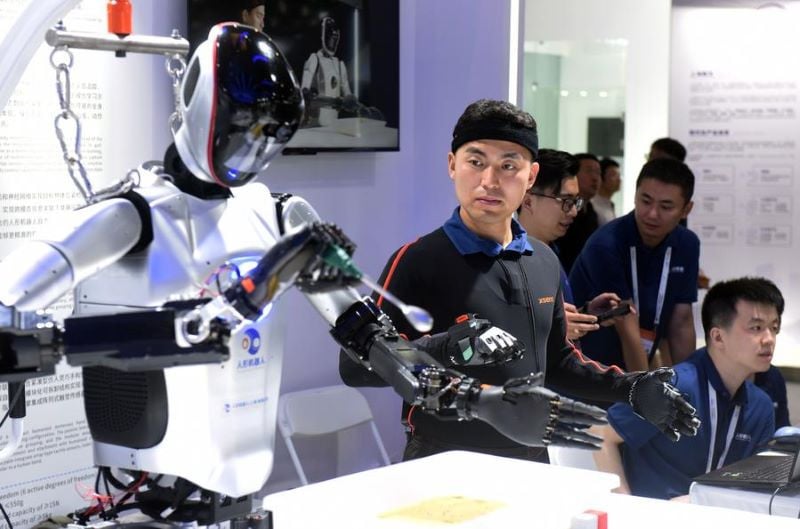
A staff member demonstrates a gesture-controlled robot during the AI World Conference 2024 in Shanghai, east China, July 4, 2024. PHOTO: XINHUA
A staff member demonstrates a gesture-controlled robot during the AI World Conference 2024 in Shanghai, east China, July 4, 2024. PHOTO: XINHUA
As rising stars in China’s new innovation-fueled growth engines, known as new quality productive forces, these humanoid machines are flexing smart muscles to play a big role in supercharging the country’s long-term growth.
The nascent but promising industry
The black, metallic humanoid robot, named Tien Kung, is the brainchild of the Beijing Embodied Artificial Intelligence Robotics Innovation Center, or HUMANOID.
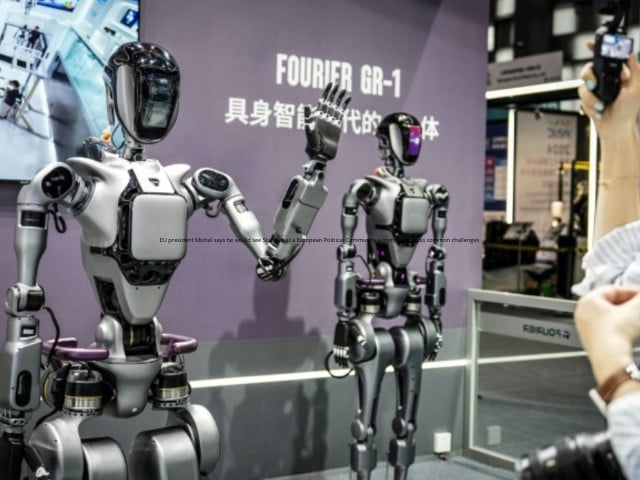
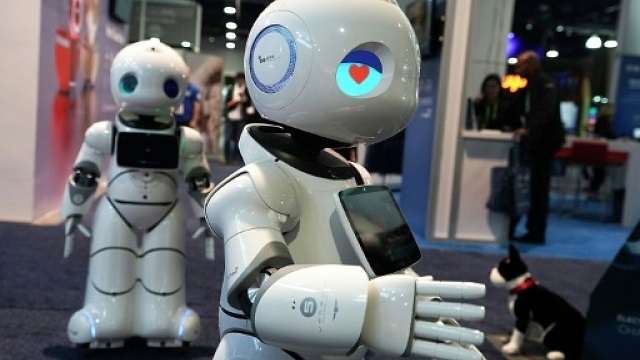
Humanoid robots on display at the World Congress on Artificial Intelligence in Shanghai PHOTO: AFP
The platform, founded late last year, has already broken into the cutting-edge sector globally with the debut of Tien Kung in April.
With a height of 1.63 meters and a weight of 43 kilograms, Tien Kung can maintain a constant running speed of 6 kilometers per hour. It achieved the world’s first humanoid operation of a full-sized, fully powered embedded intelligent robot.
“It’s really a step forward in terms of technological advancement,” said Rick Xiong, the center’s general manager and an industry veteran with more than two decades of experience in the field.
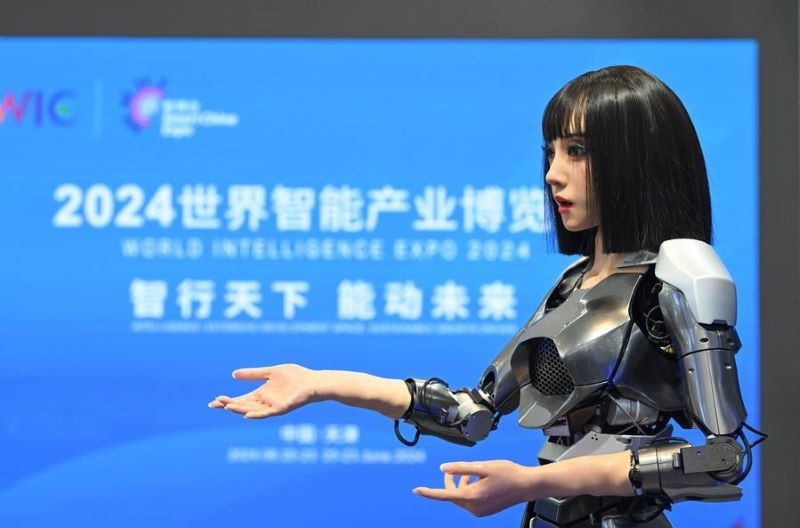
Xiaoqi, a humanoid robot, is pictured at the World Intelligence Expo 2024 in Tianjin, north China, June 21, 2024. PHOTO: XINHUA
Featuring a sophisticated combination of cutting-edge technologies such as artificial intelligence (AI) and robotics, humanoid robotics is an emerging high-tech industry that is gaining global attention and investment. Xiong believes it is set to become a trillion-dollar industry with the potential to “revolutionize the way we live, work and interact.”
Xiong envisions a future where humanoid robots can care for the elderly in nursing homes or seamlessly perform tasks in car factories. “Impossible? It’s already a reality in the making.”
In China, humanoid robots are starting to come out of labs and exhibit in labs. Industrial giant UBTECH, which also has an office near HUMANOID in the ZGC E-Town International Robot Industrial Park, recently introduced its products to a smart car factory in eastern China, where they help workers transport car parts.
Xiong predicts that humanoid robotics will be implemented on a larger scale in the home in the next three to five years.
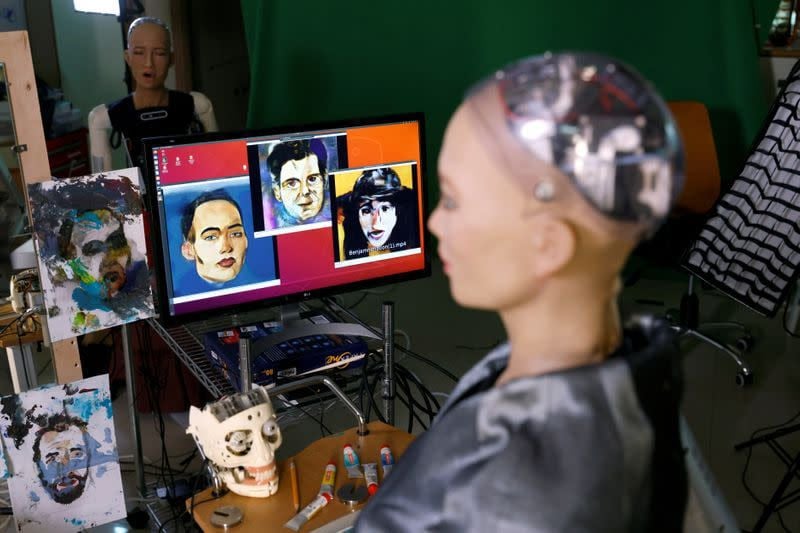
Sophia, the humanoid robot, developed by Hanson Robotics, looks at paintings in her studio before auctioning her own non-fungible robot (NFT), in Hong Kong, China, March 16, 2021. PHOTO: REUTERS
An industry report compiled by UBTECH and other partners predicts that the market size of humanoid robots in China will reach about 2.76 billion yuan in 2024 and is expected to reach 75 billion yuan by 2029, accounting for about one-third of global total. By 2035, the market is projected to expand even further, with a potential size of 300 billion yuan.
Right time, place and people
Xiong attributed the rapid growth of HUMANOID and the domestic industry to a growing ecosystem for humanoid robotics in China, citing the country’s stable high-tech manufacturing sector, a galloping AI market and a growing range of application scenarios.
China is home to the most integrated industrial system in the world, with a production and manufacturing system that is unmatched on a global scale and diverse in its range of sectors. It is also the largest market for robotics applications worldwide.
In E-Town, where HUMANOID is located, there are over 110 robotics companies, forming a healthy industrial chain system covering basic robotics components, complete machines and applications.
With the development of artificial intelligence booming in the world’s second largest economy, more than 4,500 companies are racing to improve the technologies, placing China at the forefront of the global artificial intelligence market. Complementing these industry advances is a supportive government policy framework.
Local governments have offered a number of supportive policies to help companies like HUMANOID grow. At the national level, the Ministry of Industry and Information Technology issued a guideline last year to accelerate the development of the industry.
To sharpen the advantage of future industries, including humanoid robotics, China will launch a series of scientific research projects, establish a number of incubators, support certain regions to explore and develop application scenarios, and cultivate more industrial flyers, Minister of Industry and Information Technology Jin Zhuanglong said at a press conference in July.
China’s top economic planner also issued a paper in June encouraging the development of humanoid robots based on large-scale artificial intelligence models to enrich consumption scenarios.
“There are concerted efforts to shape the future to our advantage,” Xiong said. “We have the right time, place and people to accelerate the humanoid robotics push.”
Technology and teamwork
While remaining optimistic about the budding industry’s prospects, Xiong cautioned against an irrational rush to jump on the bandwagon.
HUMANOID is the first of its kind in the country, and within a year many Chinese tech hubs such as Shanghai, Shenzhen and Wuhan have created similar centers or alliances to pool resources to promote the industry. A host of companies are also making inroads into the growing market.
While the West sees industrial giants dominating the robot landscape, China is characterized by a proliferation of small and medium-sized enterprises trying to navigate the competitive terrain, Xiong noted, adding that the latter may lack sufficient reserves of capital and technology. to withstand market risks brought about by intense homogenous competition that may lead to layoffs.
At a key policy meeting held last month, China’s top leadership emphasized the importance of developing new quality productive forces according to local conditions.
“Technology is the major obstacle controlling the growth of the industry,” Xiong said. “It takes time, money and above all teamwork to make real technological breakthroughs.”
HUMANOID will launch a flexible embedded intelligence platform that powers the application of related technologies later this year, and like Tien Kung, will be open to industry players at home and abroad to facilitate the entire industry, according to Xiong.
The company is also gearing up to participate in the upcoming World Robot Congress to be held at E-Town. The event will see industrial heavyweights from countries including the United States, Japan and Germany showcase the latest advancements in the industry, with more than 20 humanoid robots making their debut.
Xiong is eager to exchange ideas and experiences with global counterparts. “We are always open to global industrial cooperation,” he said. “Together, we can make the unreal real.”
a href=”https://tribune.com.pk/story/2487563/humanoid-robotics-boosting-chinas-innovation-drive”>Source link



