
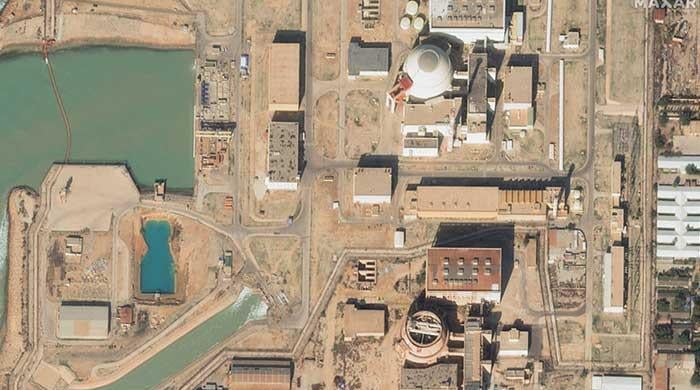

Israel’s strikes on Iran have targeted several of its nuclear facilities, claiming that the Islamic Republic is seeking to develop nuclear weapons – the category of Tehran.
They said experts AFP That while attacks have caused some damage to Iran’s nuclear program, they are unlikely to have delivered a fatal blow.
Following is an update on Iran’s nuclear sites on Monday:
What is the extent of the damage?
Israel’s operation included strikes on Uranz’s Uranz Uranus Uranus Enrichment in Natanz and Fordow and in the Isfahan nuclear region, the UN International Atomic Energy Organization (IAEA) said, citing Iran’s officials.
A key element has been destroyed above the territory of Iran’s nuclear space, including its power infrastructure.
The head of the Rafael Grossi service said on Monday that there was no “natural attack on the underground waterfall containing part of the pilot fuel fuel factory and the main fuel enrichment plant”.
However, the loss of power in the Cascade Hall “may have destroyed centrifuges”, the machines used to enrich uranium.
There has been “extensive” damage to the power supply of the site, according to a report by the Institute of Science and International Security (ISIS), an organization based on the US that specializes on nuclear proliferation, which analyzed satellite images.
If reserve power is lost, “at least, the enrichment plant becomes inappropriate at present,” he said.
At the Fordow’s underground enrichment plant in Iran, in the second country’s uranium enrichment facility, the IAEA, who observed “no damage” after the attacks, Grossi said.
In the ISFAHAN nuclear area, however, “four buildings were damaged”: the central chemical laboratory, a uranium conversion plant, the Tehran Fuel Fuel Production Factory and a metal processing facility under construction.
Significant uranium stocks are believed to be stored around the Isfahan area.
Ali Vaez, director of the Group’s International Crisis Group, told AFP that if Iran managed to transfer significant quantities to “secret installations”, then “the game is lost for Israel”.
Iran’s only nuclear power plant, the Bushehr plant, was not even targeted by Tehran researcher.
Can the program be destroyed?
While “Israel can harm Iran’s nuclear program … it is unlikely to be able to destroy it,” Vaez said, arguing that Israel does not have the massively strong bombs they need “to destroy the fortified, tanks in Natanz and Fordow”.
The destruction of these would require US military assistance, added Kelsey Davenport, a specialist in the Arms Control Association.
He also stressed that Israel’s unprecedented attack could not delete the experience created by Iran in nuclear weapons, despite the murder of nine Iranian nuclear scientists.
What are the risks to the Iranian population?
The IOEA has not identified any increase in radiation levels in affected positions.
“There is a very low risk that attacks on Iran’s uranium enrichment facilities will lead to harmful radiation release,” Davenport said.
But an attack on the Bushehr plant could “have a serious impact on health and the environment,” he added.
After Israel began its strikes, Grossi said the nuclear facilities “should never attack” and that the targeting of Iranian areas could have “serious consequences for the people of Iran, the region and beyond”.
Is Iran near the development of a nuclear bomb?
After the United States unilaterally withdrawn in 2018 by a milestone agreement that sought to limit Tehran’s nuclear activities, Iran gradually retreated from some of its obligations, especially to uranium enrichment.
By mid-May, the country had about 408.6 kg enriched up to 60 percent-a short step from the 90% required for a nuclear head.
Iran theoretically has plenty of material close to weapons, if further improved, for about 10 nuclear bombs, according to the Vienna -based appointment.
Iran is the only non -nuclear insert state that produces celestial at this level of enrichment, according to the UN nuclear observer.
While the IAEA has been criticized for the lack of Iran’s cooperation with the UN body, it says that there are no “credible indications of an ongoing, unscrupulous nuclear program”.
Tehran has consistently refused the ambitions to develop nuclear heads.
But Davenport warned that strikes could boost factions in Iran that support an individual arsenal.
“Israel’s strikes have technically put Iran, but politically the strikes are pushing Iran closer to nuclear weapons,” he said.
a href=”https://www.geo.tv/latest/609494-how-much-damage-has-israel-inflicted-on-irans-nuclear-programme”>Source link



