
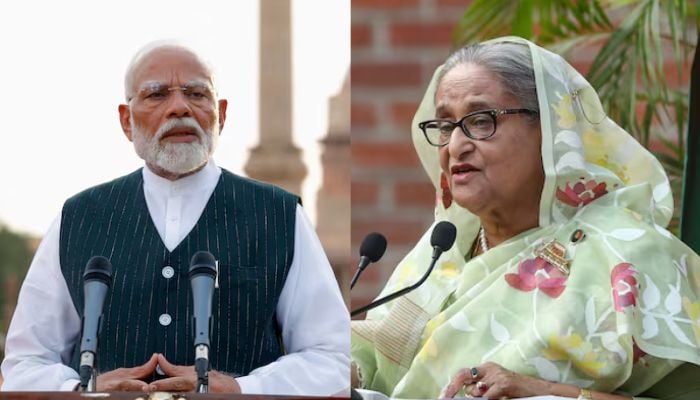
The ouster of Bangladesh’s authoritarian prime minister sparked celebrations in Dhaka this week but alarm in neighboring India, which has backed Sheikh Hasina to take on rival China, analysts say.
It has created a diplomatic dilemma for the regional power.
Hasina, 76, resigned as prime minister in the face of a student-led uprising on Monday and fled by helicopter to her longtime ally New Delhi.
Indian Prime Minister Narendra Modi was among the first to offer his “best wishes” after Bangladesh’s newly-sworn transitional leader Mohammad Yunus took office on Thursday, saying New Delhi was “committed” to working with Dhaka.
But China was also quick to welcome Dhaka’s new principles, saying it “attaches importance to the development” of relations.
With Hasina’s rivals in control in Dhaka, India’s support for the old government has come back in spades.
“From the Bangladeshi point of view, India has been on the wrong side for a few years now,” said International Crisis Group analyst Thomas Kean.
“The Indian government absolutely did not want to see a change in Dhaka and had made it clear for years that it saw no alternative to Hasina and the Awami League.”
‘Harmful’
Bangladesh is almost entirely surrounded by India, with a deeply intertwined history long before they were separated from the Indian subcontinent in 1947.
But while India’s population of 1.4 billion and its dominant economy dwarfs that of Bangladesh — with a population of 170 million — Hasina has also courted China.
India and China, the world’s two most populous nations, are fierce rivals competing for strategic influence across South Asia, including Nepal, Sri Lanka and the Maldives.
Hasina has pursued a delicate balancing act, benefiting from New Delhi’s support while maintaining strong ties with Beijing.
New Delhi saw a common threat in groups Hasina considered rivals and crushed with brutal violence, including the mainstay Bangladesh National Party (BNP).
“India … is concerned that any alternative to Hasina and the Awami League could be detrimental to Indian interests,” said Michael Kugelman, director of the South Asia Institute at the Washington-based Wilson Center.
Yunus said he wants elections in Bangladesh “within a few months”.
The BNP could be ready for a comeback, holding a massive rally in Dhaka this week.
In the immediate aftermath of Hasina’s downfall, a number of businesses and homes owned by Hindus, a group some in Muslim-majority Bangladesh saw as her supporters, were attacked.
Hundreds of Bangladeshi Hindus arrived this week at the Indian border, asking to cross.
Hindu nationalist leader Modi said on Thursday that he hoped “for a speedy return to normalcy, ensuring the safety and protection of Hindus and all other minority communities”.
“He’ll go back”
The fact that Hasina is taking refuge in India may prove to be a stumbling block in relations between New Delhi and Dhaka.
Indian Foreign Minister Subrahmanyam Jaishankar told parliament that Hasina had flown to India “at very short notice” and according to Indian media, she intended to stay only briefly in transit.
But her reported attempt to travel to Britain was rejected after London called for a “full and independent UN-led inquiry” into the deadly crackdown on protests in the final weeks of her rule.
The United States has previously praised Hasina’s economic record and viewed her as a partner on priorities such as countering extremism, but Washington has more recently imposed visa sanctions over democracy concerns.
It is not clear how long he will now stay in India or where else he might go.
Since arriving at the military air base near New Delhi, he has been housed in a secret safe house and has not spoken publicly.
Her daughter Saima Wazed said she was “hurt” not to be able to see her mother.
“As much as I would like to see Ma, I don’t want to compromise her whereabouts in any way,” Wazed, the WHO’s Southeast Asia chief, said in a since-deleted post on social media platform X.
Her son Sajeeb Wazed Joy told the Times of India newspaper his mother still hoped to run for political office.
“He will return to Bangladesh the moment the caretaker government decides to hold elections,” he said.
a href=”https://www.geo.tv/latest/558542-hasinas-ouster-a-diplomatic-dilemma-for-india”>Source link



