Despite preventive measures, low digital literacy and weak enforcement mechanisms continue to fuel fraud
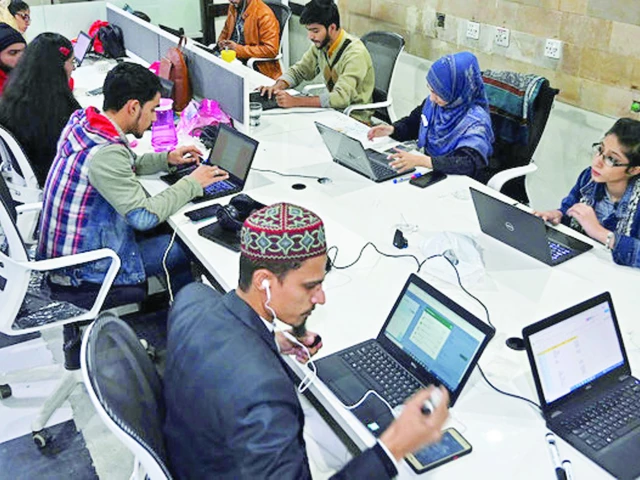
The output of DEEP component-II will be the development of Pakistan Business Portal at a cost of $15 million for the first financial year of the project i.e. 2024-25. photo: file
FAISALABAD:
Muhammad Arshad, a cloth merchant from Rail Bazaar, Faisalabad, was at his shop when he received a call from an unknown number. The caller introduced himself as an employee at his children’s school and said a new WhatsApp group had been set up to guide parents. He asked Arshad to click on a link sent to his phone to join the group.
“As soon as I clicked on the link, I was asked to log back into my WhatsApp account. Within minutes, my account was hacked and someone started messaging my friends and family asking them for urgent financial help,” Arshad said.
He said that since he occasionally borrows small amounts from close friends or relatives for business needs, some of them assumed it was a routine request and transferred nearly Rs 150,000 to the fraudsters. “One of my friends called to confirm the payment and then I realized that my WhatsApp had been hacked and someone was impersonating me to collect money,” he added. A similar scam targeted Alia Arshad, a beautician from Zia town, who lost Rs 25,000. Received a call from an unknown number claiming to have won a JazzCash lucky draw. “The caller told me that the amount in my JazzCash account would be doubled, but before that, I had to verify my account by sharing the four-digit code (OTP) sent to my phone,” he said.
Thrilled with her ‘prize’, Alia shared the code without hesitation. “The caller told me that the money would be transferred within an hour, but a few minutes later, I got a message that Rs 25,000 had been deducted from my account,” he said. “When I went to the JazzCash office to report the issue, they told me that it was a scam and that no such lucky draw had ever been announced,” he added.
According to the State Bank of Pakistan’s Annual Report 2023-24, digital payments in the country saw a remarkable growth in the last financial year, increasing by 40% in volume and 62% in value. The report said that internet and mobile banking transactions amounted to Rs 69.8 trillion in 1.34 billion transactions. ATM transactions accounted for Rs 15 trillion through 931.6 million withdrawals, while e-wallets contributed around 3% of total digital payments. Card transactions also saw strong growth, with point-of-sale (POS) transactions up 36% and e-commerce payments up 26%. In terms of value, POS transactions reached Rs 1.5 trillion (up 41%) and e-commerce reached Rs 194.3 billion (up 37%).
However, alongside this rapid digital expansion, incidents of financial fraud – including fake calls, phishing emails and the hacking of WhatsApp accounts – have skyrocketed. The Digital Rights Foundation (DRF), a non-governmental organization working on digital consumer protection since 2013, said it received 233 complaints of digital fraud in the first eight months of this year. Most complaints involved fraudsters impersonating helpline representatives to access citizens’ e-wallets, impersonating family members to demand ransom or hacking social media accounts to solicit money from friends and family. The Pakistan Telecommunication Authority (PTA), in its annual report for 2024, also highlighted an alarming increase in fraudulent calls and text message scams through mobile and online platforms. During the past year, PTA has blocked 5,294 mobile phone numbers, 4,507 IMEIs and blacklisted 113 national identity card numbers. In addition, 19,730 mobile users were issued warnings and 27,351 stolen or hijacked phones were blocked to prevent misuse.
To combat impersonation and financial fraud, telecommunications and fintech companies have stepped up preventive measures. JazzCash, Pakistan’s largest mobile wallet provider, has upgraded its platform security, while Mobilink Microfinance Bank has issued a comprehensive ‘Customer Awareness Guide’ outlining ways to avoid fraud. Despite these efforts, experts say low digital literacy, weak enforcement mechanisms and limited technological capacity to detect fraud continue to fuel the growing wave of impersonation fraud.
Muhammad Asim, a cyber security manager at a multinational company, explained that criminals involved in such scams often rely on social engineering techniques to trick their victims. “Uneducated people, the elderly and people with limited understanding of technology are often the easiest targets for these scammers,” he said. Asim noted that cybercriminals are now using obfuscation technology to mask their phone numbers, making them look similar to official helpline numbers of trusted organizations – a tactic that easily fools unsuspecting users. “In May, the National Cyber Emergency Response Team issued an advisory warning that the login credentials and passwords of more than 180 million Internet users in Pakistan were stolen during a global data breach,” he added.
It advised users to enable two-factor authentication (2FA) on all social media and communication apps and regularly check connected devices on WhatsApp to ensure there is no unauthorized access. “People should be wary of unknown callers or messages asking for urgent money transfers or verification codes. Updating all mobile apps is essential to stay cyber safe,” he stressed.
Asim further emphasized the urgent need to implement a comprehensive data protection law in Pakistan to protect citizens’ personal information. “Without such legal protection, people remain vulnerable to financial fraud, harassment and extortion arising from data leaks,” he warned.
As Pakistan rapidly transitions to a digital economy, experts warn that cybersecurity and consumer awareness must evolve at the same pace. While initiatives by the State Bank, PTA and fintech companies are making significant progress, the country still lacks a strong legal and technical framework to effectively prevent online fraud.
The author is a freelance journalist
a href=”https://tribune.com.pk/story/2573226/rising-impersonation-scams-threaten-digital-economy”>Source link