
- Ahsan Iqbal says that Balochistan has put an accelerated growth course.
- “Targeting to cover growth, expenditure through domestic resources”.
- Govt for the start of the Silicon Valley initiative to integrate technological programs.
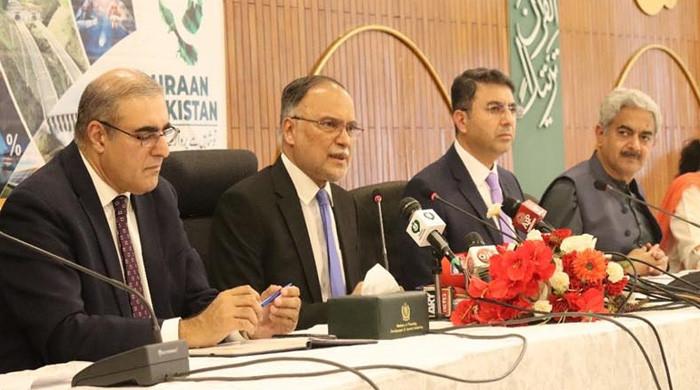
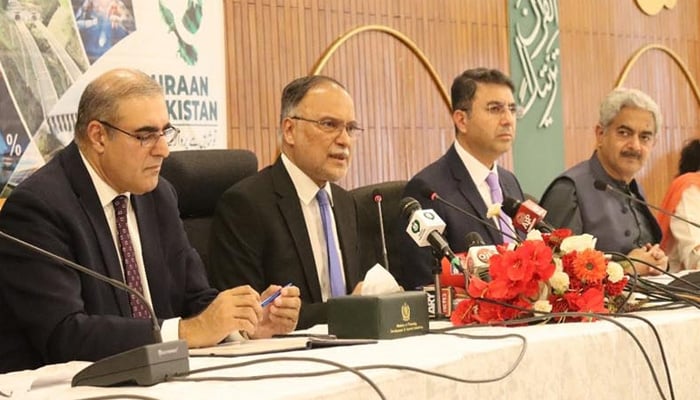
Federal Minister of Planning, Development and Special Initiatives AHSAN IQBAL, while highlighting the government’s development priorities, Balochistan has been put on an accelerated development course for which the federal budget has been proposed 2025-26.
Facing a press conference in Islamabad on Thursday, the minister said, the development of the Backedan was treated as national responsibility, according to Prime Minister Shehbaz Sharif.
The initiative aims to transform the socio -economic landscape of the province over the next two years through targeted investment into critical infrastructure projects to improve connectivity.
A key culmination of the development plan is the N-25 Chaman-Quetta-Karachi motorway, for which 100 billion Rs has been allocated.
The project is expected to be completed within two to three years and will serve as a strategic corridor. In addition, work will also accelerate on M8 and in many other regional infrastructure systems aimed at enhancing connectivity, promoting investment and securing without exclusion.
Ahsan said, with increasing concerns about the use of water as a geopolitical tool, the government offered great importance in the water sector, underlining the urgent need to complete the critical tanks to ensure the safety of Pakistan’s waters.
He said India tried to use water as a weapon. While India cannot legally stop the Pakistan water under the Waters Indus (IWT) – nor will it be allowed – it can try to disturb flows.
To cope with possible threats and ensure long -term durability, the government is rapidly moving to complete the Diamer Bhasha and Mohmand dams with a storage capacity of 6 million acres and about 1 million acres, respectively, bringing about 7 million acres.
The minister acknowledged that the strict fiscal space, driven by structural restrictions, reduced his ability to finance development projects under the Public Sector Development Program (PSDP).
He said the growth budget decreased from 2.6% of GDP in 2017-18 to just 0.8%-a trend described as serious structural concern for national development.
Looking forward, the government aims to cover the growth and other costs through domestic resources, however, achieving this goal requires an increase in tax ratio to Pakistan to at least 16%-a level already maintained by regional peers.
Speaking about the performance of the economy, he said, the country’s economic recovery was the result of bold, politically non -popular decisions taken by the coalition government led by Prime Minister Shehbaz, with the aim of ensuring long -term stability.
He said when the PDM government came to power, many predicted it would take only a few weeks.
“It was the courageous leadership of the prime minister and the harsh financial measures that saved Pakistan from the collapse,” he said, adding that these reforms came to the cost of political capital, but were necessary for the national interest.
IQBal underlined the challenges they faced at the beginning of the coalition term, including the devastating floods of 2022 that caused damage to more than $ 30 billion.
“Despite the crisis, we continued to fund growth-as opposed to the previous PTI government, which withheld the funds for an entire quarter,” he said, accusing the former ruling party-Pakistan Tehreek-E-Insaf (PTI)-to leave the 50-year-old and 50-year-old despite growth despite growth.
IQBal noted a series of positive economic indicators: inflation to 4%, the policy rate was reduced from 23%to 11%and an up -and -coming stock market. He added that international institutions have recognized Pakistan’s recovery, with world magazines calling it a “miracle of recovery”.
Tax reforms led to a record 29% increase in the Federal Revenue Council (FBR) Collection of Revenue. Growth costs have also increased sharply, with a total increase in spending by 50% to FY2025-26 to RS4,224 trillion from RS2,832 trillion, backed by improved provincial distributions.
Energy -efficient reforms, including restructuring subsidies and problem -solving IPPs, have improved fiscal discipline. The government is now focusing on continuous growth driven by domestic resources, enhanced exports and increasing remittances, which have increased from $ 27 billion to $ 37 billion.
He said the government’s development plan, named Uraan Pakistan, is already increasing the fruit and GDP projects to increase from 2.7% to 4.2% in the next use.
IQBal emphasized that boosting exports and increasing revenue was essential for the Pakistan economy to place the course of sustainable growth and removal from repetitive cycles.
a href=”https://www.geo.tv/latest/608869-govt-focusing-on-sustained-growth-driven-by-domestic-resources-enhanced-exports-iqbal”>Source link



