
Ambitious $13 billion program will help re-energize PSM, build maritime-industry partnership
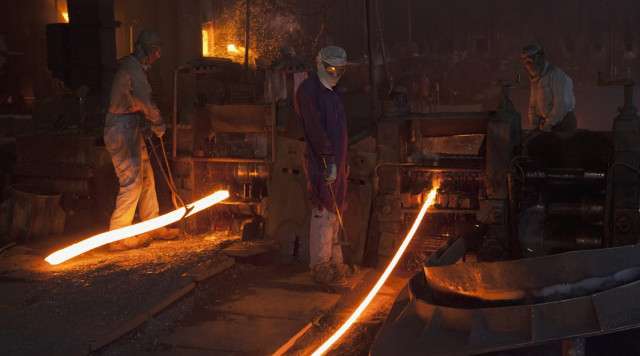
PSM has to pay billions owed to SSGC before gas pressure is restored to steel mills. PHOTO: REUTERS
Islamabad:
The Ministry of Maritime Affairs unveiled a $13 billion savings plan designed to revive Pakistan Steel Mills (PSM) by creating Pakistan’s first ‘Sea-to-Steel Green Maritime Industrial Corridor’ at Port Qasim.
Federal Minister for Maritime Affairs Muhammad Junaid Anwar Chaudhry has come up with an ambitious plan to revive the dormant PSM through advanced technology and a new maritime-industrial partnership with the Ministry of Industries and Production. During a high-level meeting with Special Assistant to the Prime Minister on Industries and Production Haroon Akhtar Khan, who invited the shipping minister to his office, Junaid Anwar presented a detailed proposal for setting up the ‘Sea-to-Steel Green Maritime Industrial Corridor’ at Port Qasim.
He said the initiative could reshape Pakistan’s industrial and shipping sectors by integrating ship recycling, steelmaking and sustainable industrial practices into one ecosystem.
Pakistan currently imports about $6 billion worth of steel annually, with demand expected to grow nearly 6 percent annually through 2035, according to a World Bank report. The minister noted that the proposed project could reduce steel imports by up to 20%, potentially saving over $13 billion for the country over the next decade.
The meeting was attended by senior officials from both ministries, as well as representatives of leading Chinese shipping companies. At the heart of the proposal is the revival of the long-dormant Iron Ore and Coal Berth (IOCB) at Port Qasim, which has been inactive since 2015. The plan envisages converting the facility into a modern ship recycling and repair complex, with a large floating berth capable of handling Aframax class ships.
Junaid Anwar explained that the steel recovered from the decommissioned ships would either be supplied to PSM or reprocessed at a new facility near Port Qasim into high quality industrial steel. This approach, he said, would reduce dependence on imported raw materials, save foreign exchange and support the country’s steel and shipbuilding industries. The minister added that the same dock could serve the Pakistan National Shipping Corporation (PNSC), which currently relies on foreign shipyards for maintenance. “The development of local repair capacity will help reduce operating costs and strengthen maritime infrastructure.”
Special Assistant Haroon Akhtar, while welcoming the proposal, stressed the need for inter-ministerial cooperation. “We must work together for the economic development of Pakistan and the well-being of our people,” he said, voicing his belief in the project’s transformative potential. The Technical Adviser to the Ministry of Maritime Affairs Commodore (Retd) Muhammad Jawad Akhtar endorsed the plan, calling it a practical expression of the government’s blue economy vision. He described the corridor as “an integrated model of sustainable ship recycling, green steelmaking and maritime industrialization”.
He added, “Once operational, the Sea-to-Steel Green Corridor will attract investment, create jobs and facilitate technology transfer, while positioning Pakistan as a regional maritime hub.” Junaid Anwar concluded that the initiative reflects a strategic alignment of maritime trade, industrial development and environmental sustainability. He said it would not only reactivate dormant assets but also create thousands of skilled and semi-skilled jobs, driving economic activity in the region. “It’s about building a self-sustaining marine-industrial ecosystem that boosts the national economy,” he said.
The meeting concluded with an agreement to finalize the financial and technical framework of the project in consultation with national agencies and international partners. A formal presentation to key stakeholders is expected in the coming weeks.
a href=”https://tribune.com.pk/story/2573582/govt-plans-green-corridor-to-revive-steel-mills”>Source link



