
GAZA STRIP:
Facing freezing temperatures and heavy rain in war-torn Deir el-Balah in central Gaza, displaced Palestinian father Tayseer Obaid resorted to digging for a little domestic comfort.
In the clay of the camp area where his family was displaced by the war, Obaid dug a square hole nearly two meters deep and covered it with a tarpaulin stretched over a makeshift wooden A-frame to keep out the rain.
“I had an idea to dig into the ground to expand the space as it was very limited,” Obaid said.
“So I dug 90cm, it was fine and I felt the space grow a bit,” he said from the shelter as his children played on a small swing stuck to the board that serves as a beam for the tarp.
Over time, Obaid was able to dig 180 centimeters deep (about six feet) and then layer the bottom, so, he said, “it felt comfortable, sort of.”
With old flour sacks filled with sand, he opened the entrance to the shelter to keep it from getting muddy, while he carved steps into the side of the pit.
Clay soil is both soft enough to dig without power tools and strong enough to stand on its own.
The pit provides some protection from Israeli airstrikes, but Obaid said he feared the clay soil could collapse if a strike landed close enough.
“If there was an explosion around us and the ground collapsed, this shelter would become our grave.”
Almost all of Gaza’s 2.4 million residents have been displaced by the war that has ravaged the Palestinian territory for more than 14 months.
The UN Satellite Center (UNOSAT) determined in September 2024 that 66 percent of Gaza’s buildings had been damaged or completely destroyed by the war, in which Israel has made extensive use of airstrikes.
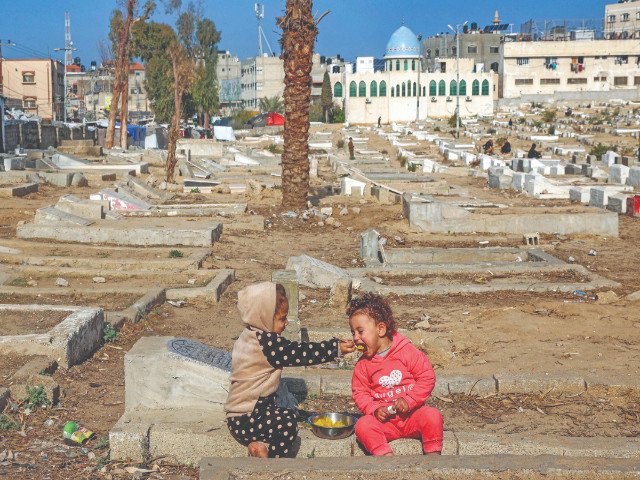
For Palestinian civilians fleeing the fighting, the lack of safe buildings means many have had to gather in makeshift camps, mainly in central and southern Gaza.
The shortages caused by the complete blockade of the coastal area mean that construction materials are scarce and the displaced must make do with what is available.
In addition to the sanitation problems created by the lack of proper water and sanitation for the thousands of people crammed into the camps, the winter weather has brought its own difficulties.
On Thursday, the UN agency for Palestine refugees, UNRWA, warned that eight newborns died of hypothermia and 74 children died “amid brutal winter conditions” in 2025.
“We enter this new year carrying the same horror as last — there has been no progress and no comfort. Children are now freezing to death,” said UNRWA spokeswoman Louise Wateridge.
The health ministry in Hamas-run Gaza said on Sunday that 28 people had been killed in the Palestinian territory in the past 24 hours, bringing the total death toll to 46,565.
The ministry said at least 109,660 people have been injured in more than 15 months of war. The United Nations has recognized these figures as reliable.
Obaid’s sunken shelter provides some protection from the cold winter nights, but not enough.
For warmth, he dug a chimney-like structure and a fireplace in which he burns discarded paper and cardboard.
a href=”https://tribune.com.pk/story/2521749/gazans-dig-shelter-against-winter-war”>Source link



