
DEIR EL-BALAH, GAZA:
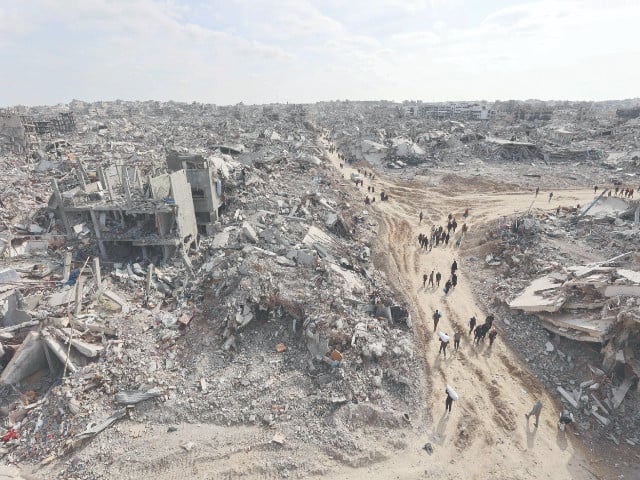
Thousands of displaced, war-weary Gazans started across the devastated Palestinian territory to return to their territories on Sunday, after a long-awaited truce between Israel and Hamas came into force after an initial delay.
As part of the cease-fire agreement, Hamas released three female Israeli hostages, Romi Gonen, Emily Damari and Doron Steinbretcher, from captivity to be reunited with their families. A senior Hamas official later said the next group of hostages would be released on Saturday.
The ceasefire began nearly three hours later than scheduled in which Israeli shelling killed 19 people and wounded 25 others. However, minutes after the truce began, the UN said, the first trucks carrying humanitarian aid entered Gaza , where many residents did not return.
Thousands of Gazans carrying tents, clothes and personal belongings were seen returning to their homes after more than 15 months of war that displaced the vast majority of the population, in many cases more than once.
In the northern region of Jabalia, hundreds descended a sandy path, returning to an apocalyptic landscape littered with ruins and destroyed buildings. “Unprecedented devastation,” said Walid Abu Jiab, who returned to Jabalia. “There is nothing left in the north worth living for.”
Aid workers say northern Gaza is particularly hard hit, lacking all essentials such as food, shelter and water. In the southern city of Khan Yunis, people who had not yet returned celebrated their return home. “I long for Gaza (City) and I long for our loved ones,” Wafa al-Habeel said.
As hundreds of trucks waited at the Gaza border, Jonathan Whittall, interim head of the UN humanitarian agency for the Palestinian territories, told X that the first trucks had started coming in after the ceasefire, after “a huge effort” to prepare for a aid burst across the territory.
The truce was scheduled to begin at 8:30 a.m., but a last-minute dispute over the list of hostages to be released on the first day led to the suspension. Qatar, a truce broker, later confirmed that the ceasefire agreement had entered into force.
An initial 42-day truce brokered by Qatari, US and Egyptian mediators is intended to allow much-needed humanitarian aid to flow into Gaza and the release of Israeli hostages in exchange for some 1,900 Palestinians in Israeli custody.
The Israeli military said the first three hostages, all women, “crossed the border into Israeli territory” in the afternoon and were “going home.” On the other hand, dozens of Palestinian prisoners were to be released by Israel in exchange later on Sunday.
A total of 33 Israeli hostages, 31 of whom were captured by Hamas fighters in the October 7, 2023 attack, are to be returned from Gaza during the initial ceasefire. The Israeli military said that of the 251 people taken hostage, 91 were still in Gaza, while 34 were dead.
An Egyptian source, speaking on condition of anonymity, said “260 aid trucks and 16 fuel trucks” entered Gaza on Sunday. Egyptian Foreign Minister Badr Abdelati earlier said 600 trucks a day would pass through the war-torn enclave.
World leaders welcomed the start of the ceasefire and stressed the need for both sides to respect the terms of the ceasefire. “It is imperative that this ceasefire removes significant security and political obstacles to aid delivery,” UN Secretary-General Antonio Guterres told X.
On the eve of the truce, Netanyahu called the first phase a “temporary ceasefire” and said Israel has US backing to return to war if necessary. Hamas’s armed wing, the Ezzedine al-Qassam Brigades, said its adherence to the ceasefire would “depend on the enemy’s commitment”.
US President Joe Biden, whose administration has been engaged in months-long mediation efforts, welcomed Sunday’s ceasefire, saying “after so much pain, death and loss of life, today the guns in Gaza have fallen silent”.
The truce came into effect on the eve of Donald Trump’s inauguration for a second term as president of the United States. Trump, who claimed credit for the ceasefire deal, told US network NBC on Saturday that he had told Netanyahu the war “has to end”.
The October 7 Hamas attack, the deadliest in Israel’s history, resulted in the deaths of 1,210 people. Israel’s retaliatory campaign devastated much of Gaza, killing at least 46,913 people, most of them civilians, according to figures from the Hamas-run territory’s health ministry.
a href=”https://tribune.com.pk/story/2523247/gazans-head-destroyed-homes”>Source link



