

MANAMA: A de facto partition of Gaza between one area controlled by Israel and another increasingly likely, multiple sources said, as efforts to push US President Donald Trump’s plan to end the war beyond a ceasefire falter.
Six European officials with direct knowledge of efforts to implement the next phase of the plan said Reuters effectively ground to a halt, and this rebuilding now seemed likely to be confined to the Israeli-controlled area. This could lead to years of separation, they warned.
Under the first stage of the plan, which took effect on October 10, the Israeli military currently controls 53 percent of the Mediterranean territory, including much of the arable land, along with Rafah in the south, parts of Gaza City and other urban areas.
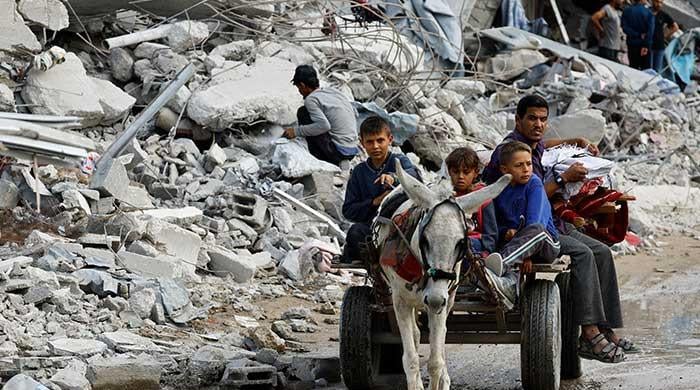
Almost all of Gaza’s two million people are crammed into tent camps and the ruins of destroyed cities in the rest of Gaza.
Reuters Drone footage taken in November shows cataclysmic destruction in the northeast of Gaza City after Israel’s latest offensive before a cease-fire following months of previous shelling. The area is now divided between Israeli and Hamas control.
The next stage of the plan calls for Israel’s further withdrawal from the so-called yellow line agreed to under Trump’s plan, along with the establishment of a transitional authority to govern Gaza, the development of a multinational security force to take over from the Israeli military, the disarmament of Hamas and the start of reconstruction.

But the plan provides no timelines or mechanisms for implementation. Meanwhile, Hamas refuses to disarm, Israel rejects any involvement of the Western-backed Palestinian Authority and uncertainty remains over the multinational force.
“We are still working on ideas,” Jordanian Foreign Minister Ayman Safadi told a security conference in Manama this month. “Everybody wants this conflict to end, we all want the same end game here. The question is how do we make it work?”
Without a major push from the US to break the deadlock, the yellow line looks set to become the de facto border dividing Gaza indefinitely, according to 18 sources, including the six European officials and a former US official with knowledge of the talks.
The US has drafted a UN Security Council resolution that would grant the multinational force and a transitional government body a two-year mandate. But ten diplomats said governments were still reluctant to commit troops.
European and Arab nations, in particular, were unlikely to join if responsibilities extended beyond peacekeeping and meant direct confrontation with Hamas or other Palestinian groups, they said.

US Vice President J.
Such U.S. proposals suggest that the fragmented reality on the ground risks “getting caught up in something much longer term,” said Michael Wahid Hanna, director of the U.S. program at think-tank International Crisis Group.
A State Department spokesman said that while “tremendous progress” had been made in advancing Trump’s plan, there was more work to be done, without answering questions about whether the rebuilding would be limited to Israeli-controlled territory.
Prime Minister Benjamin Netanyahu has said Israel has no intention of reoccupying or governing Gaza, even though far-right cabinet ministers have called for the revival of settlements dismantled in 2005.
The military, too, has resisted such demands for permanent occupation of the territory or direct supervision of Gaza’s civilians. Netanyahu instead pledged to maintain a buffer zone in Gaza along the border to prevent any repeat of the October 2023 Hamas attack.
Yellow line
Israeli forces have placed large yellow concrete blocks to demarcate the withdrawal line and are building infrastructure on the side of Gaza that their troops control. In the Shejaiya neighborhood of Gaza City, the army moved journalists last week to a fortified outpost after the ceasefire.
There, satellite images show that earth and building debris have been bulldozed into steep mounds, forming a protected vantage point for soldiers. Fresh asphalt has been laid.

Israeli military spokesman Nadav Shoshani said Israel would withdraw from the line once Hamas meets conditions, including disarmament, and once an international security force is in place.
Once “Hamas keeps its side of the deal, we are ready to move forward,” Shosani said. An Israeli government official, responding to written questions for this article, said Israel had kept the deal and blamed Hamas for stalling.
Hamas released the last 20 living hostages held in Gaza and the remains of 24 dead hostages as part of the first stage of the plan. The remains of four other hostages are still in Gaza.
Nearby, in the Palestinian areas of the city, Hamas has reasserted itself in recent weeks. It provided police for security workers and politicians guarding food stalls and clearing paths through the shattered landscape using battered backhoes, Reuters shows video.
“We really need to fill the security gap in the Gaza Strip,” German Foreign Minister Johann Wadephul told the Manama conference, urging speed and warning that a resurgence of Hamas could trigger renewed Israeli military operations in Gaza.
Hazem Qassem, Hamas’ spokesman in Gaza City, said the group was ready to hand over power to a Palestinian technocratic entity so that reconstruction could begin.

“All areas of Gaza are equally deserving of reconstruction,” he said.
One idea under discussion, according to two European officials and a Western diplomat, was whether Hamas could decommission weapons under international supervision instead of handing them over to Israel or another foreign power.
European and Arab states want the West Bank-based Palestinian Authority and its police to return to Gaza along with a multinational force to take on Hamas.
Thousands of its officers trained in Egypt and Jordan are ready for deployment, but Israel opposes any Palestinian Authority involvement.
Reconstruction under Israeli occupation
The six European officials said that absent a significant change in Hamas or Israel’s positions or US pressure on Israel to accept a role for the Palestinian Authority and the path to statehood, they did not see Trump’s plan moving beyond a ceasefire.
“Gaza must not be stuck as a neutral country between peace and war,” British Foreign Secretary Yvette Cooper told the Manama conference.
Gaza City resident Salah Abu Amr, 62, said that if there was no progress in disarming Hamas and reconstruction began beyond the yellow line, people might consider moving there. But the reality of a divided Gaza was difficult to contemplate, he said.
“Will we all be able to move into this area? Or will Israel have veto power over the entry of some of us,” he said. “Will they also divide families?”
It remains unclear who would finance the rebuilding of parts of Gaza under Israeli occupation, with Gulf states loathe to intervene without the involvement of the Palestinian Authority and a path to statehood that Israel resists.
Reconstruction cost $70 billion
Reconstruction costs are estimated at $70 billion. Any de facto territorial partition of Gaza will further undermine Palestinian aspirations for an independent nation including the West Bank and exacerbate the humanitarian disaster for a people without adequate shelter and almost entirely dependent on aid for sustenance.
“We cannot have a fragmentation of Gaza,” said Jordan’s Safadi. “Gaza is one and Gaza is part of the occupied Palestinian territory.”
Palestinian Foreign Minister Varsen Aghabekian Shahin also rejected the territorial division of Gaza and said the Palestinian Authority is ready to take “full national responsibility.”
“There can be no real reconstruction or lasting stability without full Palestinian sovereignty on the ground,” she said in a statement in response to questions from Reuters.
a href=”https://www.geo.tv/latest/633102-partition-of-gaza-a-looming-risk-as-trumps-plan-falters”>Source link



