
GAUZE:
As Gazans prepare for an Israeli ground offensive, following days of intense airstrikes and a blockade in response to an onslaught by the Palestinian group Hamas, health ministry official Ashraf Al-Qidra wonders how hospitals will cope.
Doctors are scrambling to help a growing number of patients, including children injured in airstrikes, in overcrowded hospitals that are short of medicine and fuel because of the blockade. Only the most acute cases are operated on because there are not enough resources, doctors say.
“If the hospital stops working, the whole world will be responsible for the lives of hundreds and thousands of patients who rely on our services, especially from Shifa,” said Qidra.
Shifa serves the entire Gaza Strip but more directly the approximately 800,000 people living in Gaza City.
Also read: Aid to Gaza stuck as Egypt says Israel is not cooperating
Israel is carrying out its heaviest airstrikes and is expected to launch a ground assault on Gaza, one of the world’s most populous areas with 2.3 million people.
He vowed to wipe out Hamas in retaliation for its militants’ rampage in Israeli cities nine days ago in which its fighters shot dead men, women and children and took hostages in the worst attack on civilians in the country’s history.
About 1,300 people were killed in the surprise attack, with graphic cellphone footage and reports from medical and emergency services of atrocities in the overwhelmed towns and kibbutzim.
“This is so hard”
Some Palestinians have fled their homes in Gaza City after the Israeli army warned them to head south.
But some people said they risked Israeli airstrikes on that trip, and some are returning north because of insecurity and a lack of accommodation in an increasingly overcrowded south.
The Israeli military was not available for comment.
Palestinians in Gaza said Israel’s overnight bombing campaign was the heaviest since it launched its retaliatory attacks. The shelling was particularly heavy in Gaza City, with airstrikes hitting areas around two of the city’s main hospitals, they said.
Saeed Al-Abdala was lying in a hospital bed hooked to a dialysis machine. He escaped shelling at his home in Khan Younis.
“I am on dialysis and this process is very difficult, we suffer a lot. We suffer from transportation and movement,” he said.
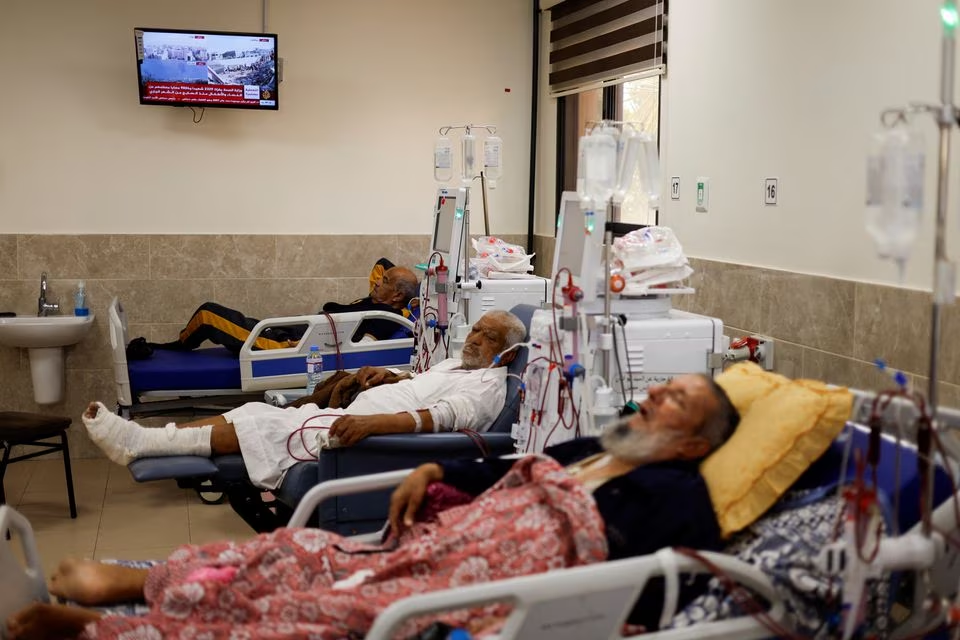
Palestinian kidney patients lie in hospital beds as health officials say they are running out of fuel to operate dialysis machines, amid the ongoing Israeli-Palestinian conflict, at Naser Hospital in Khan Younis in the southern Gaza Strip, October 15, 2023. PHOTO: Reuters
“And now we’re at war, war is destruction and death and torture. We’ve been displaced from our homes and we’re not in our homes anymore. This is so hard.”
Diplomatic efforts are underway to try to open a border crossing into Egyptian-controlled Gaza, with foreign aid donations being delivered to the Egyptian side.
At Khan Younis’ Nasser Hospital in the southern Gaza Strip, where ambulances carrying casualties continue to arrive, patients with chronic illnesses face the prospect of medical devices failing.
“We have 220 (kidney) patients. Half of the machines will be out of order tonight and we won’t be able to do dialysis for everyone,” said Dr. Mohamed Zakout. “This is a human disaster.”
Kidney patient Nahed Al-Khuzundar, who was forced to flee with his family from Gaza City to Khan Younis, said he was supposed to have three dialysis sessions a week, but so far he has had none.
“My legs started swelling, I feel suffocated and I urgently need dialysis,” said Khuzundar. Reuters as he waited outside the kidney ward at Khan Younis Hospital, where dozens of injured have arrived, along with the bodies of the dead.
a href=”https://tribune.com.pk/story/2441397/gaza-hospitals-struggling-to-cope-with-air-strikes-blockade”>Source link



