

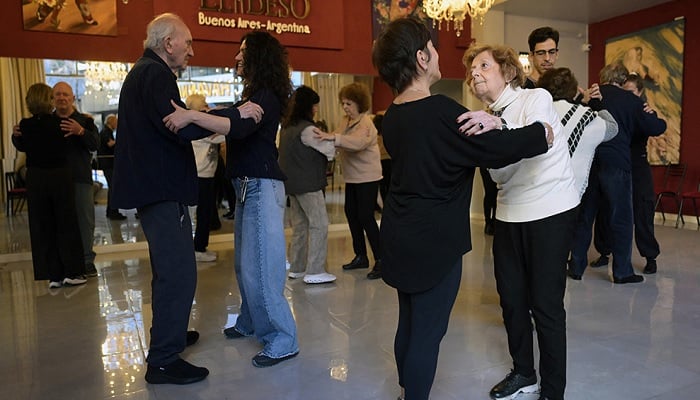
When the tango starts to play, Lidia Beltran is removed from the Parkinson that hurts her, takes her neck and dances, her body and her steps as part of an innovative treatment program in Buenos Aires.
About 200 patients have participated in Tango laboratories offered for the last 15 years at Ramos Mejia Hospital to study the impact of dance on the symptoms of this incurable neurodegenerative disease, the organizers on AFP said.
“One of the main problems of the disease is gait disorder and tango as a walk on foot, works to start and stopping steps and walking strategies,” says neurologist Nelida Garretto.
The results were encouraging. Many patients find ways to relieve symptoms such as engine blocks that freeze their walk, says neurologist Tomoko Arakaki.
“A patient told us that when she freezes, she tries to make ‘Eight’ Figure ‘ – one of the classic tango steps – with her feet, and this allows her to get out of the freeze,” says Arakaki.
Tango’s dance helps to build a “sensor path” that helps with walking, he says.
“We know that Parkinson requires pharmaceutical treatments. Tango is used to restore the motor section, with music, you can get out of complex situations,” he says.
Beltran, 66 and diagnosed with Parkinson two years ago, had never danced the tango. He joined the workshop with the advice of doctors.
“If progress is going to stop, I have to do it. I have to dance for my life,” he says.
In addition to horrors, stiffness, difficulty with balance and speech problems, Parkinson leads to social isolation and depression. The Tango lab can help in these areas.
Beltran reports that dance enhances its stability and mood. “Tomorrow I am sure I will feel better because today I danced Tango,” he says.
Tuesday’s happiness
Patients are dancing with partners who do not suffer from Parkinson and under the guidance of the therapists of dancers such as Manuco Firmani, a Tango professional dancer involved in the rehabilitation of Parkinson from 2011.
Emilia, 86, does not want to give her surname because she is dancing to the wishes of her son, who is worried about a two -hour bus trip to get to the studio at Central Buenos Aires.
“For me this is the happiness of every Tuesday,” says the retired teacher with a weak, bent body and a whispered voice, for which Tango causes memories of her youth.
“Every year we carry out specific evaluations to analyze the benefits of Tango,” says Neurologist Sergio Rodriguez. “We have measured improvements in cognitive skills, motor skills, walking and balance.”
Multiple task
Walking is at the core of Tango, Argentina, experts say. But this is not the only reason why it is an effective method of rehabilitation for Parkinson patients.
Tango also requires dancers to follow rhythms, move in a defined direction and interpret the natural points of their dance.
“There are many at the same time messages to be resolved, which are very positive for this disease,” says Garretto.
At the end of the class, there is applause and “an air of satisfaction” in the room, says the therapist Laura Segade.
“After all, who can take away whatever they dance?”
a href=”https://www.geo.tv/latest/621858-in-argentina-the-tango-keeps-parkinsons-symptoms-at-bay”>Source link



