
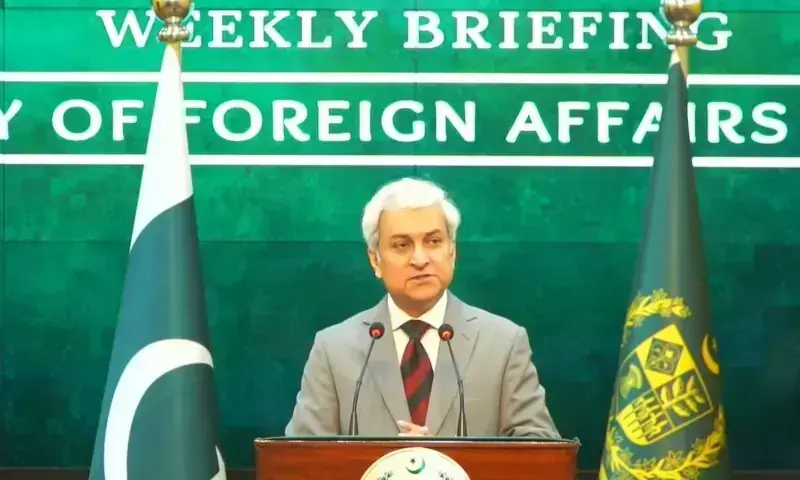
Pakistan remains “hopeful” despite the sharp escalation between the United States and Iran and will “continue to strive for dialogue and diplomacy”, Foreign Office spokesperson Tahir Andrabi said at his weekly press briefing on Wednesday (Dawn).
On Iran
Andrabi pointed to Pakistan’s mediation record — the Islamabad Memorandum of Understanding signed in June, and the April ceasefire that preceded it. Deputy Prime Minister Ishaq Dar pressed the same point on Iranian Foreign Minister Abbas Araghchi at the SCO summit in Bishkek on Monday.
The optimism sits against an unpromising day: Iran struck US bases in Jordan, Bahrain and Iraq on Wednesday after a second wave of American strikes, with Iranian sources reporting 11 dead inside Iran.
On the water treaty
The more concrete development concerned India. Andrabi said the Permanent Court of Arbitration had confirmed that “India’s purported decision to place the treaty in abeyance does not relieve it of its obligations under the treaty.”
He was referring to a ruling issued on 31 August — not a new decision, but the subject of the Foreign Office’s first formal comment on it (Al Jazeera; Express Tribune).
What the tribunal actually found
The decision was unanimous, binding on both parties and not subject to appeal. It held that India’s move to place the treaty in abeyance “is not permissible under the treaty or other applicable rules of international law”, and that the treaty “has not been terminated or its operation suspended and rather remains fully in force.”
It also ordered India not to build the dam wall and power intake structure at the Ratle Hydro-Electric Plant above certain levels until 90 days after a neutral expert rules on whether the works comply with the treaty — a decision due by July 2027.
India has rejected the ruling. That is the fact which limits how far Islamabad’s satisfaction can run.
Why this matters
The 1960 treaty, brokered by the World Bank, governs the rivers on which Pakistan’s agriculture depends. India moved to hold it “in abeyance” — a status the treaty itself does not provide for — and Pakistan has argued throughout that no such exit exists.
This was the first time an international court has ruled on whether that abeyance is legally valid. An arbitral finding does not restore data-sharing or guarantee flows on its own, and a rejected ruling moves no water at all. What it does is remove the legal argument that abeyance suspends obligation, which is the ground on which every subsequent dispute will now be fought.
Prime Minister Shehbaz Sharif told the SCO summit on Monday that water “must never be weaponised”. The Punjab Assembly passed a unanimous resolution on the same subject this week.
No Afghanistan-related questions were addressed at the briefing.
[Image: X/@ForeignOfficePk via Dawn]



