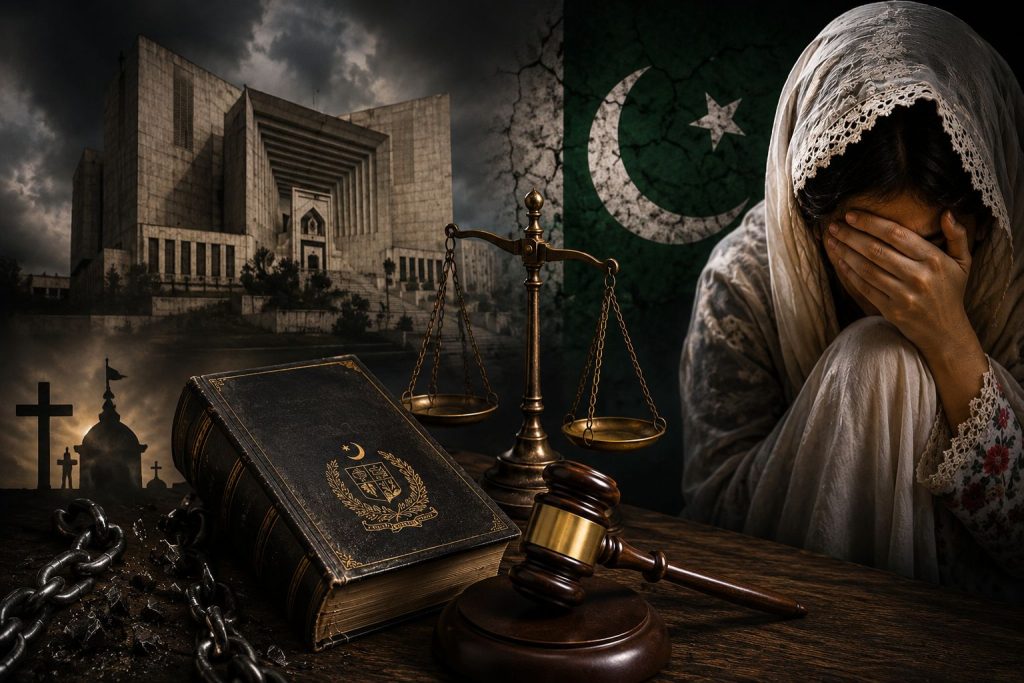
Pakistan is an Islamic republic where the Constitution of Pakistan guarantees every citizen complete religious freedom, human equality, and fundamental rights. At the time of Pakistan’s creation, the founder of the nation, Muhammad Ali Jinnah, clearly stated that every individual in Pakistan would be free to practice their religion and that the state would treat all citizens equally without discrimination. Based on this principle, religious freedom was recognized as a fundamental right in the Constitution. However, over time, the issue of forced religious conversions in Pakistan has emerged as a significant social, legal, and human rights concern. This issue is considered particularly sensitive in relation to religious minorities, underage girls, and women. It has drawn the attention not only of domestic courts but also of international human rights organizations.
In recent years, numerous cases involving the abduction and forced conversion of Hindu and Christian girls have surfaced, particularly in Sindh and Punjab. Legally, Article 20 of the Constitution grants every citizen the freedom to practice their religion, yet in practice, courts often focus merely on establishing whether the conversion took place “with consent,” without thoroughly investigating whether such consent may have been obtained under coercion. Regrettably, Pakistan has no clear legal framework governing conversion from one religion to another, while the concept of severe punishment for leaving Islam continues to exist socially and ideologically, leaving minority communities feeling insecure.
Pakistan’s judiciary has issued contradictory judgments on this matter. The 2006 Neelum Ladhani case remains a historic example in which the then Chief Justice of the Supreme Court, Iftikhar Muhammad Chaudhry, allowed a Hindu girl who claimed to have converted to Islam willingly to live with her husband. However, in an unusual move, the court required the husband’s father to submit a bank bond worth 1.5 million rupees and transfer a share of property in Neelum’s name as security. The court also ordered that the husband’s family facilitate Neelum’s communication with her parents. The Secretary General of the Human Rights Commission described the decision as an acknowledgment of women’s vulnerability. This judgment remains important today because the court prioritized human protection concerns over rigid legal formalities.
In contrast, in the 2012 Rinkle Kumari case, the Supreme Court ignored the question of whether the religious conversion itself was valid and relied solely on an affidavit, thereby setting a dangerous precedent in which statements by underage girls could be accepted without psychological evaluation. In 2014, a Supreme Court bench headed by Chief Justice Tassaduq Hussain Jillani issued a comparatively progressive ruling, stating that religious freedom should be viewed from the perspective of minorities practicing their own faith rather than through the lens of the majority religion. The bench also emphasized the need for an institutional mechanism to prevent forced conversions. Unfortunately, that decision largely remained symbolic and was never meaningfully implemented.
A major recent case was heard in 2026 by Pakistan’s Federal Constitutional Court in the Maria Shahbaz case. The court refused to annul the marriage of a 13-year-old Christian girl to a 30-year-old Muslim man. Declaring Maria to be “mature enough,” the court handed her over to her husband despite her parents presenting official documents proving that she was underage. The court argued that child marriage may be punishable but is not automatically void. All Pakistan Minorities Alliance leader Dr. Paul Jacob Bhatti criticized the ruling, calling it destructive to “fundamental rights, child protection, and human dignity.” Maria’s father, Shahbaz Masih, maintained that his daughter had been abducted, forcibly converted to Islam, and married against her will. Investigations conducted by a sessions court reportedly found the marriage certificate to be fraudulent, while local authorities confirmed that the marriage had never been officially registered. Despite this, the higher court upheld the marriage.
In this ruling, the Federal Constitutional Court established several principles: that a Muslim man marrying a Christian woman is permissible under Islamic teachings and Pakistani law; that underage marriage is punishable but not automatically invalid; and that consent in matters of conversion should be determined primarily through the girl’s sworn statement. Following the verdict, Pakistan’s Federal Information Minister Attaullah Tarar announced the formation of a committee, though Bishop Samson Shukardin expressed skepticism, remarking that “these issues usually cool down before such committees ever present their reports.”
According to the Centre for Social Justice, at least 515 cases involving the abduction and forced conversion of minority girls and women were reported between 2021 and 2025. Among them, 353 victims (69 percent) were Hindu girls, while 160 (31 percent) were Christian girls, with most victims being under 18 years of age. These are only the cases that were officially reported; the actual number may be far higher due to fear, intimidation, and lack of legal assistance.
Legal weaknesses include ambiguities regarding the legal age for conversion, courts relying more heavily on personal statements than documentary evidence, and discriminatory legal practices in interfaith matters.
Pakistan is also a signatory to the United Nations Convention on the Rights of the Child, under which preventing marriage involving individuals under the age of 18 is a state responsibility. However, in the Maria Shahbaz case, the court effectively disregarded this international obligation. In February 2026, the Supreme Court issued another important ruling stating that recording religion or caste details in official records is unlawful and that terms such as “non-Muslim” should not be used. Although this ruling was not directly related to forced conversions, it nevertheless sent a strong message against discrimination following religious conversion.
Religious leaders also reacted strongly. Bishop Samson Shukardin, President of the Pakistan Catholic Bishops’ Conference, stated that “the Church does not support marriages conducted under such circumstances,” while Pastor Shehzad Gul argued that when courts rely on disputed documents and brief statements without considering the realities faced by vulnerable families, they ignore the truth on the ground.
Thus, the issue of forced religious conversion in Pakistan is not merely a legal problem but a profound social and human tragedy. The 2006 Neelum Ladhani case reflected a more protective judicial approach, whereas the 2026 Maria Shahbaz case signaled a decline in judicial sensitivity. Declaring a 13-year-old girl “mature” and allowing her marriage to stand represents a departure from Pakistan’s constitutional guarantees and international commitments.
Until Pakistan introduces clear, impartial laws ensuring safeguards for minors in matters of religious conversion, and until courts stop relying solely on formal affidavits and statements, daughters belonging to minority communities will continue to remain vulnerable. Sindh passed an amendment in 2016 criminalizing forced religious conversion, but effective nationwide implementation remains essential.