
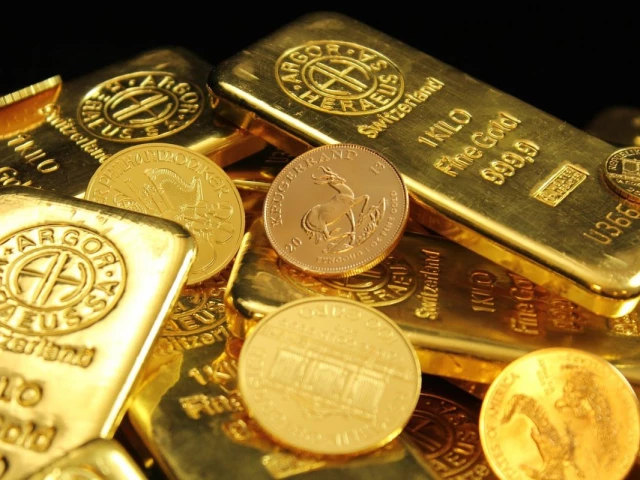
At current prices, the looted gold is worth about $70 million. PHOTO: PIXABAY
KARACHI:
Gold prices in Pakistan rose further on Wednesday, extending their strong upward momentum in line with record gains in the international gold market, as investors continued to flock to the precious metal amid currency weakness, expectations of easier global monetary policy and heightened geopolitical uncertainty.
In the domestic market, gold price per tola rose by Rs 2,000 to hit a new all-time high of Rs 472,862, according to prices released by the Pakistan Sarafa Gems and Jewelers Association (APGJSA). This marked another sharp rise after Tuesday’s burst, when gold jumped by Rs 8,500 to Rs 470,862 per tola.
Similarly, 10 gram gold price rose by Rs 1,714 to Rs 405,402. Market participants noted that bullion prices have been hitting back-to-back record highs in recent sessions, reflecting strong spillovers from global markets as well as continued demand for safe-haven assets at home.
Silver prices also posted gains, with the price per tola rising by Rs 500 to Rs 7,505. Analysts noted that silver has dramatically outperformed gold in percentage returns this year, with prices up more than 140% year-to-date, compared to gold’s gain of more than 70%. As a result, the gold-to-silver ratio, a key metric watched by investors, fell sharply to around 64 from around 105 in April, underscoring silver’s recent outperformance, according to Reuters.
Adnan Agar, Director of Interactive Commodities, said this is the “year of the metals” as all major metals have rallied, with gold emerging as the favorite first among banks and later among individuals due to fear of missing out (FOMO).
Internationally, gold soared to near $4,500 an ounce on Tuesday, while silver traded just below $70 as expectations of looser U.S. monetary policy and simmering geopolitical tensions pushed both metals to record highs. Spot gold touched a record high of $4,497.55 an ounce, while silver climbed to a high of $69.98.
Market analysts say gold’s rally ranks among the strongest advances in the metal’s modern history, with prices scaling record highs amid a potent mix of macroeconomic and geopolitical factors. A weaker US dollar, increased global uncertainty, accommodative monetary policy and continued central bank buying combined to push investors decisively towards traditional stores of value, strengthening gold’s role as a hedging cornerstone.
One of the most influential factors behind the rise was the steady weakening of the US dollar. The U.S. dollar index ( DXY ), which measures the greenback against a basket of major currencies, has fallen to around 98 amid softer economic data and growing expectations that U.S. interest rates will continue to move lower. Because gold is priced in dollars, a softer dollar lowers costs for international buyers, increasing demand and supporting higher prices. This dynamic once again highlighted the historically inverse relationship between gold and the dollar.
Fiscal sustainability concerns further strengthened gold’s appeal. Rising public debt, persistent budget deficits and questions surrounding long-term financial management in major economies have increased investor concern about fiat currencies. In response, capital has turned to hard assets that are seen as offering protection against currency depreciation and systemic risk.
Monetary policy expectations also played a central role. The US Federal Reserve has already made multiple rate cuts and markets widely expect further easing in 2026 as inflation eases and economic growth moderates. Lower interest rates reduce the opportunity cost of holding non-yielding assets such as gold, making gold more attractive relative to bonds and other income-producing instruments. Some analysts believe markets are also pricing in a longer-term shift, with central banks potentially tolerating higher inflation, a scenario that would further boost gold’s long-term investment.
Geopolitical risks have increased the urgency of the gold market throughout the year. Conflicts involving major powers, disruptions in energy supplies, trade and tariff uncertainties, and rising tensions along key shipping lanes have maintained an environment of increased risk. During these periods, investors typically prioritize capital preservation, reinforcing gold’s safe-haven status.
Another critical pillar of price support has been continued demand from central banks. Central banks around the world have added hundreds of tonnes to their gold holdings this year, particularly in emerging markets seeking to diversify away from dollar-denominated assets. Although the pace of purchases has moderated from post-pandemic peaks, it remains historically strong.
Silver mirrors gold’s strength, albeit with greater volatility, benefiting from both safe-haven demand and strong industrial use in renewable energy and technology. While short-term technical indicators suggest that gold markets may be overbought, many investors view any pullbacks as buying opportunities rather than signs of a trend reversal.
Meanwhile, the Pakistan rupee edged higher against the US dollar on Wednesday, closing at 280.20 in the interbank market from 280.21 the previous day.
a href=”https://tribune.com.pk/story/2583836/fomo-fuels-gold-rally”>Source link



