

- The upgrade follows Islamabad’s offer to maintain the IMF review.
- Fitch sees strict economic policies continue to support FX’s recovery.
- Finmin says the move will further strengthen the government’s economic agenda.
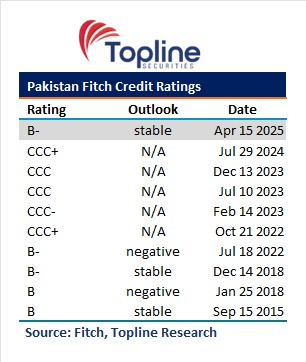
Fitch’s evaluations on Monday upgraded Pakistan’s delay with long-term external currency version in “B- from” CCC+”, reporting improved fiscal integration, stabilizing external account and more powerful macroeconomic management. The prospects are constant.
The Evaluation Service said in a statement Monday that the move was reflected in increasing confidence in Pakistan’s ability to maintain stricter budget controls and implement reforms under the continuing program of the International Monetary Fund (IMF).
The upgrade is coming as Islamabad seems to maintain the momentum after its IMF agreement in March to review a € 7 billion of expansion of expansion funds and a new $ 1.3 billion dollars (RSF).
“We expect that strict economic policies will continue to support the recovery of international stocks and contain external funding needs,” Fitch said, warning that funding requirements remain high and the risks of implementation remain.
Finance Minister Muhammad Aurangzeb welcomed, Geo said. “Upgrading is a strong vote of confidence in our economic reforms and policies.”
Pakistan was previously in Category B in July 2022, according to the Topline Securities Stock Exchange Company.
The finance minister says this move “will further strengthen the government’s economic agenda”.
“After this development, the country is expected to see increased investment, trade, employment opportunities, industrial growth and access to additional financial resources,” he said.
“Progress, global evaluation services, investors and financial institutions will have more confidence in Pakistan,” he concluded.
Pakistan’s fiscal prospects have improved, with the budget deficit projected to limit 6% of GDP FY25 from almost 7% last year, led by cuts of expenditure and provincial surpluses. The main surplus is expected to exceed 2% of GDP.
Fitch noted that public debt levels decreased to 67% of GDP FY24 from 75% last year, with a gradual downward trend expected to continue. However, the cost of interest remains burdensome, with a prediction of interest ratio to a 59% intensity of FY25, well above B with 13% medium.
Inflation is expected to facilitate 5% FY25, below 20% in the previous two years, before the FY26 returns to 8%. Pakistan’s state bank (SBP) has maintained its policy unchanged at 12% after aggressive monetary relaxation in 2024 is expected to recover at 3% FY25.
The country’s external position has stabilized, with a surplus of a $ 700 million balance recorded during the first eight months of FY25, reinforced by the increase in remittances and the hypotonic import prices. Gross exchange of foreign exchange reserves reached nearly $ 18 billion in March, from a low height of under $ 8 billion in early 2023.
Further, Pakistan faces the external debts of debt of about $ 9 billion in FY26, after over $ 8 billion this year. The government expects to secure additional funding of $ 10 billion in the second half of FY25, mainly through polymer and commercial channels.
On the political front, Prime Minister Shehbaz Sharif holds a parliamentary majority, but lacks a strong public order. Persistent political tensions, institutional fragility and security concerns in areas bordering Afghanistan remain risks, the organization said.
Fitch’s domination model gave Pakistan equivalent to “CCC+”, but the evaluation committee implemented an upgrade of a cap to reflect improvements in macroeconomic management and inflation control.
a href=”https://www.geo.tv/latest/600139-fitch-upgrades-pakistans-credit-rating-to-b-on-improved-fiscal-external-metrics”>Source link



