
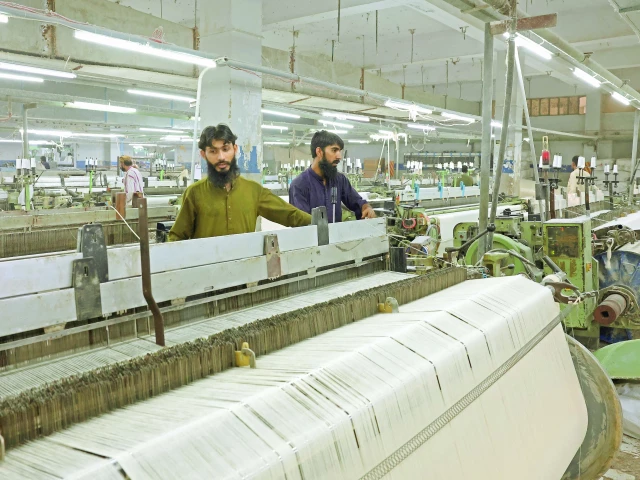
Workers inspect loom machines weaving fabric at a textile manufacturer in Karachi. Photo: REUTERS
KARACHI:
Pakistan’s textile sector entered 2026 at a defining juncture, with its long-standing export model facing increasing pressure from tighter global regulations, intensifying competition and domestic cost constraints. After a modest recovery in 2025 that boosted textile exports to an estimated $17.85 billion, industry leaders are now warning that the industry’s preferential access to European markets under the GSP Plus regime is increasingly at risk.
These concerns dominated discussions at the Global Procurement and Supply Chain Summit (GPS 2026), held in Karachi, where policymakers, procurement leaders and textile executives assessed the evolving global trade environment. Addressing the summit as chief guest, Shahbaz H Syed, Chairman and CEO of EXIM Bank of Pakistan, described the current environment as a “perfect storm”, driven by rising energy costs, aggressive sustainability regulations and redirected global supply flows.
At the heart of the challenge is the European Union’s Green Deal, which is reshaping procurement patterns worldwide. Regulations such as the Ecodesign for Sustainable Products Regulation (ESPR) and the Carbon Border Adjustment Mechanism (CBAM) are fundamentally changing the way buyers evaluate suppliers. According to GPS Advisory Board member Imran Mushtaq, procurement is undergoing a structural change.
“Procurement is no longer just about price; it’s about provenance,” Mushtaq said. He noted that EU regulations now require detailed traceability throughout the supply chain, standards that most Pakistani mills currently lack at a granular level. Without reliable systems to demonstrate environmental compliance and product provenance, exporters risk being shut out by key European buyers, regardless of price competitiveness.
The energy economy further complicates the picture. Pakistan’s increased grid tariffs have significantly eroded margins, forcing manufacturers to rethink their operating models. Industry participants emphasized that on-site renewable energy solutions such as solar and biomass are increasingly being viewed not only as sustainability measures but also as strategic tools to manage cost volatility. Similarly, the use of recycled fibers and certified cotton has shifted from a niche preference to a basic requirement for access to EU markets.
The growing influx of Chinese textile shipments is adding to the regulatory pressure. As the United States tightens trade restrictions on China, excess Chinese inventory is being redirected to European Union and Middle Eastern markets at deeply discounted prices. This has intensified competition, particularly in commodity product categories.
Syed warned that Pakistani exporters cannot compete on price alone with such volumes. Instead, it urged a strategic shift toward high-compliance, value-added segments. Vertically integrated mills, those that control the entire value chain from spinning to sewing, maintain an advantage through shorter lead times, higher transparency and better alignment with buyer compliance requirements. Most importantly, strict adherence to EU rules of origin allows Pakistani exporters to legally benefit from duty-free access to GSP Plus, an option not available for diverted Chinese products.
Technology adoption emerged as a recurring theme at the summit, particularly the role of artificial intelligence and digital traceability in procurement. Altaf Gul Muhammad, Chief Supply Chain and Operations Officer, Yunus Textile Mills, emphasized the need for stronger coordination between industry, regulators and technology providers.
He emphasized that evolving procurement practices require practical alignment rather than fragmented initiatives. As part of this transition, Muhammad highlighted Digital Product Passports (DPPs) as a critical next step. “Mills need to adopt blockchain-based or centralized ERP systems that can track a garment’s journey from seed to shelf,” he said, adding that such systems are fast becoming essential for credibility with international buyers.
Early adopters of Pakistan’s textile mills are already reporting tangible benefits. AI-powered demand forecasting has helped leading factories reduce excess inventory by 15-20%, while automated supplier selection and predictive pricing have shortened procurement cycles by up to two weeks. In energy-intensive operations such as spinning, AI-enabled monitoring has yielded 5-8% efficiency gains by optimizing motor loads and humidity controls.
Despite these operational improvements, the major medium-term risk remains CBAM. Although it currently applies to carbon-intensive sectors such as cement and steel, EU policymakers have signaled plans to extend CBAM to textiles by 2027. Once implemented, CBAM will effectively impose carbon costs at EU borders, penalizing exporters from countries with carbon-intensive production or low emissions accounting.
For Pakistan, this could prove decisive. Industry estimates suggest that CBAM-related levies could offset the 10-12% price advantage provided by GSP Plus, effectively neutralizing the benefit of preferential access.
a href=”https://tribune.com.pk/story/2587220/eu-green-rules-threaten-exports”>Source link



