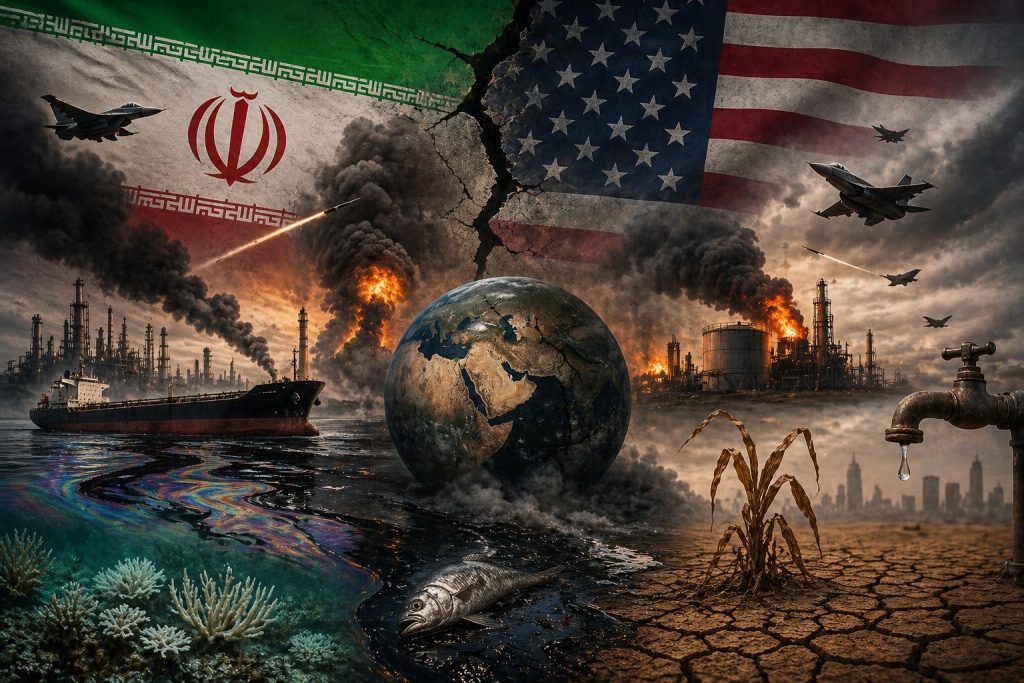
The Iran–U.S. war that began in February 2026 has written a new chapter of destruction in the Middle East. This conflict has not only caused loss of human life and economic instability, but has also left deep and long-lasting effects on the environment. It has severely impacted water resources, air quality, oil pollution, agriculture, and climate change.
One of the most overlooked aspects of this war is the destruction of water resources. Gulf countries, including Bahrain, Kuwait, Qatar, Saudi Arabia, and the United Arab Emirates, are among the nations facing severe freshwater shortages. These countries rely heavily on desalination plants for their daily water needs. During military operations, several of these plants were targeted, putting access to water for millions of people at risk.
The Gulf states operate nearly 40 percent of the world’s desalination plants, collectively producing 7.2 billion cubic meters (1.9 trillion gallons) of freshwater annually. Qatar is the most dependent on desalination, with 61 percent reliance, followed by Bahrain at 59 percent.
Iran itself is also suffering from severe water stress. According to the World Resources Institute, Iran ranks as the 14th most water-stressed country in the world, with 26 out of its 31 provinces facing extreme water shortages. Qeshm Island, Iran’s largest island, which depended heavily on desalination plants, has become almost completely without water due to bombardment, leaving nearly 30 villages without water supplies. Experts have warned that millions of people could be forced to migrate because of this crisis.
Bombing of oil facilities during the war released massive amounts of toxic substances into the atmosphere. When Israeli forces attacked multiple oil storage facilities in Tehran, huge explosions sent thick black smoke into the air, which soon returned to the ground in the form of black rain.
This black rain contained sulfur, nitrogen oxides, and cancer-causing chemical compounds. Residents of Tehran reported symptoms such as headaches, dizziness, coughing, and eye irritation. The pollution was not confined to Iran alone; it spread into neighboring countries, affecting millions of people.
Environmental organizations report that toxic emissions from oil fires contain polycyclic aromatic hydrocarbons and heavy metals, which can cause cancer and respiratory diseases over the long term.
The Persian Gulf, known for its fragile coral reefs, mangrove forests, and marine life, suffered major oil spills during the conflict. Satellite imagery revealed vast stretches of oil contamination in the Gulf that were visible even from space.
Environmental organizations such as Greenpeace warned that these oil spills could drive nearly 700 species of fish in the Persian Gulf toward extinction, while the world’s second-largest population of dugongs (sea cows) faces severe danger. During the Iran–Iraq War from 1980 to 1988, oil pollution nearly wiped out the hawksbill sea turtle, and experts fear the current conflict could prove even more devastating.
Modern agriculture depends heavily on chemical fertilizers, much of which are produced in the Middle East. Saudi Arabia is the world’s second-largest exporter of ammonia, while sulfur—essential for phosphate fertilizers—also largely comes from this region. More than 70 percent of these fertilizers pass through the Strait of Hormuz, which has been blocked because of the war.
As a result, fertilizer prices in Africa and Asia have risen by 80 to 120 percent. According to Matt Simpson, CEO of Brazil Potash, “Geopolitical tensions are driving fertilizer prices higher, forcing farmers to shift toward lower-yield crops.”
The increase in food prices has severely affected Asian countries. Rice and palm oil production in Indonesia, Malaysia, and Thailand are under threat, while experts predict food inflation could rise to between 8 and 12 percent by mid-year.
Another major environmental consequence of the war has been the extraordinary increase in carbon emissions. In just 40 days of conflict, 5 million tons of carbon dioxide were released—more than Iceland’s total emissions in 2024. In the first six days alone, U.S. military operations reportedly emitted 20 billion tons of greenhouse gases, while the world’s total annual emissions under normal conditions are less than 500 billion tons.
Experts estimate that the world’s armed forces collectively account for 5.5 percent of global greenhouse gas emissions. If considered as a single country, the global military sector would rank as the world’s fourth-largest carbon emitter.
In addition, oil pollution in the Persian Gulf has severely damaged mangrove forests and seagrass ecosystems, reducing their ability to absorb carbon and weakening natural carbon sinks. Months-long naval blockades in the Strait of Hormuz also worsened pollution due to heavy tanker emissions.
One of the most alarming aspects of the war has been attacks on nuclear facilities. U.S. efforts to dismantle Iran’s nuclear program led to direct strikes on these sites. Although no large-scale radiation leaks have been reported so far, experts at the University of Oxford warned that any damage to nuclear facilities could produce environmental consequences lasting decades.
During the 1991 Gulf War, U.S. forces used 300 tons of depleted uranium, which later contributed to alarming increases in birth defects and cancer rates among Iraqi children.
The war has now continued for more than 40 days, and contrary to the expectations of the U.S.–Israel alliance, Iran continues retaliatory strikes with 60 to 70 percent operational capability. Experts warn that the longer the war continues, the greater and more irreversible the environmental damage will become.
Analysts at the Vienna Institute of International Studies have warned that a fundamental flaw in U.S. strategy is the assumption that military power can automatically produce political outcomes, whereas Iran, as a revolutionary state, interprets pressure as structural hostility.
The Iran–U.S. war has demonstrated that the consequences of warfare are not limited to human casualties and economic destruction alone. This conflict has caused severe damage to the fragile ecosystem of the Persian Gulf, and recovery may take decades.
From black rain to toxic gas emissions, from oil spills to water shortages, and from agricultural crises to climate change, this war poses a grave threat to future generations, proving that war destroys not only humanity but the planet itself.
As Greenpeace stated in its report, “Adopting renewable energy is essential not only for combating climate change but also for global security, because no one can blockade the sun and wind in the Strait of Hormuz.”