
The caretaker prime minister said from the ECP that their role is limited to day-to-day matters necessary to manage government affairs
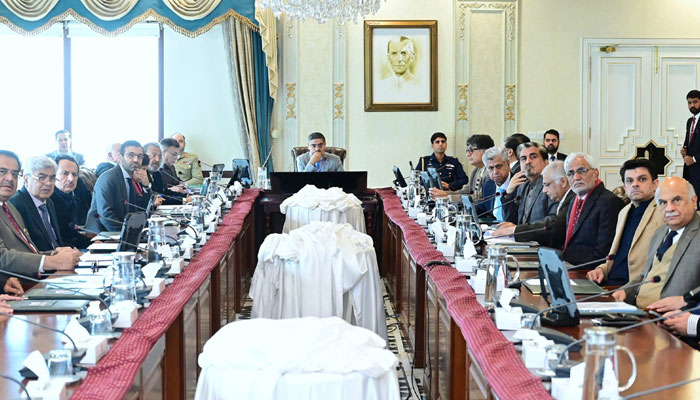
- The ECP directive comes after the cabinet approved the FBR restructuring plan.
- The legislation is to be made by the next elected government: official.
- The plan seeks to increase FBR’s tax to GDP ratio to 18% in 5 years.
The caretaker federal government has been barred from carrying out structural reforms in the Federal Board of Revenue (FBR) and has been instructed to leave the matter to the elected leaders, The news reported on Wednesday.
The Election Commission of Pakistan (ECP) on Tuesday reminded caretaker Prime Minister Anwaar-ul-Haq Kakar that their role was limited to dealing with day-to-day matters necessary to run the government, stressing that they should refrain from making major political decisions .
The ECP’s directive comes hours after the federal cabinet approved the restructuring and digitization of the FBR amid reservations from its senior officials and fears of conflict of interest.
Chaired by Chief Minister Kakar, the Cabinet approved the restructuring and digitization of FBR in a summary forwarded by the Revenue Directorate.
When this reporter asked a senior government official if there was a possibility of issuing a decree to implement the restructuring plan on an immediate basis and leave the issue of legislation to the incoming government, he replied: “No. I think the legislation will be done by the next elected government. However, it will depend on the official minutes issued by the cabinet for today’s meeting.”
The cabinet approved in principle to advance the reform plan to the next government.
There is no doubt that the FBR is in dire need of reform, but it was not understood why the caretaker finance minister is pursuing it in such a hurry.
Almost all of December was wasted in this futile exercise. The Department of Revenue secretary/FBR chairman finalized the summary and forwarded it to the Finance Minister in the early hours of Tuesday after receiving the official minutes of the last cabinet meeting.
The caretaker prime minister also made all efforts to convince the cabinet members as well as other stakeholders about the reform plan but remained unable to develop a consensus.
Ultimately, the summary was approved in principle, but for all practical purposes, the cabinet accepted the third point of the official minutes of the last cabinet meeting, suggesting that its implementation and legislation be left to the next government.
Following the ECP’s directive, the Finance Ministry kept mum and preferred not to issue any official statement till the filing of this report in the evening.
The letter, available with The news, written by ECP Secretary Dr Syed Asif Hussain to the Prime Minister’s acting secretary Captain (retd) Muhammad Khurram Agha.
The letter referred to constitutional provisions and relevant laws, including the 2017 Elections Act.
“Subsequent to this officer’s letter of the same title dated January 27, 2024, I would like to draw your attention to the editorial at Annexure-A and the news items at Annexure-B appearing in the daily Dawn and daily The news, respectively. These reports suggest that the federal government is taking a major decision to revamp the FBR through an ordinance, along with other concerns,” the letter said.
He continues, “Improving and reforming government institutions are undoubtedly key responsibilities of government to improve overall performance. However, in accordance with the constitutional scheme and legislative intent as expressed in Section 230 of the Elections Act, 2017, the functions of the caretaker government are defined. Special attention is drawn to Sections 230 (1) (a) and (c) and 230 (2) (a) and (b) of the act reproduced below.
“Article 230: Functions of Service Government. — (1) A caretaker Government – (a) performs its duties to attend to day-to-day matters necessary for the administration of the affairs of the Government.
“(c) is limited to routine activities, non-controversial, urgent, in the public interest and reversible by the future government elected after the election; and
“(2) The caretaker government shall not—(a) make major policy decisions except on urgent matters; (b) take any decision or policy which may affect or prevent the exercise of power by the future elected government’.
The letter concludes that the proposed reform of the FBR falls under the above statutory provisions and is a major policy decision, which is the prerogative of the elected government.
The ECP, responsible for conducting elections under Article 218(3) of the Constitution, is required to outline the role and actions that the caretaker government should refrain from under Article 230 of the aforementioned act.
“In view of the above, I am directed to convey that the Honorable Caretaker Prime Minister of Pakistan may be advised not to pursue major reforms in the FBR and keep it pending for consideration by the newly elected government after the 2024 general elections.” , the ECP secretary says in the letter.
Salient features of FBR reforms
Caretaker Finance Minister Dr Shamshad Akhtar on Tuesday evening shared the salient features of the plan under which the FBR’s tax-to-GDP ratio will rise to 18% in five years to FY2029.
In her televised speech on Tuesday night, Shamshad did not mention anything related to the ECP’s letter.
He said the federal cabinet, on January 30, approved the plan to restructure and digitize the FBR in the preparation stage and under discussion from September 2023.
The plan, an indigenous product, is the result of significant consultations between the finance minister, the FBR chairman and members along with highly qualified independent tax experts.
The plan is based on substantial research and recommendations of the long-term multilateral engagement and technical assistance studies funded by the FBR over the years.
The caretaker government recognizes the macroeconomic challenges and has prioritized critical reforms, particularly the urgent need to mobilize domestic resources.
The tax to GDP ratio in decline
Pakistan’s tax-to-GDP ratio is declining, with the FBR tax-to-GDP ratio of just 8.5% in 2022/23, while the country’s fiscal capacity has largely remained around 22% of GDP, including taxes under the jurisdiction of provinces yielding just 1% of GDP Revenue.
The number of taxpayers in Pakistan is just 2.3 million. Corporate taxpayers make up 0.8% of commercial and industrial electricity users and GST-registered entities just 13% of the 1.4 million taxpayers.
The FBR’s ability to utilize tax resources under its jurisdiction has been constrained by complex and opaque tax administration, top-heavy management lacking authority and accountability, an overly large staff pool, and conflict of interest between the policy and collection functions below. from the same roof.
High level of policy gaps exist due to high revenue sources earmarked for provinces and large undocumented sector have served as an obstacle. At the same time, the tax compliance gap is much larger due to the failure to introduce tax net than what is feasible to achieve such as wholesalers and service providers etc.
The overwhelming undocumented sector, absence of data and lack of digital integration, tax evasion and avoidance due to loopholes in the legal and administrative system and integrity issues are some of the critical gaps in tax administration.
a href=”https://www.geo.tv/latest/529231-ecp-bars-caretakers-from-fbr-overhaul-over-limited-mandate”>Source link



