
SBP Annual Report Urges Urgent Focus on Human Capital, Technology, Innovation to Promote Sustainable Development
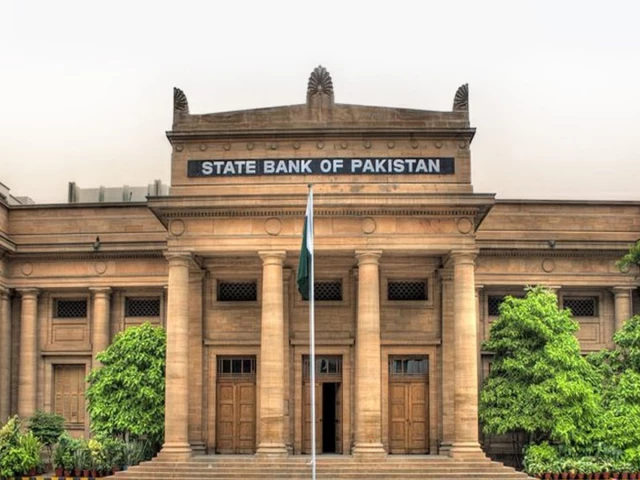
State Bank of Pakistan. Photo: Archive
Persistent fiscal imbalances, low domestic savings, weak productivity and climate-related crises remain critical obstacles to sustainable progress, the State Bank of Pakistan noted in its Annual Report on the State of the Economy 2024-2025.
The State Bank of Pakistan (SBP) forecasts GDP growth in FY26 at 3.25-4.25%, near the lower end of its forecast range, while inflation is expected to hover around 5-7%. The current account deficit is forecast at 0-1% of GDP, indicating stability in the external sector. But the central bank warned that agricultural losses caused by flooding, high energy costs and global trade uncertainty could derail those gains.
Recent floods in Punjab and Khyber-Pakhtunkhwa submerged vast agricultural lands, destroying key kharif crops such as rice, cotton, maize and sugarcane.
The SBP warns that the resulting supply chain disruptions may cause inflationary pressures and weaken the availability of raw materials for agro-industries. Increased spending on reconstruction, while supporting growth, could also strain fiscal space already constrained by large debt repayments.
The central bank’s analysis identifies low domestic savings as one of Pakistan’s most persistent economic weaknesses. Over the past two decades, gross domestic savings have fallen to one of the lowest levels among comparable economies.
“Low per capita income, high inflation, fiscal imbalances and weak financial intermediation have collectively suppressed the savings rate,” the SBP notes in the report.
The high dependence on consumption, which constitutes about 92% of GDP, left little room for productive investment. This consumption-driven model, sustained through foreign borrowing and remittances, has produced short-term bursts of growth but failed to lay the foundations for long-term expansion.
As the report observes, “Pakistan’s economy remains predominantly consumption-driven, with potential GDP growth steadily declining over the past two decades.”
The savings-investment gap, combined with chronic budget deficits, perpetuates a “debt spiral” where income barely covers current spending. Interest payments alone consistently exceed development spending, squeezing funds for health, education and infrastructure.
Public sector inefficiencies, especially in SOEs, continue to weigh on the national coffers, draining scarce fiscal resources that could otherwise fuel productive investment.
The report highlights weaknesses in Pakistan’s financial intermediation system. The banking sector, constrained by heavy government borrowing and low deposit mobilization, is struggling to channel savings into private investment.
Capital markets remain shallow, with limited concerns about investor engagement and governance. Despite de-meritisation, the Pakistan Stock Exchange is still dominated by a few large brokerage firms, eroding investor confidence.
Furthermore, a large segment of the population remains excluded from the formal financial system. Informal savings through gold, real estate, livestock and rotating savings committees (ROSCA) replace institutional mechanisms such as insurance or pension funds.
Religious concerns about interest-based banking and low financial literacy further discourage formal savings, with 35% of respondents to SBP’s 2025 survey preferring informal channels.
As a result, Pakistan’s financial depth, as measured by private sector credit and deposit-to-GDP ratios, lags far behind regional peers such as Malaysia, Turkey, and even Bangladesh.
The SBP warns that without greater financial inclusion and capital market development, domestic savings will remain insufficient to sustain economic growth.
Pakistan’s structural vulnerabilities extend beyond the fiscal and financial sector. The report highlights the need to diversify industrial capacity, particularly through investment in petrochemicals, mining and renewable energy.
The country’s prolonged dependence on imported industrial inputs and fossil fuels has exposed it to external shocks, currency volatility and persistent balance of payments pressures.
In agriculture, productivity is hampered by antiquated irrigation systems and climatic disasters. Effective water management, small and medium-sized dams, and climate-resilient crop varieties are critical to mitigating future food insecurity and flood risks.
Trade competitiveness also remains constrained by non-tariff barriers, limited product diversification and over-reliance on low-value textile exports. While recent reforms to reduce anti-export bias are a step forward, the SBP urges policymakers to expand these efforts to include regulatory and logistical reforms that attract foreign investment and integrate local industries into global value chains.
The report links Pakistan’s economic stagnation to deeper social and demographic challenges. With nearly 65% of the population under the age of 30, high reliance on youth and limited job creation are putting enormous pressure on consumption and public spending. Persistent poverty, estimated at around 44%, combined with underinvestment in education and health, reduces productivity and savings capacity.
The SBP argues that human capital development should be made a national priority. Without investment in vocational training, technology and innovation, Pakistan risks falling further behind regional competitors that have successfully transitioned to knowledge-based economies.
a href=”https://tribune.com.pk/story/2572776/debt-low-productivity-climate-risks-weigh-economy”>Source link



