
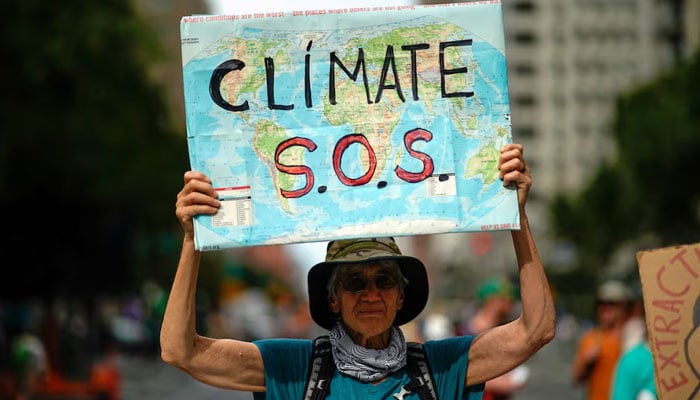
- Wealthy nations are expected to commit to funding goals of more than $100 billion.
- Negotiators have barely agreed on a dollar amount of aid.
- Talks reach an impasse owho should pay, receive the money.
PARIS: Countries hosting this year’s United Nations Climate Summit of the Conference of the Parties (COP29) have called on countries to start compromising to break the deadlock over how to help poorer countries deal with global warming .
The climate summit, to be held in Azerbaijan in November, was supposed to lead to a global agreement on how rich nations should help finance climate investment in developing countries, but negotiations have stalled.
A crucial diplomatic meeting in Bonn last month ended in a bitter stalemate with countries unable to move forward on an issue that has eroded trust between nations at climate talks for years.
Developing nations need huge investments in energy systems to reduce their own carbon footprints while also strengthening defenses against the effects of global warming.
However, poorer nations are the least responsible for carbon emissions, but suffer the most from a warming planet.
In a letter to the roughly 200 nations that have signed UN climate agreements, COP29 president Mukhtar Babayev lamented the lack of “necessary progress” and warned that time is running out.
“We clearly need a rapid increase in the pace of our work. Lost time is lost lives, livelihoods and the planet,” wrote Babayev, a government minister and former executive of Azerbaijan’s national oil company.
“We call on all parties to increase the pace of their work and move forward from their early negotiating positions,” he added.
Complex, challenging issue
Rich nations have come under pressure to commit to new funding targets that far exceed the $100 billion a year pledged in 2009.
Developing countries excluding China will need to increase their current climate investment budgets 25-fold to about $2.4 trillion a year by 2030, according to an expert assessment commissioned by the UN, nearly 25 times current levels.
Negotiators have barely agreed on a dollar amount of aid, with negotiations bogged down over who should pay, what form the money should take and who should receive it.
Under a 1992 climate agreement, only a small handful of the richest industrialized nations at the time were required to pay climate finance.
However, some want the pool of participants to be widened, notably to include China, which is much wealthier today than it was thirty years ago and the largest emitter of greenhouse gases.
This was a non-starter for developing countries, who accused rich countries of trying to shirk their responsibilities.
To break the ice, Azerbaijan will host negotiators for an informal two-day retreat starting July 26. They have appointed two experienced diplomats — Dan Jorgensen of Denmark and Yasmine Fouad of Egypt — to help the parties make progress.
Babayev said the impasse “will not be resolved by negotiators alone” and called the political leadership to the sidelines to help move talks toward consensus.
a href=”https://www.geo.tv/latest/554637-cop29-host-tells-rich-nations-to-break-climate-stalemate”>Source link



