
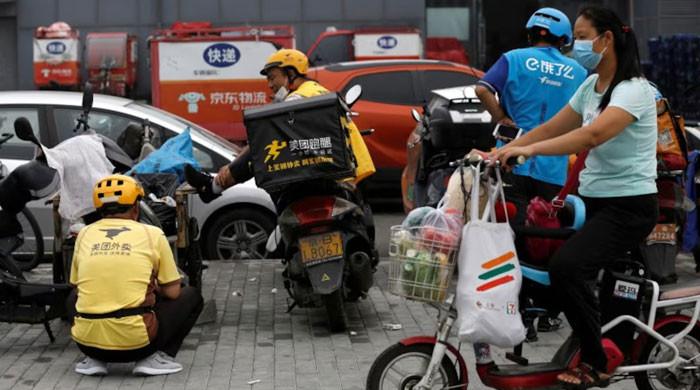
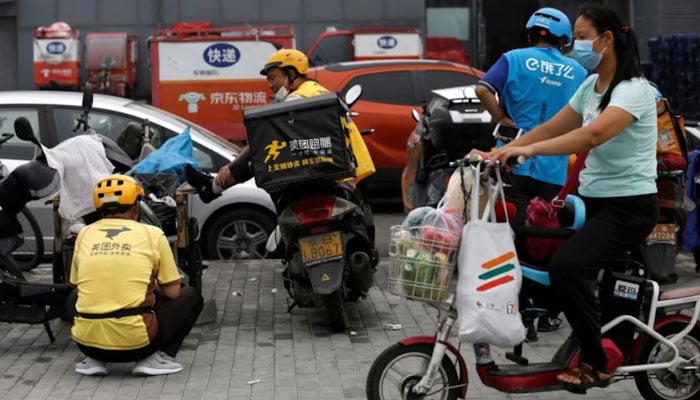
Shanghai: China’s largest online shopping companies, Alibaba and JD.com, are now struggling to deliver orders faster than ever.
This year, both have begun to offer immediate retail services, with the aim of taking goods to customers in just 30 to 60 minutes. They spend great and move quickly to win this new battle for speed.
Investors will analyze the strategy when JD.com reports its quarterly profits on Tuesday and Alibaba on Thursday, as finding new growth avenues has proven to be difficult for China’s largest retailers.
Their market penetration is already high and prices for goods are under pressure due to consumer deceleration led by worries about employment and salaries, as well as prolonged real estate market decline.
The new warfare of speed focuses on speed comes at high costs in the short term, as e -commerce giants seem to attract consumers with great discounts.
JD.com’s JD.com app and Alibaba’s food application last month pledged 10 billion yuan ($ 1.38 billion) in subsidies. JD Takeaway said he would invest the amount for one year, while Ele.me did not reveal the time frame.
“The competition is so intense, there are not many growth growth opportunities, so everyone moves to territories of all others and the immediate retail is the last example of this,” said Jason Yu, general manager of CTR Research Market Research.
China’s food market leader has moved to develop its activities, expanding its platform, which provides non -food goods within 30 minutes, and JD.com announced its entry into food delivery in February.
“In the past people would go to JD.com to buy a mobile phone and hand over the same day. Then they could suddenly go to Meituan and have the new Apple iPhone to deliver within 30 minutes.
At the end of April, Alibaba expanded the portal of immediate markets to the domestic implementation of Taobao e -commerce. This gave users access to restaurants, cafes and bubble tea chains available at Alibaba’s Ele.Me-the second largest food player in China behind Meituan-as many other categories, including food and clothing.
Alibaba, JD.com and Meituan did not respond to requests for comments.
Subsidized expenses for immediate retail sale by Alibaba and JD.com are called by consumers who have realized the cost.
Users at JD Takeaway are currently enjoying up to 20 yuan discounts, or $ 2.77, per day for restaurant deliveries such as McDonald’s, Haidilao and Burger King. At Taobao’s direct market gate, consumers can receive 11 yuan discounts on a bill at least 15 yuan.
Liu Qi, 24, a small business owner in Tianjin, said he was happy when he recently bought a coconut Latte at JD Takeaway for only 5.9 yuan.
“I asked the tradition and said he was doing 4 yuan per tradition. So JD.com bought me a cup of coffee and gave it to my door,” Liu said.
It was even more surprised days later, when he bought a coffee at the Taobao direct market gate for only 3.9 yuan. “It was 2 yuan cheaper than JD.com!” He said.
Warriors
While the subsidy for consumer discounts for immediate retail is expensive, China’s e -commerce giants have significant cash reserves. On December 31, Alibaba, JD.com and Meituan had net cash positions of 400 billion, 144 billion and 110 billion yuan respectively, according to Morningstar analysts.
And despite the low margins in the business inherent, a renewed focus on direct retailing made sense for JD.com and Alibaba in part because both operations have a carrier of carrier already available, analysts said.
This means that there is no need for a precise building infrastructure building, as it would require for other potential participants such as the TMU-owner PDD Holdings.
Industry of the Pedic-based industry, Liu Xingliang, said Alibaba and JD.com used the demand for high frequency for food, coffee and bubble to enhance the demand for lower frequency for clothes, electronic and other markets with higher margins.
For JD.com, the expansion to immediate retail was particularly important given the traditional e -commerce business that appears to have hit a ceiling, he said.
“Must try to gain market share in new business sectors.”
a href=”https://www.geo.tv/latest/604264-chinas-e-commerce-giants-enter-new-race-for-ultra-fast-delivery”>Source link



