
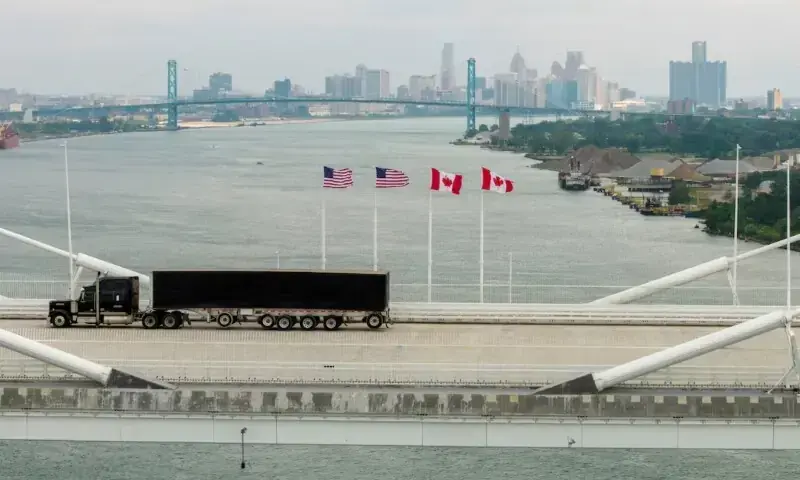
Canadian retaliatory tariffs on $20 billion of US goods took effect just after midnight on Tuesday (Dawn).
The measures
Duties of 15 to 50 percent on steel, furniture, clothing and electronics.
They mirror US tariffs imposed last month on Canadian wine, furniture, dairy, cement, clothing, fishing rods and hockey equipment — also covering about $20bn, or roughly 5pc of Canadian exports to the United States.
No talks
Negotiations collapsed last month. A government source said “there are currently no talks between the two sides among ministers or government officials.”
The quote that frames it
“What we are worried about is an escalatory spiral,” said Michael Harvey, executive director of the Canadian Agri-Food Trade Alliance. “The prime minister needs to find areas of leverage.”
That is the difficulty in one line. Matching $20bn with $20bn is symmetric in dollars and asymmetric in consequence: the US takes roughly three-quarters of Canadian exports, while Canada is a much smaller share of American trade. Proportionate retaliation between unequal partners costs the smaller one more.
The larger stake
The dispute is 18 months old, and the US-Mexico-Canada agreement itself is now uncertain after President Donald Trump declined to extend it for another decade. Prime Minister Mark Carney is managing a trade relationship whose governing framework may not survive.
Why it matters here
Pakistan is not a party, but the precedent is the point. A rules-based agreement between three signatories has been suspended by one of them without penalty. For a country whose own trade access rests on a preference scheme reviewable at the grantor’s discretion — as we reported yesterday of GSP+ — that is the relevant lesson.
[Image: Reuters/File via Dawn]



