
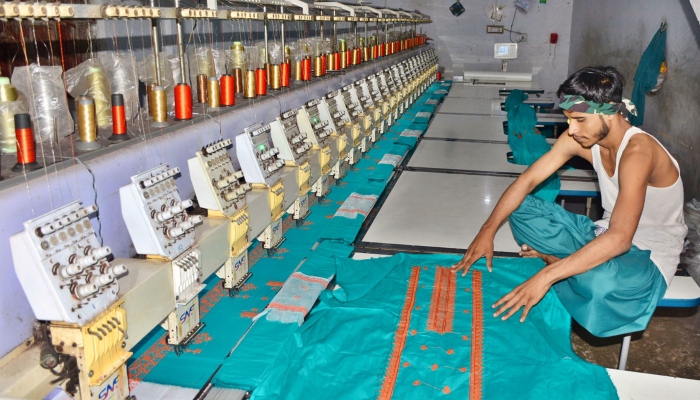
ISLAMABAD: Bangladesh, which has grown its exports to $47 billion a year, is in massive political and economic turmoil.
Many MNCs are in the process of shifting sourcing operations from Bangladesh to mitigate risks.
This provides a unique opportunity for Pakistan to step in as an alternative sourcing hub, given its established textile industry and strategic location. Moreover, increasing exports is crucial for Pakistan to address its foreign exchange shortage, which is expected to exceed $25 billion annually for the next five years.
Pakistan has a long history of textile and apparel production, with well-developed infrastructure, a skilled workforce and a reputation for high quality and environmental sustainability.
The facts are that Pakistan has access to large markets in Europe, North America and the Middle East and can enhance its attractiveness as a potential alternative to Bangladesh. In FY22, Pakistan’s textile exports reached nearly $20 billion, signaling strong potential in the sector.
However, by FY24, exports plummeted to $16.7 billion due to prohibitive increases in energy prices, withdrawal of zero rating and overall economic deterioration. The withdrawal of zero rating (SRO 1125) was a major blow to the industry as it drained all liquidity from the market, leaving manufacturers struggling to stay afloat.
Now, with global supply changes, Pakistan has a renewed opportunity to boost exports of value-added garments. However, realizing this potential requires immediate and targeted reforms.
If the country’s decision makers ensure regionally competitive energy tariffs of 9 cents per unit supply of electricity and 9 dollars per MMBTU supply of natural gas, Pakistan’s textile industry will regain its viability, compete effectively on the global stage and arrest the exodus of sourcing garments from Bangladesh but several reforms are necessary. There are reports that the task force on electricity sector is vigorously working out a strategy under which the industrial tariff will be brought down to a reasonable level, besides reducing the electricity tariff for other categories of consumers.
In addition, the tax regime for the domestic supply chain needs to be aligned with that of the import supply chain to create a level playing field. And, most importantly, zero rating (SRO 1125) must be restored for the entire textile value chain. And interest rates should fall to single digits to ease the liquidity crunch and encourage higher output and investment. However, some economists say that there are chances that at the end of the current calendar year, the interest rate will be reduced to 12-13%. And finally, the top government posts must increase their focus on hiking cotton production to at least 15 million bales per year on a sustainable basis.
Pakistan’s textile industry faces a number of significant challenges that hinder its ability to capitalize on the changing global apparel sourcing dynamics. A major obstacle is the prohibitive cost of energy. Industrial power tariffs in Pakistan are over 15 cents/kWh, which is almost double the 8.3 cents/kWh in Bangladesh. Furthermore, while the Bangladeshi industry benefits from cheap natural gas at $7.4/MMBtu, the industry in Pakistan is supplied with an RLNG/natural gas mix at $13/MMBtu.
Labor costs also contribute to financial pressure on Pakistan’s textile sector. The minimum wage for garment workers in Bangladesh is $113 a month, while in Pakistan, it is $135, a difference of about 20%. This wage gap, combined with higher energy costs, is further eroding Pakistan’s competitiveness.
In addition to these cost disparities, Bangladesh offers a number of incentives that make it an attractive destination for garment manufacturing. These include income tax exemptions for 50% of export earnings, preferential income tax rates of 10-12% for Readymade Garment (RMG) factories and reduced withholding tax on export earnings of just 0.5%.
New companies in Bangladesh can also benefit from phased or partial tax exemptions for five to 10 years, along with financial support mechanisms such as 15% cash credit for pre-shipment costs, packing credit for CIF costs, post-shipment financing that covers 50-80 % of L/C value and long-term financing in USD with a maximum interest rate of 8.5%.
Instead, Pakistani exporters are charged an upfront tax of 2% and a final income tax rate of 29%. The withdrawal of zero-rating (SRO 1125) dealt a major blow to the domestic industry and more recently, the sales tax exemption on local supplies for export processing was also cancelled.
The negative impact of these policy changes is further compounded by persistent and indefinite delays in sales tax refunds. Coupled with tight monetary policy and high interest rates, this has led to an industry-wide liquidity crunch and a lack of working capital. Interest rates in Bangladesh are significantly lower at 8.5% compared to 19.5% in Pakistan, further tilting the playing field in favor of Bangladesh.
Originally published on The News
a href=”https://www.geo.tv/latest/561011-can-pakistan-emerge-as-textile-sourcing-hub-amid-bd-turmoil”>Source link



