
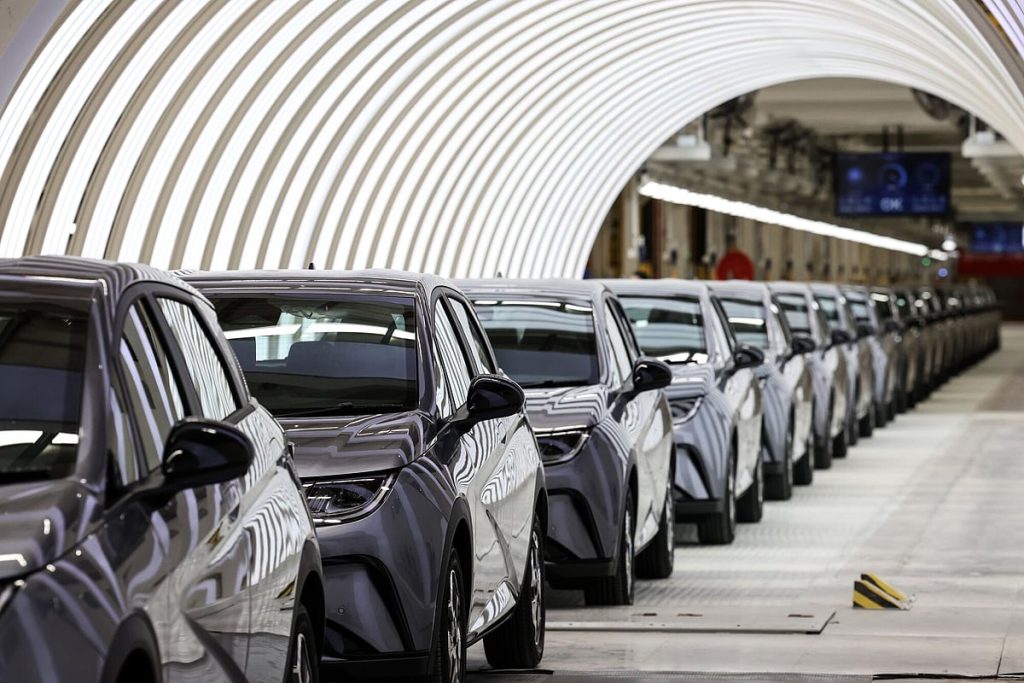
KARACHI — China’s BYD, the world’s largest electric-vehicle maker, is preparing to begin local assembly in Pakistan in the second half of 2026, a move that analysts say will intensify pressure on the Japanese brands that have long dominated the country’s roads.
The company’s first Pakistani plant is being built near Karachi through its local partner, Mega Motor Company, a subsidiary of the Hub Power Company, and is expected to become operational between the third and fourth quarters of the year, according to Gulf News. The facility represents an estimated investment of around $150 million and will have an annual capacity of 25,000 vehicles once running at full tilt, the same report said.
The plant, under construction since 2025, will initially assemble imported kits before gradually raising local content, Dawn reported, with the line expected to start operating on a double-shift basis at roughly 25,000 units annually. BYD aims to produce both battery-electric vehicles and plug-in hybrids tailored to local conditions, beginning its market push with imported models such as the Shark 6 plug-in hybrid pickup, the newspaper said.
The Chinese carmaker, which entered Pakistan in 2024 with imported vehicles, is targeting a 30 to 35 per cent share of the emerging EV segment, Dawn reported, citing company officials. Pakistan’s total EV market was tiny in 2024 at roughly 1,000 units, but was expected to grow three- to four-fold during 2025, the report added. “We do not foresee excess capacity in our system as demand in Pakistan will catch up,” Danish Khaliq, vice-president of sales and strategy at Mega Motor Company, told Dawn.
The timing is striking. Chinese automakers now account for about 20 per cent of Pakistan’s passenger-vehicle market, per Gulf News, having gained ground in SUVs, hybrids and EVs under concessions in the country’s auto policy. Shehryar Qadir, senior vice-chairman of the auto-parts association PAAPAM, noted that new entrants enjoyed a 20 per cent concession on parts imports — “which is huge in the auto parts manufacturing industries, where profit margins are around the 5 per cent mark,” he told Gulf News.
BYD’s expansion is landing as the wider market rebounds. Passenger-car sales rose 48 per cent year-on-year in May 2026, while production in the same category climbed 45 per cent, according to PakWheels, citing PAMA data. Sales of SUVs and pickups were up 37 per cent and two- and three-wheeler sales rose 30 per cent over the same period, the report said.
The recovery has been building for months. In January 2026, passenger-car production jumped 57 per cent and sales 45 per cent month-on-month, PakWheels reported, with individual models such as the Toyota Fortuner and Hilux posting a sharp sales surge as buyer confidence returned on the back of falling interest rates.
Whether BYD can convert that momentum into volume will depend on charging infrastructure, financing and the durability of the broader upturn. But with a domestic line due to fire up within months, the company is positioned to challenge the cost advantage and assembly footprint that have kept Japanese marques at the centre of Pakistan’s car market for decades. Clean mobility, Khaliq said, had become “an urgent consideration rather than a distant goal,” Gulf News reported.



