
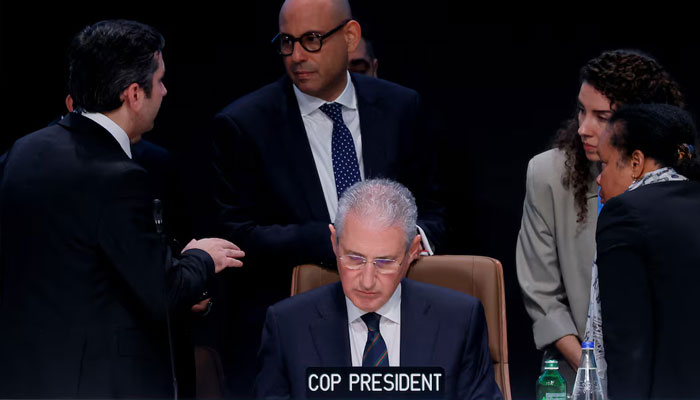
Countries at the COP29 summit in Baku agreed on an annual global funding target of $300 billion on Sunday to help poorer nations deal with the effects of climate change. However, the intended beneficiaries criticized the agreement as grossly inadequate.
The agreement, reached after extensive negotiations at the two-week conference in the capital of Azerbaijan, was aimed at boosting global efforts to combat climate change in what is set to be the hottest year on record.
While some delegates responded with a standing ovation in the plenary hall, others condemned rich nations for their perceived lack of commitment and criticized Azerbaijan’s leadership for rushing to approve the controversial plan.
“I am sorry to say that this document is nothing more than an optical illusion,” Indian delegation spokesman Chandni Raina said at the conclusion of the summit, minutes after the agreement was signed. “This, in our opinion, will not address the enormity of the challenge we all face, therefore we are opposed to the approval of this document.”
UN climate chief Simon Stiell acknowledged the difficult negotiations that led to the deal, but hailed the outcome as an insurance policy for humanity against global warming.
“It was a difficult journey, but we reached an agreement,” Steele said. “This agreement will sustain the growth of clean energy and protect billions of lives.
“But like any insurance policy, it only works if premiums are paid in full and on time.”
The deal will provide $300 billion a year until 2035, building on an earlier commitment by rich countries to provide $100 billion a year in climate finance by 2020. That earlier goal was reached two years later, in 2022, and expires in 2025 .
The agreement also lays the groundwork for next year’s climate summit, to be held in Brazil’s Amazon rainforest, where countries are to map out the next decade of climate action.
The summit was at the center of the debate over the financial responsibility of industrialized countries – whose historical use of fossil fuels has caused most of the greenhouse gas emissions – to compensate others for worsening climate change damage.
It also revealed the differences between rich governments constrained by tight domestic budgets and developing countries suffering the costs of storms, floods and droughts.
The negotiations were due to end on Friday but were delayed as representatives from nearly 200 countries struggled to reach a consensus. The talks broke down on Saturday as some developing countries and island nations walked out in frustration.
“We’re leaving with a small fraction of the funding that climate-vulnerable countries urgently need. It’s not nearly enough, but it’s a start,” said Tina Stege, the Marshall Islands’ climate envoy.
Nations are seeking funding to meet the Paris Agreement’s goal of limiting global temperature increases to 1.5 degrees Celsius (2.7 degrees Fahrenheit) above pre-industrial levels – beyond which there could be catastrophic climate impacts.
The world is currently on track for a temperature increase of up to 3.1 C (5.6 F) by the end of this century, according to the UN’s 2024 emissions gap report, with global gas emissions greenhouse gas emissions and fossil fuel use continue to increase.
Sunday’s agreement failed to set out detailed steps for how countries will act on last year’s UN climate conference pledge to move away from fossil fuels and triple renewable energy capacity this decade. Some negotiators said Saudi Arabia had tried to block such a plan during the talks.
“There is a challenge to be more ambitious when you’re negotiating with the Saudis,” said US climate adviser John Podesta.
A Saudi official did not immediately comment.
What counts as a developed nation?
The list of countries required to contribute — about two dozen industrialized countries, including the U.S., European nations and Canada — dates back to a list decided upon during the 1992 UN climate talks.
European governments have asked others to pay, including China, the world’s second-largest economy, and the oil-rich Gulf states. The agreement encourages developing countries to contribute, but does not require them.
The deal includes a broader goal of raising $1.3 trillion in climate finance annually by 2035 – which would include funding from all public and private sources and which economists say matches the amount needed to tackle global warming planet.
Countries also agreed on rules for a global market to buy and sell carbon credits that supporters say could mobilize billions more dollars into new projects to fight global warming, from reforestation to developing clean energy technologies.
Securing the climate finance deal has been a challenge from the start.
Donald Trump’s victory in the US presidential election this month has raised doubts among some negotiators that the world’s largest economy will pay into any climate finance targets agreed in Baku. Trump, a Republican who takes office in January, has called climate change a hoax and vowed to once again withdraw the US from international climate cooperation.
President Joe Biden congratulated COP29 participants for reaching a historic agreement that would help mobilize much-needed resources, but said more work is needed.
“While we still have substantial work ahead of us to meet our climate goals, today’s result brings us a significant step closer. On behalf of the American people and future generations, we must continue to accelerate our work to maintain a cleaner , safer, healthier planet in our hands,” Biden said in a statement.
Western governments have seen global warming slip down the list of national priorities amid rising geopolitical tensions, including Russia’s war in Ukraine, expanding conflicts in the Middle East and rising inflation.
The showdown over funding for developing countries comes in a year that scientists predict will be the hottest on record. Climate woes are piling up, with widespread flooding killing thousands across Africa, deadly landslides burying villages in Asia and droughts in South America shrinking rivers.
Developed countries have not been spared. Torrential rain caused flooding in Valencia, Spain last month that left more than 200 dead, and the U.S. so far this year has recorded $24 billion in damage — just four fewer than last year.
a href=”https://www.geo.tv/latest/576121-cop29-300b-climate-deal-termed-insufficient-by-developing-nations”>Source link



