
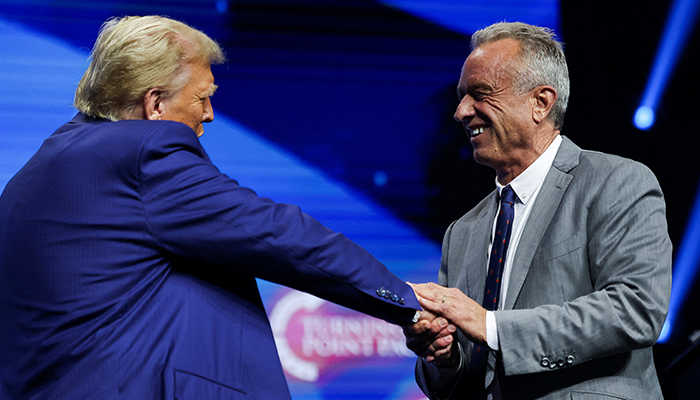
United States President-elect Donald Trump said Thursday that he has chosen Robert Kennedy Jr., an environmental activist who spread misinformation about vaccines, to lead the Department of Health and Human Services, the nation’s top health care agency.
In a post on X, Kennedy pledged to work to end chronic disease, clean up corruption and provide Americans with the data they need to make informed decisions, pledging to Trump that he would work to “Make America Healthy again”.
Kennedy ran for president in this year’s election as an independent before dropping out in August and endorsing Trump in exchange for a role in the Republican administration.
Kennedy, the son and nephew of two titans of Democratic politics, has spoken frequently about tackling what he calls the “chronic disease epidemic” of conditions such as obesity, diabetes and autism and reducing chemicals in food.
“The Safety and Health of all Americans is the most important role of any administration, and HHS will play an important role in ensuring that everyone is protected from the harmful chemicals, pollutants, pesticides, pharmaceuticals and food additives that have contributed to the overwhelming crisis health in this country,” Trump said in a social media post.
Later Thursday, during a speech at his home in Mar-a-Lago, Florida, Trump praised Kennedy, saying he would do “incredible” things in his new position. “We want you to think about things and ideas and things that you’ve been talking about for a long time,” Trump said, without elaborating.
The Department of Health and Human Services oversees drug regulation, public health services, including the Centers for Disease Control and Prevention, and health insurance for more than 140 million people, including the poor, those 65 and older, and people with disabilities through of Medicare and Medicaid.
HHS had a budget of $3.09 trillion for fiscal year 2024, representing 22.8% of the US federal budget.
Drew Altman, president of the health research firm KFF, described the move as historic and said what Kennedy would ultimately do in his role, given that he has not often discussed programs like Medicaid and Medicare, which are responsible for many. of the US health budget.
“Historically, secretaries have been people with real experience and office in national health care and this is certainly not that, and he has views outside the mainstream and is a renegade appointment,” Altman said.
The appointment, which had been seen as a possibility for weeks, raised concerns among some public health advocates who said Kennedy could have a negative impact on the health of Americans given his power over these agencies. The Democratic Party decried the decision.
Some politicians and business groups supported the nomination, including the National Association of Community Pharmacists, which said it was encouraged by his willingness to take on companies.
Health priorities
Kennedy was a member of Trump’s transition team and was reviewing the resumes of candidates for top jobs at US health agencies.
Kennedy has suggested he would gut the 18,000-employee Food and Drug Administration — which ensures the safety of food, drugs and medical devices — and replace hundreds of employees at the National Institutes of Health.
“The FDA’s war on public health is about to end,” he wrote in X in late October, adding that it includes an “aggressive crackdown” on psychedelics, peptides, stem cells, raw milk, sunshine and more.
“If you work for the FDA and are part of this corrupt system, I have two messages for you: 1. Keep your records and 2. Pack your bags,” he wrote.
In early November, he said he would recommend removing fluoride from public water supplies, falsely claiming to X that the chemical is linked to bone fractures and cancer.
Dr. Ashish Jha, former White House COVID-19 Response Coordinator and dean of the Brown University School of Public Health, said, “Most people don’t realize that it’s not about the fluoride in the water, or even the vaccines, so much as important as they are. The HHS secretary oversees Medicare. He and his appointees will decide what drugs are available to the American people.”
James Capretta, a senior fellow at the American Enterprise Institute and a former White House staffer under George W Bush, said it was unclear what impact Kennedy would have, but that it would not be immediate.
“There are a lot of policy-making constraints at the service level, even at the secretariat level,” he said.
Vaccines
Shares of vaccine makers fell after news of Kennedy’s nomination, falling as much as 2%.
Kennedy has been criticized for making false medical claims, including that vaccines are linked to autism. He opposed state and federal restrictions imposed during the COVID-19 pandemic and was accused of spreading misinformation about the virus.
He disputes the anti-vaccine label, saying he wants more rigorous vaccine testing. However, he chaired Children’s Health Defense, a nonprofit focused on anti-vaccine messaging.
In an interview in March, when he was still running for president, Kennedy said that Americans who want a vaccine for themselves or their children will continue to have access to it if he is elected. But he said he doubts the effectiveness of measles vaccines.
Measles is one of the most contagious human viruses and is almost completely preventable through vaccination. 95% vaccine coverage is required to prevent outbreaks between populations. Coverage rates in the U.S. have fallen below that level among young children, the CDC said this month.
Vaccines have saved more than 154 million lives in the 20th century — the equivalent of six lives every minute every year for the past 50 years, said Michael Osterholm, an infectious disease expert at the University of Minnesota.
“Immunization has continued to be the biggest factor of any health intervention to ensure that babies not only see their first birthday, but continue to live healthy lives into adulthood,” he said.
a href=”https://www.geo.tv/latest/574496-trump-selects-rfk-jr-to-lead-top-us-health-agency”>Source link



