Documentary film on distinguished actor, director and broadcaster Zia Mohyeddin to be screened on January 30
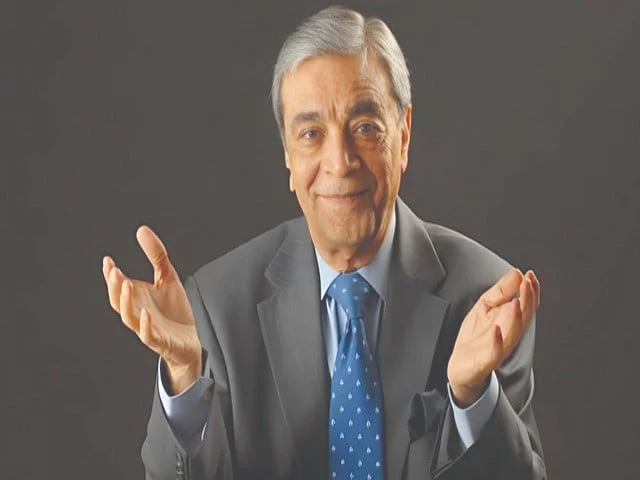
Zia Mohyeddin. Photo: file
KARACHI:
The premiere of the documentary film, ‘Rang Hai Dil Ka Mere’, made by Pakistan’s eminent actor, director, broadcaster and owner of a unique voice and dictionary, Zia Mohyeddin, was held at a cinema in the city. Completed after nearly 15 years of tireless effort, the film covers Zia Mohyeddin’s higher education at the Royal Academy of Dramatic Art (RADA) in the UK, his role in the famous 1960s film ‘Lawrence of Arabia’, PTV’s famous show ‘Zia Mohyeddin Show’ and his many years of service at the National Academy of Performing Arts (Performing theNA).
The 100-minute long documentary, ‘Rang Hai Dil Ka Mere’, will be screened on January 30 in select cinemas in Karachi, Islamabad and Lahore.
The film was shot at NAPA, Karachi and various locations in Karachi and Lahore, while the editing process alone took nearly two years.
The premiere ceremony of ‘Rang Hai Dil Ka Mere’ featuring the artistic services and personal life of late famous actor, broadcaster and director Zia Mohyeddin was held at the famous Nueplex Cinema in Defense Phase 8. A large number of fans of Urdu literature and fine arts attended the event. The credit for making this unique film—a first in Pakistan—goes to its director, Umar Riaz. While studying theater in the United States, he decided to pay tribute to this multifaceted Pakistani personality in a unique way.
Before fully realizing this idea, Umar Riaz made a short video of Zia Mohyeddin’s recitation and took it to his academy in the United States. Despite not knowing Urdu, the English instructors there were deeply captivated by Zia Mohyeddin’s recitation, which encouraged him to expand the short video into a full-length documentary. Work on the film began during Zia Mohyeddin’s lifetime. Although the thorough research and filming took a lot of time, the final version of the film is a one-of-a-kind experiment.
Speaking to Express News, director Umar Riaz said that before production began, every frame of the film was conceptually envisioned from multiple angles. Zia Mohyeddin’s long list of artistic contributions has been extensively researched. The film highlights not only his work in Hollywood and Britain, but also his television career in Pakistan and, in particular, his ongoing association with the National Academy of Performing Arts, where he remained active until the end of his life.
According to Umar Riaz, much of his inspiration for making the film came from watching Zia Mohyeddin’s recitations of Faiz Ahmed Faiz’s poetry and, at times, Mirza Asadullah Khan Ghalib’s letters. These were cases where the audience arrived much earlier than the scheduled time, often resulting in a lack of seats. The rapturous attention with which people listened to Zia Mohyeddin’s recitation was a unique experience for him.
One cannot claim that the documentary presents the entire work of Zia Mohyeddin, as time constraints made it impossible to show everything. However, it can be said that an attempt was made to “contain an ocean in a small boat”. The full production took 15 years, with about two years spent on editing.
The film shows that when Zia Mohyeddin returned to Pakistan after his role in ‘Lawrence of Arabia’, a large number of fans were present at the airport to welcome him. He was one of the first Pakistani actors to appear in an expensive Hollywood film, playing the role of an Arab Tafa in 1962. Despite his limited screen time, his impressive performance established his talent and ranks him among the first Pakistani actors to appear in a major international production.
According to Zia Mohyeddin’s wife Azra, during the first ten years of the film’s development, most of the consultations were done directly with Zia Mohyeddin himself. Although he was only able to see a portion of the footage, a lot was conveyed in this limited duration. She is confident that Umar Riaz’s hard work will not go to waste as the film is the result of a long and dedicated effort.
Renowned intellectual and cultural thinker Javed Jabbar said that the way this documentary has been woven gives it a unique and extraordinary dimension – an experiment never attempted before in Pakistan. He added that documentary films, often referred to as ‘dast?vezi’ films in Pakistan, have never been given the status they deserve. There is a common misconception that documentaries are limited in scope or limited to specific topics, which is completely wrong. Through such films, a point of view can be conveyed effectively, as director Umar Riaz has masterfully done in ‘Rang Hai Dil Ka Mere’. This experiment has a distinct and remarkable quality.
The film also features reflections from Zia Mohyeddin’s two ex-wives as well as Faiz Ahmed Faiz’s daughters. Syeda Arifa Zahra and Daud Rahbar’s talks on Zia Mohyeddin are widely presented, shedding light on his habits and principles that are not widely known to the public.
At the end of the documentary, Zia Mohyeddin is shown traveling by car through the streets of Lahore, looking for his home in an upscale area. Years later, the house completely changed its appearance. He is seen reminiscing about the 14 jamun (black plum) trees that once stood nearby, most of which have since been cut down. Seeing concrete houses replace the greenery in front of his former home, he expresses visible sadness.
According to the film team, ‘Rang Hai Dil Ka Mere’ will release on January 30 in select theaters in Karachi, Islamabad and Lahore.
a href=”https://tribune.com.pk/story/2587709/tribute-to-a-showbiz-literary-legend-premieres-in-karachi”>Source link