
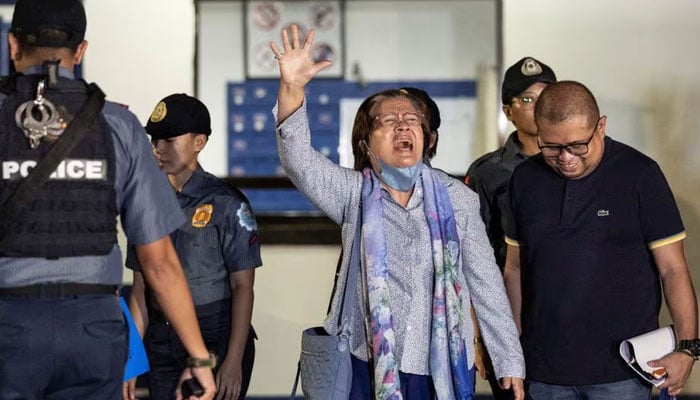
Leila De Lima, a prominent critic of former President Rodrigo Duterte’s controversial “war on drugs,” has been granted bail by a district court in the Philippines after six years in police custody.
The decision was taken by the President Judge Mr. Gener M. Gito, with bail conditions set at approximately $5,300 (300,000 Philippine pesos).
De Lima, who was acquitted of two of three charges related to allegations of payoffs from convicted drug gangs, expressed her need to rebuild her life after the lengthy detention. Cheering supporters greeted her as she left the courtroom under a police escort.
International organizations, including the United Nations High Commissioner for Human Rights, Amnesty International and Human Rights Watch, criticized De Lima’s prolonged detention as “arbitrary” and called for her immediate release.
Despite the threats and harassment, De Lima, who has been in a police cell since February 2017, has not been convicted of any charges.
Court proceedings against De Lima have faced delays, with changes in judges handling her cases and challenges such as prosecution witnesses failing to appear in court.
Her release on bail marks a major development in a country where political activists and the media often face threats and harassment to control those in power.
De Lima plans to prioritize spending quality time with her family, especially her 91-year-old mother. Amnesty International stressed that De Lima’s bail should lead to the dismissal of the latest charge against her, given her targeted criticism of the “murderous war on drugs” and human rights abuses.
Leila De Lima and Duterte have a long history of conflict dating back to Duterte’s tenure as mayor of Davao City. In 2009, as chairman of the Commission on Human Rights, De Lima investigated the suspected Davao Death Squad, uncovering extrajudicial killings and a mass grave linked to the group. Later elected to the Senate in May 2016, De Lima continued to question Duterte’s war on drugs, calling for an investigation into extrajudicial killings.
Duterte’s anti-drug campaign, marked by thousands of deaths and extrajudicial killings, has faced international criticism. Despite the global outcry and the International Criminal Court investigation, Duterte remained popular in the Philippines.
His successor, President Ferdinand Marcos Jr., announced the country’s disengagement from the ICC, rejecting its authority in matters of national sovereignty.
a href=”https://www.geo.tv/latest/518778-leila-de-lima-philippine-ex-leader-dutertes-top-critic-bailed-after-6-years”>Source link


