

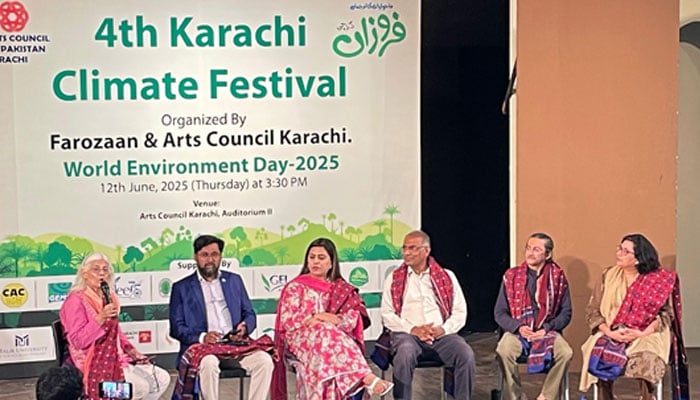
The Pakistan Council of Arts hosted the Fourth Carachi Climate Festival on Thursday to celebrate World Environment Day, underlining the impact of climate change on the metropolis.
The opening of the 2025-wherean climate risk risk index where Pakistan is ranked among the most vulnerable countries in the world-the festival discussed the unjust distribution of water, the connection of climate health, the role of media awareness of climate, among others.
The panel was tempered by Afia Salam, who joined Muhammad Toheed, Munazza Siddiqui, Mahapara Khan, Saeed Baloch and Yasir Khan as a panel.
Muhammad Toheed, a urban designer based in Karachi, stressed that the city faced two more alarming challenges: increasing temperature and urban floods.
“Average city day temperature rose by 1.6 degrees Celsius, while night temperatures have increased by 2.4 degrees,” the urban designer said, citing a study done at Karachi Urban Lab on Met [Pakistan Meteorological Department] 60 years of age.
Investigating the connection between climate change and public health, public health expert Mahapara Khan described the growing prevalence of aqueous diseases, the disease caused by temperature and respiratory issues due to vehicle emissions.
“Diseases increase due to increasing temperatures. It involves fever, polio, diarrhea, pneumonia, lungs and cardiovascular disease,” he said.
Immediately after that, the AFIA Salam Coordinator is interrupted – who is a famous environmental expert – and explained the relationship between high temperatures and fever fever fever saying: “Due to increasing temperature, the fever fever is increasing [in Karachi] As the mosquitoes of the dengue fever are now reproduced in areas where they are not used to doing. ”
Munazza Siddiqui, a senior journalist, expressed concerns about the limited report and climate coverage, saying that this position does not receive coverage because the public pays little attention to such news.
In addition, it eliminated the incorrect perception of the media that did not give proper climate change.
He gave an example, saying: “Heat -related deaths are undervalued because when journalists go to hospitals [to get data]They are being informally told by hospital staff that they have received instructions from senior government officials that heat-related deaths should be put in other health categories … Government officials-including politicians and bureaucrats-want to protect them. “
Yasir Hussain, an environmental expert and head of the Karachi Climate Action Center, emphasized the importance of climate data and public awareness, urging the government to support the adaptation programs guided by the community throughout the bourgeoisie.
Pakistan Secretary -General Fisherfolk Forum Saeed Baloch sheds light on the vulnerability of coastal communities in climate change. He condemned the dumping of unprocessed industrial sewage in the Arabic Sea, a practice that threatens aquatic ecosystems and traditional means of living.
a href=”https://www.geo.tv/latest/609049-karachi-climate-festival-calls-for-immediate-stringent-measures-to-tackle-climate-change”>Source link


