

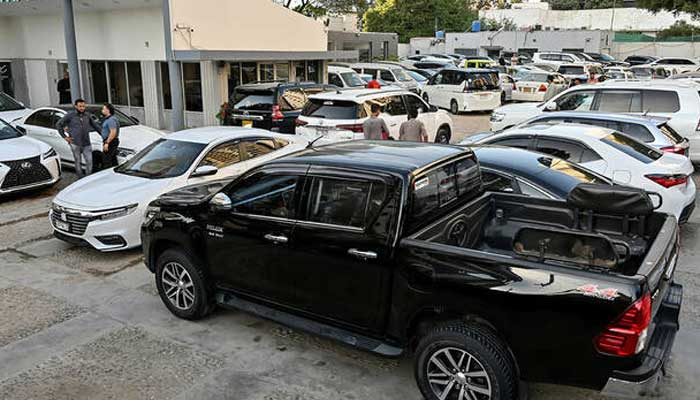
- The government is considering introducing strict measures to prevent misuse.
- Auto industry opposes car imports, government wants balanced approach.
- The industry consists of approximately 1,200 factories and provides 2.5 million jobs.
Islamabad: The federal government is considering scrapping a used car import scheme while tightening regulations on the remaining two schemes, The News reported on Tuesday.
The Department of Commerce has forwarded a summary to the Cabinet’s Economic Coordination Committee (ECC) recommending the abolition of the personal baggage regime.
The other two schemes — Home Transfer Scheme and Gift Scheme — are proposed to be tightened, with the ministry proposing measures to curb their abuse.
“Various proposals are under consideration to tighten the Gift and Home Transfer schemes for import of used cars, while the Baggage Scheme is expected to be scrapped. The ECC will take the final decision on this,” top official sources confirmed to the publication.
The auto sector strongly opposes used car imports, but the government is pursuing a balanced approach. The auto sector argued that data compiled from December 2024 to October 2025 indicated a sharp revival in used vehicle imports.
By comparison, the share of used cars remains negligible among regional peers: India maintains virtually zero used car inflows, Vietnam at 0.3% and Thailand at 1.2%.
The auto sector has informed the government that regional economies are restricting used car imports to protect their automotive value chains.
Pakistan has charted the opposite path — particularly after notification 1895 issued by the Ministry of Commerce on September 30, 2025, which allowed imports of vehicles up to five years old. After June 2026, this limit will reportedly be removed altogether, potentially opening the floodgates for large-scale inflows of old vehicles.
Pakistan’s automotive sector currently includes around 1,200 factories, provides 2.5 million jobs, generates an estimated Rs 500 billion annually in government revenue and holds around $5 billion in foreign investment.
“Import-friendly policies risk undermining these gains at a time when industrial revitalization and localization are being declared priorities,” said Shehryar Qadir, Senior Vice President of the Pakistan Association of Parts & Accessories Manufacturers (PAAPAM).
Of the 45,758 vehicles imported into Pakistan during the period (December 2024–October 2025), nearly 99% came from Japan — a right-hand drive market compatible with local driving conditions. The remaining numbers were negligible: 130 units from Thailand, 55 from the USA, 49 from Jamaica, 47 from Germany, 22 from Australia, 20 from China and just five from the UAE.
Industry estimates put the loss faced by local vendor industries at around Rs 50 billion during the period under review. The foreign exchange impact is equally stark: local manufacturers require about $10,138 in documented imports through bank channels per vehicle, while used car importers raise about $14,010 per unit – much of it through unofficial channels.
While the government is drafting a new Auto Policy to boost domestic manufacturing, stakeholders remain divided on whether localization efforts can succeed alongside a liberal used car import regime. The data suggest that Pakistan is an outlier among manufacturing economies — both in terms of policy direction and market outcome.
a href=”https://www.geo.tv/latest/636911-govt-considers-scrapping-personal-baggage-used-cars-import-scheme”>Source link


