
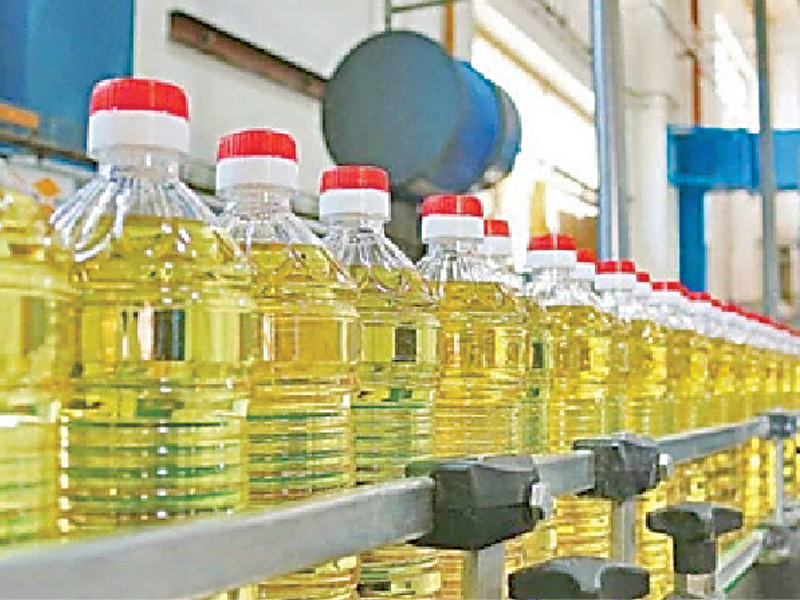
The government should consider imposing 20-22% sales tax and 5% income tax on commercial importers to discourage them, said KK Group of Industries CEO Khalid Islam Sheikh. Photo: file
KARACHI:
Edible oil manufacturers have called for a reduction in crude palm oil (CPO) duty, repeal of Section 8B of the Sales Tax Act and enhanced taxes on commercial importers. The aim is to encourage farmers and others to stimulate industrial development in the country.
They reported that over 3.2 million metric tons of palm oil are imported into the country. The edible oil sector procures raw materials from domestic and global sources, manufacturing 4.5 million metric tonnes of standard and high quality Banaspati and cooking oil to meet national demand.
Speaking to The Express Tribune, they noted that the annual turnover of the edible oil industry exceeds Rs 2,400 billion annually. Manufacturers contribute up to Rs 550 billion directly or indirectly to the national exchequer in terms of duties, taxes and other levies. This sector ranks among the top five earners of the country as announced by the Federal Board of Revenue (FBR) and the Ministry of Finance. The palm oil industry is a pillar of the country’s economy and plays a key role in meeting the ever-increasing national demand.
Federation of Pakistan Chambers of Commerce and Industry (FPCCI) president and former president of Pakistan Vanaspati Manufacturers Association (PVMA), Atif Ikram Sheikh stressed the need for more economic and political stability in the country to promote industrialization and strengthen national economy, to the benefit of all industrialists and the business community.
Discussing several issues in the edible oil industry, he reiterated his earlier statement that Section 8B of the Sales Tax Act, 1990 should be repealed. He pointed out that the 10% differential, which disadvantages and discourages industrialists over commercial importers, should be eliminated as it disrupts cash flow.
He also proposed to impose higher duties on commercial importers than on industries to facilitate local industries. There should be a significant difference in tariffs between manufacturers and commercial importers, with manufacturers receiving lower rates.
Finally, he called for the reduction of the duty on crude palm oil (CPO) as many refineries are closed due to the high duty on crude palm oil. He noted that in the past there was a lower duty on crude palm oil imports, resulting in better industrial development.
Reading
Increasing local edible oil production: expertsTalking about oil palm plantations in the country, he mentioned that both the local industry and the government are working on it. Earlier attempts were made and palm fruits were also grown, but proper yield was not achieved due to certain weather conditions such as excessive rainfall.
He said that the stakeholders continued their efforts, expressing the hope that the fresh fruits would yield a bountiful harvest in areas like Thatta and Sujawal, where the weather conditions are conducive to fruit cultivation.
“The government is not currently in a position to offer immediate assistance to the industry. However, it should consider raising taxes on commercial importers to create more room for local industry to grow and thrive. Currently, the industry pays 18% sales tax and 2% income tax, while commercial importers pay the same sales tax and 3% income tax. The government should consider imposing 20% to 22% sales tax and 5% income tax on commercial importers, thus discouraging them,” observed KK Group of Industries CEO Khalid Islam Sheikh.
He pointed out that if the government puts in place favorable and supportive policies, it will incentivize farmers to grow more sunflower, canola and soybeans instead of focusing solely on wheat.
“About 1.5 to 1.6 million metric tons of canola, sunflower and soybean seeds are imported for oil export purposes. By increasing import duties on these seeds, the government can encourage growers to grow more of these crops for the next harvests and also supply seeds to the industry. Consequently, this policy would reduce the import bill for seeds,” he added.
Concluding his remarks, he noted, “During a two-month season, we rely solely on domestic cottonseed oil to meet a local demand of 200,000 to 250,000 metric tons. However, this oil is mainly consumed by other industries.”
Published in The Express Tribune, February 13u2024.
Like Businesses on Facebook, follow @TribuneBiz on Twitter to stay updated and join the conversation.
a href=”https://tribune.com.pk/story/2456256/edible-oil-industry-advocates-tax-reform”>Source link



