
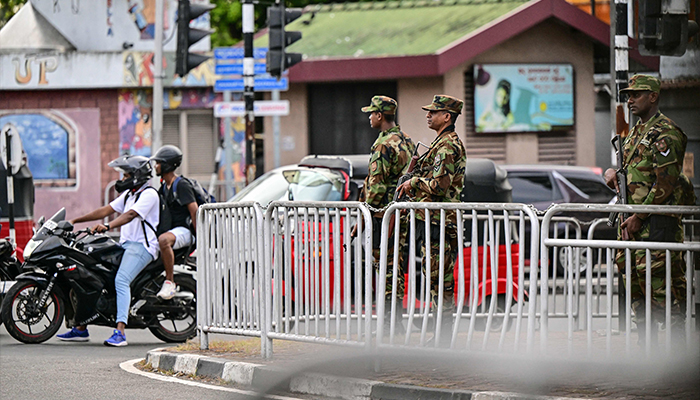
- Enforcing a curfew “an additional measure to protect people”: police.
- In Saturday’s election, an estimated turnout of 75% is completed.
- The results of the presidential election are expected to be announced on Sunday.
Sri Lanka imposed a nationwide night-time curfew on Saturday despite a peaceful presidential election that is effectively a referendum on an unpopular IMF bailout.
Police announced the eight-hour curfew shortly after the independent Electoral Commission said Saturday’s poll was the most peaceful in the country’s electoral history.
President Ranil Wickremesinghe, who faces an uphill battle to hold on to power, imposed the unexpected travel restriction “as an additional measure to protect people,” police said in a statement.
He urged people to stay indoors. Earlier, the government declared Monday a special holiday. The results of Saturday’s election are expected on Sunday.
Turnout was about 75 percent when polling stations closed after nine hours of voting, an election official said, citing provisional figures.
The record voter turnout for a presidential election in Sri Lanka was set in 2019 at 83.72%.
Wickremesinghe is seeking re-election to continue austerity measures that have stabilized the economy and ended months of food, fuel and medicine shortages after Sri Lanka’s worst economic collapse in 2022.
His two years in office restored calm to the streets after recession-induced civil unrest that saw thousands storm the compound of his predecessor Gotabaya Rajapaksa, who fled the country as anger mounted.
“I brought this country out of bankruptcy,” Wickremesinghe, 75, said after casting his vote.
But Wickremesinghe’s tax hikes and other measures, imposed under the terms of a $2.9 billion IMF bailout, have left millions struggling to make ends meet.
“The country has been through a lot,” said Soundarie lawyer and musician David Rodrigo AFP after voting in Colombo.
“So I just don’t want to see another twist coming anytime soon.”
Wickremesinghe faces a tough challenge from two formidable contenders. One is Anura Kumara Dissanayaka, the leader of a once fringe Marxist party tarnished by its violent past.
The party led two failed uprisings in the 1970s and 1980s that left more than 80,000 people dead and won less than 4% of the vote in the previous parliamentary elections.
But Sri Lanka’s crisis has proved an opportunity for 55-year-old Dissanayaka, who has seen a surge of support based on his pledge to change the island’s “corrupt” political culture.
He told a polling station that he was confident of securing the top spot.
“After victory there should be no clashes, no violence,” he said. “Our country needs a new political culture.”
Fellow opposition leader Sajith Premadasa, 57, the son of a former president who was assassinated in 1993 during the country’s decades-long civil war, is also expected to make a strong showing.
Premadasa has vowed to fight endemic corruption, and both he and Dissanayaka have pledged to renegotiate the terms of the IMF bailout.
Three way match
said political analyst Kusal Perera AFP it was difficult to predict a winner from the three-way match — the first in island history.
“What is clear is that no candidate will break the 50 percent mark” needed to win outright, he said.
Officials would then count the second- and third-preference votes to determine the winner, a process that could delay the final result.
More than 17 million people were eligible to vote in the election, with more than 63,000 police officers deployed to guard polling stations and counting centers in schools and temples.
The government also banned the sale of alcoholic beverages over the weekend and said no victory rallies or celebrations would be allowed until a week after the results were announced.
Economic issues have dominated the eight-week campaign, with public anger rife over the hardships suffered since the height of the crisis two years ago.
Official figures showed that Sri Lanka’s poverty rate doubled to 25% between 2021 and 2022, adding more than 2.5 million people to those already living on less than $3.65 a day.
Experts warn that Sri Lanka’s economy remains vulnerable, with payments on the island’s $46 billion foreign debt yet to resume after the government defaults in 2022.
The IMF said reforms introduced by Wickremesinghe’s government were starting to pay off, with growth slowly returning.
a href=”https://www.geo.tv/latest/565388-curfew-imposed-in-sri-lanka-after-polls-close-peacefully”>Source link


