

PUBLISHED November 09, 2025
Creating compositions and creating space for children’s participation in music, Thaheer Production has been shaping a much-desired revolution in Balochi literature since 2016, amidst the snow-capped mountains of Quetta and the elegant landscapes of Balochistan.
The Balochi word “Thaheer” means “comfort”. Appropriately, Thaheer Production’s artistic creations and compositions bring comfort to listeners of all ages in the region. It was co-founded by Farooq Baloch and Azam Baloch, with Obaid joining the production company later. Azam Baloch is a mixer and Obaid is a guitarist, both of whom use their creativity to enhance the sound of each project.
“Our most important goal is to create a platform for Baloch singers and artists to contribute uniquely to Baloch music,” says Azam Baloch. “Balochistan is full of young talent, but the raw talent needs refinement. Our children are far behind in Balochi language and such inventive work is not taught in schools.”
Thaheer Production hopes to showcase the creative arts and compositions of youth from across the vast province of Balochistan. Baloch worries that while young children recite English rhymes, they have no idea about Balochi poetry. For this reason, the Thaheer team decided to include Lab and Lacha on their platform in order to introduce music to a wider group of children. “Children should sing Balochi poems at school and learn the Balochi language,” says Baloch.
“Music and literature are two different things and we would like to see the youth in Balochistan familiarize themselves with their provincial language, music and literature,” says Baloch. “We are inspired by our society and culture to create themes for songs and videos based on our cultural needs. While documenting the Danko project, we shot a location and projected our cultural artifacts through video, connecting everything to music. Lyrics, I believe, are the soul of music.”
Discussing the meaning of Thaheer, Baloch explained, “It means relief and solace, so dance, music, culture and art should aim to provide that. We are proud to produce such music for our listeners.”
The group works to develop and streamline basic learning in the field of music so that in the future children can use their talent to earn money as local singers. Baloch believes that the music industry lacks a meaningful struggle and structure to foster such growth. “We plan to shape Thaheer Production into an institution where children can learn modern forms of music and literature,” he says. “Learning, not copying, is the source of creativity. That’s why we want Thaheer Production to be a school for children to study creative work.”
“We use a variety of instruments in our music, such as choroz, drums, banjo, tamborag, codas and guitars — so that everyone can enjoy the lyrics and understand the music,” continues Baloch.
“Many people still love Man shapan roch, mahan saal kana, our first effort composed in 2017,” shares Baloch. “Our journey in music has since created many melodies and compositions for our audience.”
It is true that the audience inspires them to create even more beautiful music. For Thaheer, this is a journey full of love and passion for Balochi literature. In a short span of time, they have created a variety of compositions that are popular all over Balochistan. They work not for profit, but out of love and devotion to Balochi literature — producing fewer, but memorable, compositions.
Thaheer Production has become the home of every Baloch artist, offering people – especially children – a place to turn whenever they need solace and nourishment for the soul.
Farad Fida is a bright young singer with a pleasant voice who sings cover versions of Balochi songs and uploads them on TikTok.
“My son sings often and everyone likes to hear him,” says Fida’s father, who wants his son to formally learn music.
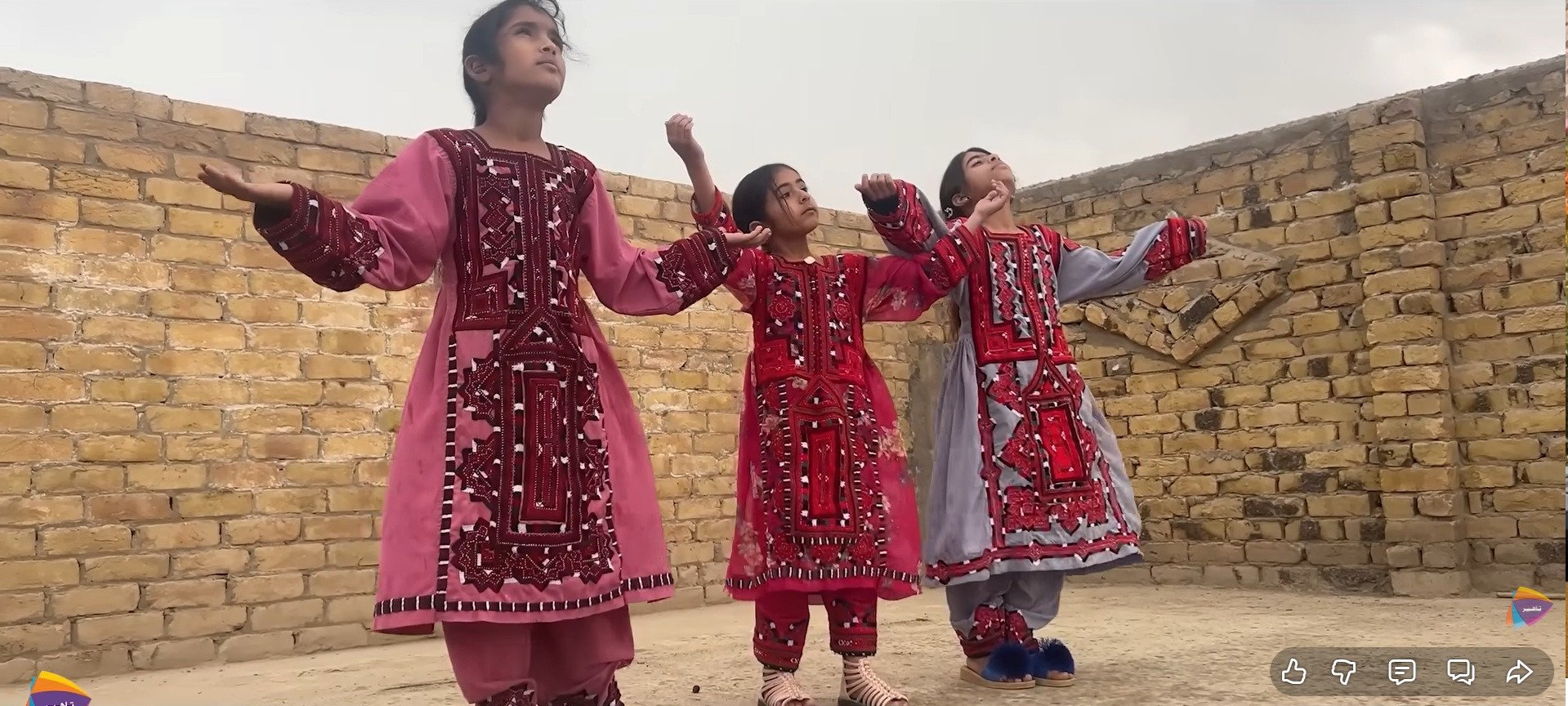
In Balochistan, where there is a lack of government support and an ongoing economic crisis, Thaheer Production provides aspiring artists a platform to sing and encourages them to pursue artistic opportunities in music and literature — regardless of gender.
Sainkal and Horo Horo from the Laib Lacha series are beautiful songs performed by Keegad Baloch, Sadganj Baloch, Banadi Baloch and Seemak Baloch — young children who contribute mightily to Balochi music.
“My father taught me how to sing,” says Keegad Baloch, Obaid’s daughter and singer of the Laib Lacha series. “He is my only role model in all areas of life because he truly inspires me and supports me. It is his encouragement that allows me to participate in school programs related to music.”
Sadganj Baloch, another kid who plays alongside Keegad, became interested in singing after hearing her.
“We are grateful to Thaheer Production because this platform has encouraged and nurtured us,” says Banadi. “It gave us a unique opportunity to strengthen and showcase our talents.”
The gratitude expressed by these guys reveals that Thaheer Production does more than just make music. It helps people find solace from pain and suffering, preserves culture, and gives voice to those who are otherwise unheard.
All facts and information are the sole responsibility of the author
The writer is a lawyer based in Turbat, Balochistan. He tweets at @MunajGul , and can be reached at munaj1baloch@gmail.com.
a href=”https://tribune.com.pk/story/2576584/songs-of-solace”>Source link



