

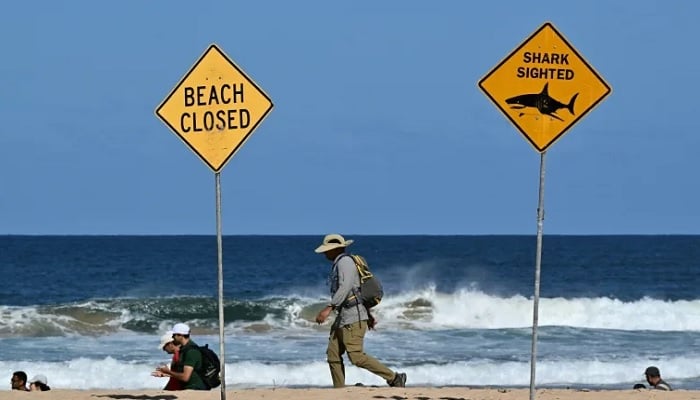
A shark killed one person and seriously injured another on Thursday at a beach in the eastern Australian state of New South Wales, lifeguards and police said.
The attack took place in the early hours of the morning and one of the victims, a woman, died at the scene.
The other suffered serious leg injuries and was airlifted from the remote beach at Crowdy Bay — about 250 kilometers (155 miles) north of Sydney — to hospital in a stable condition.
“They were known to each other and they were going for a swim and the shark attacked,” NSW Police Inspector Timothy Bailey told reporters.
State Ambulance Inspector Joshua Smyth credited a bystander with potentially saving the man’s life by wrapping a makeshift tourniquet around his leg.
“The courage from some of the attendees is amazing in this situation — putting yourself out there is very heroic,” he added.
Surf Life Saving NSW chief executive Steven Pearce described it as “a really, really terrible incident”.
“This area is so remote, there are no lifeguards up there,” Pearce told local radio station 2GB.
The beach and surrounding areas have been closed and authorities are working to determine what type of shark attacked the two bathers.
Protecting people and sharks
There have been more than 1,280 shark encounters in Australia since 1791, more than 250 of which resulted in death, according to a database of the predators’ human encounters.
Ocean liners are more likely to be bitten by great whites, tigers and bull sharks, data show.
In September, a great white killed a surfer at a popular Sydney beach.
The man, who leaves behind a wife and young daughter, lost “several limbs” and his surfboard broke in two, police said.
Australia’s oceans are teeming with sharks, with great whites topping the list of species that could kill a human.
Undaunted, Australians are flocking to the sea in huge numbers — with a 2024 survey showing almost two-thirds of the population made a total of 650 million visits to the coast in a single year.
How best to protect people from sharks is a sensitive issue in Australia.
Authorities have taken a multi-layered approach — deploying drones, attaching acoustic trackers to sharks so they can be detected by listening to buoys near popular beaches, alerting people in real time with a mobile app and setting up old-fashioned nets.
Researchers say shark lives need protection too.
Globally, about 37% of the ocean’s shark and ray species are now listed as either endangered or critically endangered by the International Union for Conservation of Nature, an endangered species database.
a href=”https://www.geo.tv/latest/635829-shark-kills-one-person-injures-another-in-australia”>Source link


